Table of contents
Share
Multi-country exposure — why complex claims need specialized counsel
A significant portion of the post-SCOTUS refund population involves importers whose entries span multiple affected countries, with shipments classified across various HTSUS codes, often with overlapping tariff authorities applied at different points in time. These are not edge cases. For mid-sized and larger importers — particularly those with diversified supply chains, contract manufacturers in multiple countries, or product lines that draw on components from across regions — multi-country exposure is the default profile, not the exception.
These claims require specialized recovery counsel. This article explains why, and what the structural difference means for firms positioning themselves in the recovery economy.
What makes a multi-country claim complex
A clean single-country refund claim has a tidy structure: one country, one applicable IEEPA rate (or a small set of rates across one or two periods), one set of HTSUS codes, one tariff layer. The math is direct and the legal posture is uncontested.
A multi-country claim breaks several of those simplifying assumptions at once.
Country-specific rate variation. Different countries faced different IEEPA tariff rates at different points in time. The rate applicable to a shipment from China in mid-2025 is not the rate applicable to a shipment from Vietnam in the same week. Per-country, per-period attribution is mandatory for accurate refund calculation.
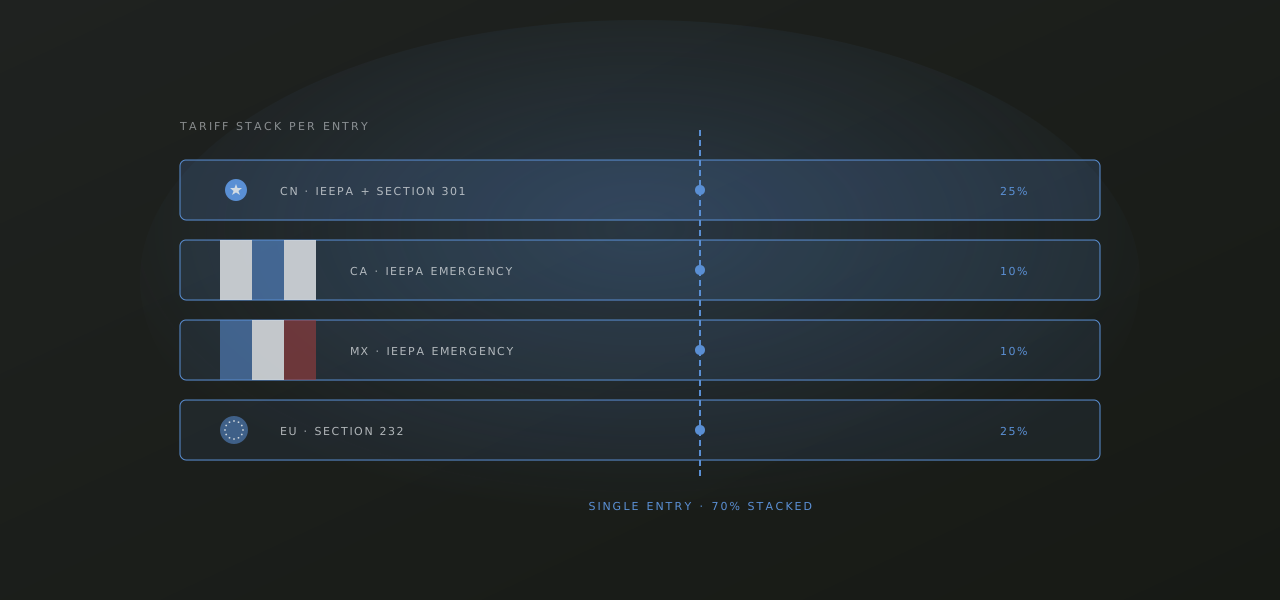
Layered tariff authorities. Many of the most affected countries — China most prominently, but others as well — had Section 232 or Section 301 tariffs in place alongside the IEEPA tariffs. Determining which portion of duties paid is refundable requires legal analysis of which authority each portion of the duty was assessed under, whether the authorities overlap, and what the appropriate refundable rate actually is.
Classification interaction effects. The same HTSUS code applied across goods from different countries may have produced different effective tariff treatments because of the layered authorities. A classification that is uncontested in a single-country claim may become disputable when the analysis spans countries with different overlay regimes.
Contested origin determinations. For goods that involve multi-country supply chains — components from one country, assembly in another, final goods imported — the country of origin determination itself can be contested, and that determination has direct refund consequences.
Why this is counsel-grade work
Each of the complications above is, on its own, a question that benefits from legal analysis rather than administrative processing. In combination, they are structurally outside the scope of streamlined CAPE work, even Phase 2.
Specialized recovery counsel brings several things to multi-country claims that administrative-grade processing cannot:
Legal analysis of overlapping authorities. Determining which portion of paid duties is refundable under IEEPA versus which is non-refundable under separate authorities is a statutory interpretation exercise. It is not a documentation exercise.
Classification advocacy. Where the original entry classification interacts with the multi-country analysis to produce a contested refundable amount, counsel can argue for the reading that maximizes the recovery within defensible limits.
Standing to litigate. When CBP's administrative position is unfavorable, or when the case requires escalation to the Court of International Trade, counsel has the standing and the experience to take the case there. Administrative-grade firms generally do not.
Coordination with related litigation. Many multi-country claims involve facts or legal questions that overlap with other active CIT cases. Recovery counsel familiar with the broader litigation landscape can position individual claims to benefit from favorable rulings in related matters.
The economics
Multi-country claims, almost by definition, involve larger total recovery amounts than single-country claims. The importers with diversified supply chains are typically the importers with substantial trade volume. The per-entry duties paid are often higher, and the cumulative refundable amount across a complex claim can be very large.
For recovery counsel, this is the population where the engagement economics work. The per-claim work is more substantial than a clean administrative filing, but so is the recoverable amount. Contingent fee structures align cleanly with the value at stake. Per-engagement fee structures, sometimes with reduced upfront and increased backend participation, give counsel the ability to take on cases where the legal work is significant and the eventual recovery is large.
For importers, the math also works. The legal fees on a multi-country claim are a meaningful expense, but they are typically a fraction of the recovery uplift that specialized counsel produces over what an administrative-grade filing would have captured.
The friction is matching the right counsel to the right importer at the right point in the timeline. Importers don't usually have existing relationships with specialized trade recovery counsel. Counsel doesn't always have visibility into the universe of importers with multi-country claims that fit their practice. The market clears inefficiently, with capacity on the counsel side and demand on the importer side that don't always find each other in time.
Where the exchange fits
A qualified candidate brief that surfaces an importer's multi-country exposure, with per-country attribution, classification status, layered tariff analysis, and confidence-scored refund estimate, lets recovery counsel evaluate whether the case fits their practice in minutes rather than days. The qualification work has already been done. The introduction is to a pre-evaluated candidate, not a cold prospect.
What Corvant does
Corvant qualifies importers with multi-country and complex exposure profiles using AI-assisted analysis across public court filings, regulatory records, state registrations, and licensed trade data. We introduce these candidates to recovery counsel matched by practice area, capacity, and engagement structure preferences.
If your firm wants to participate in the exchange, request access.