Customs brokers and importers
The money is real. The deadlines are real. The paperwork is what kills it.
Importers paid IEEPA tariffs that courts ruled unlawful, and CBP is refunding them. But only two parties may file, every entry runs its own clock from its own liquidation date, and one bad line returns the whole declaration. Corvant reads a book from one ACE report, shows what is actually refundable with the deadline on each entry, and prepares the declaration you file.
Founding brokersThe first ten customs brokers get 500 lines, free.Claim a founding place →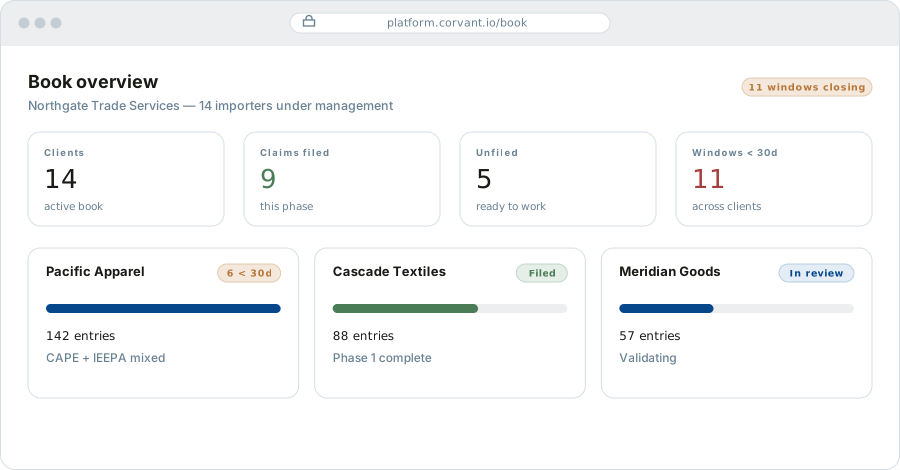
$166B
Total refund opportunity
IEEPA duties subject to refund per CBP
CBP / CIT filings, 2026
$126B
Already sent for payment
Of $136.6B accepted into CAPE, as of Oct 2
CBP / CIT filings, Oct 2026
$11.4B
Still in play: Phase 3
Finally liquidated entries, CIT order required
CBP / CIT filings, 2026
180 days
Section 1514 protest window
From liquidation, before claims expire
Before anything else
CBP has warned about tariff-refund scams. They are right to.
Money this size attracts people who should not be near it. Three questions are worth asking anyone offering this service, including us.
Who files? The importer of record, or the customs broker who filed the entry. CBP accepts a CAPE declaration from nobody else. Corvant prepares and validates; it does not file and does not touch ACE on anyone's behalf.
Who touches the refund? Not us. CBP pays by ACH directly to the importer of record. Corvant is never in the money path.
What do you take? From a broker, a flat price per line filed -- no share of a broker's fee and no share of a refund, per 19 CFR 111.36. From an importer coming alone, one payment per filing pack at export, shown before they pay. Nothing is taken from a refund.
The full statement of what Corvant is, what it does not guarantee, and where responsibility sits is at Regulatory Disclosures.
The problem
Four things stand between a refund and the entry it belongs to.
None of them is exotic, and none of them is about effort. They are the reason a claim that was always valid quietly stops being one.
01 - The number is not the number
Refundable is not the same as paid.
Duty on an entry is layered. IEEPA duty is refundable. Duty under Section 232, Section 301 or Section 122 is not, and it sits on the same entries. Anything that totals all of it gives a bigger number and a worse answer, and the difference only shows up after someone has been promised the bigger one.
02 - The clocks
The cheap path closes first, entry by entry.
Once an entry liquidates, CBP may reliquidate it for 90 days (19 U.S.C. 1501). The protest window runs 180 days from liquidation (19 U.S.C. 1514). After that, the only route is the Court of International Trade. A book of four hundred entries is four hundred separate deadlines, each anchored to its own date.
03 - The filer
Only two parties may file, and one error returns everything.
The importer of record, or the broker who filed the entry. A third party who never touched it is rejected, whatever the arrangement was called. And CAPE returns a whole declaration on a single bad line -- not the line, the declaration. So the work is not submitting. It is being right first.
04 - The ground moves
A later ruling can reach lines already filed.
These refunds exist because courts ruled the tariffs unlawful, and that story is not over. When a decision narrows the scope, the useful question is never what the court said. It is which entries it touches and for how much -- and that is a question only something holding the entries can answer.
How it works
Drop in your entries. The platform does the rest.
Every IEEPA refund starts as a stack of entries that has to be read, validated, and filed through the CAPE portal. Corvant automates that spine end to end.
01 - Read
One report becomes the whole book.
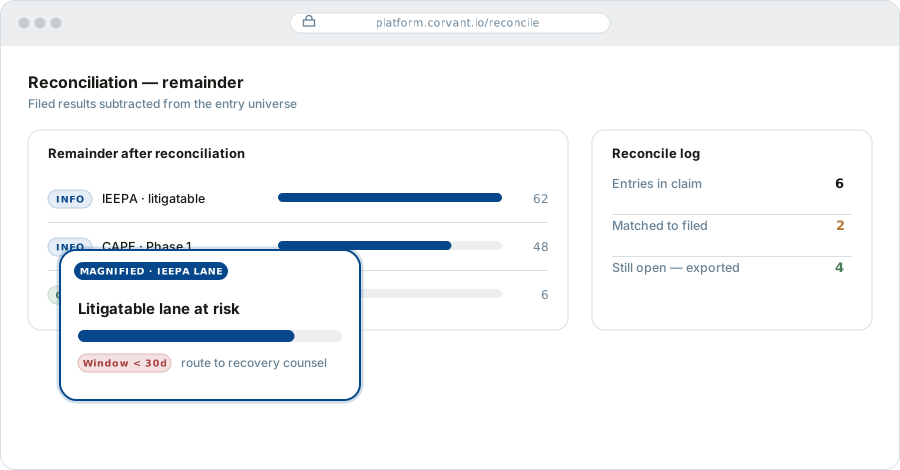
Export ES-003 from ACE as CSV or Excel and upload it. Corvant reads it at tariff-line grain: entry numbers, HTS lines, country of origin, entered value, liquidation date. One pull returns a broker's entire book, or an importer's entire history.
02 - Sort
Every entry lands in its lane, with its clock.
Unliquidated, inside the reliquidation window, inside the protest window, or court-track. Each entry carries the days remaining in its own lane. Entries CBP has suspended, extended or placed under review are marked excluded with the reason, not given a countdown.
03 - Validate
Be right before you submit.
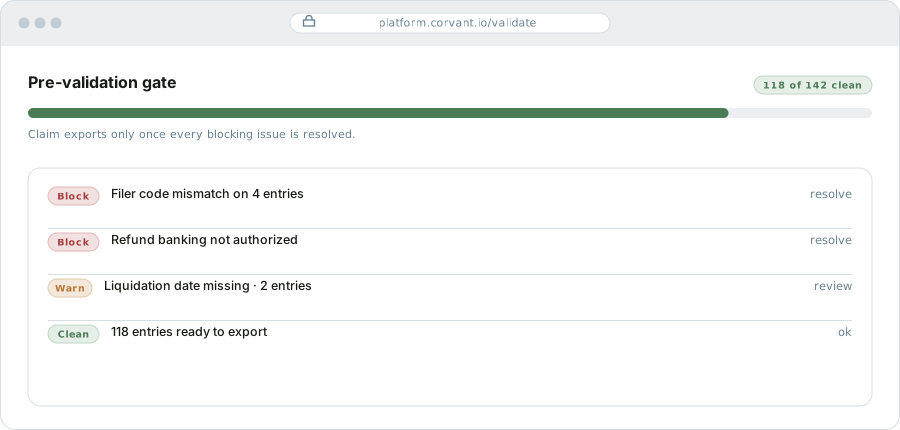
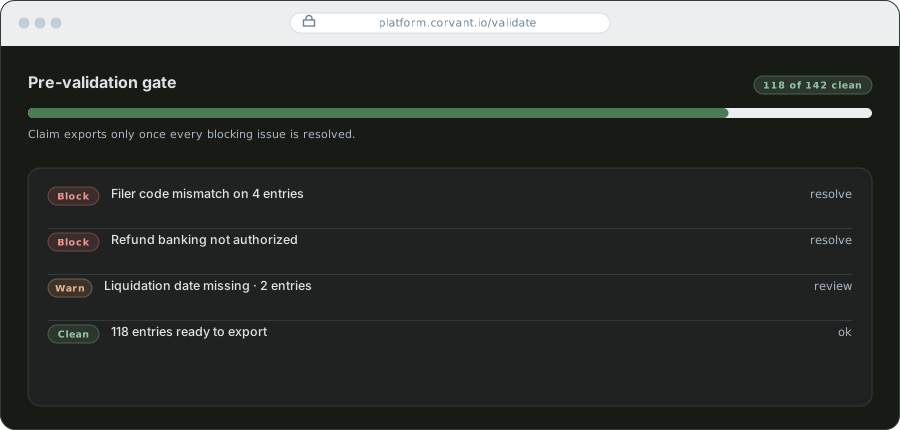
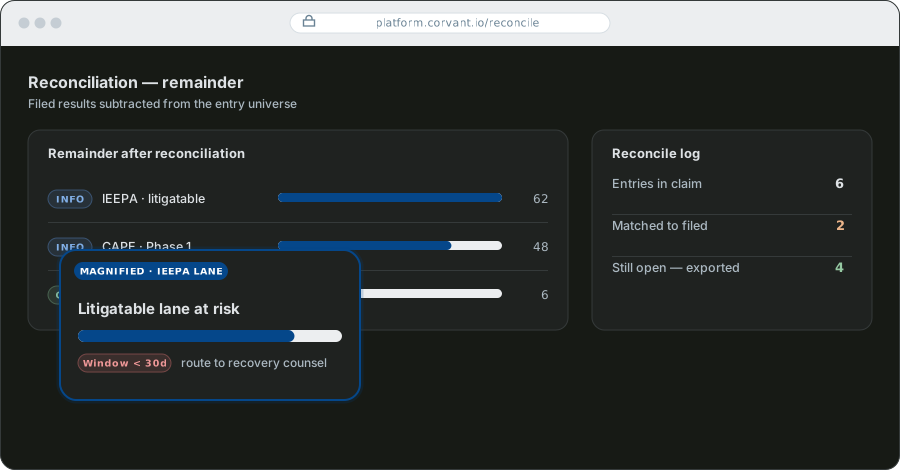
CBP returns a whole declaration on a single error. Corvant checks every line against the rules the portal enforces, flags what needs a second look with a reason, and exports a CAPE-ready declaration only once it is clean.
The fork - for customs brokers
Manage your book. Not just your refunds.
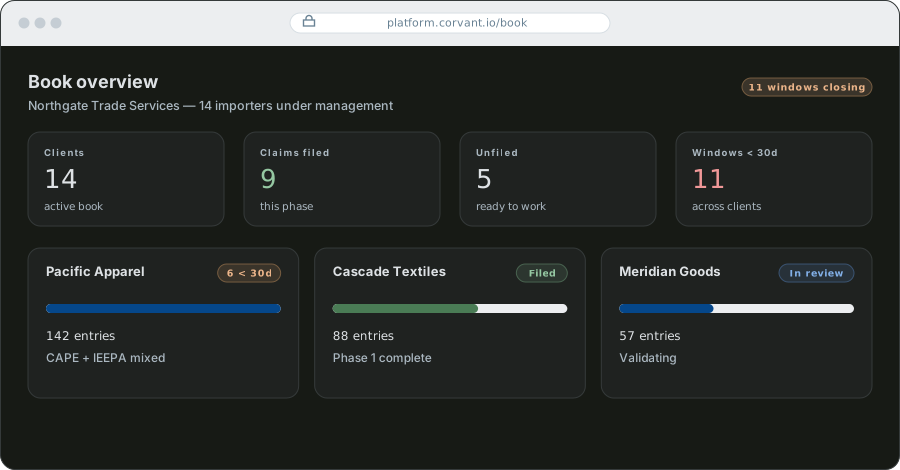
One ACE report resolves into every importer you file for, ranked by exposure, with the clock on every entry. Phase 3 entries are sorted the same way: ready to file now, waiting on CBP, or in need of a court order. File as broker of record, bill your clients your way, and pay a flat price per line -- never a percentage of your fee. When a court ruling lands, Corvant names the clients it touches and totals the duty exposed.
The fork - for importers
See what you are owed before you pay anyone.
Upload your entries and see what is actually refundable, entry by entry, with the deadline on each -- free, before anyone asks you for anything. If the broker who filed them works on Corvant, he is billed and you are not. If you come alone, you pay once per filing pack when you export, and resubmitting a corrected pack is free.
For recovery counsel
Documented matters, not raw leads.
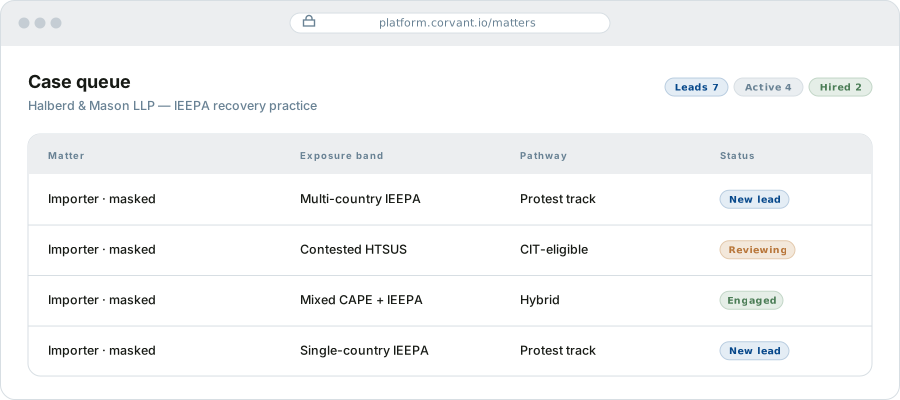
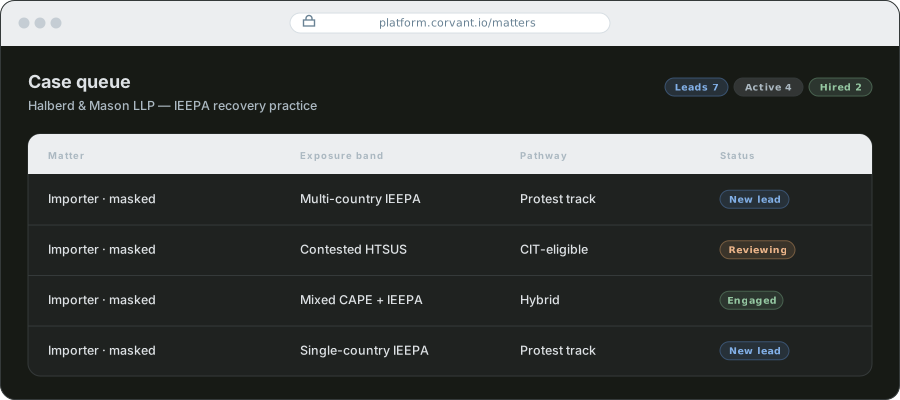
Only the portions that genuinely need a lawyer route to you -- contested classifications, protest-track entries, multi-country exposure. Each arrives as a documented matter: entries already read from the ES-003 report and validated, exposure and filing status on the record, the client's identity masked until you engage.
For factoring firms
Advance against a verified claim, not a guess.
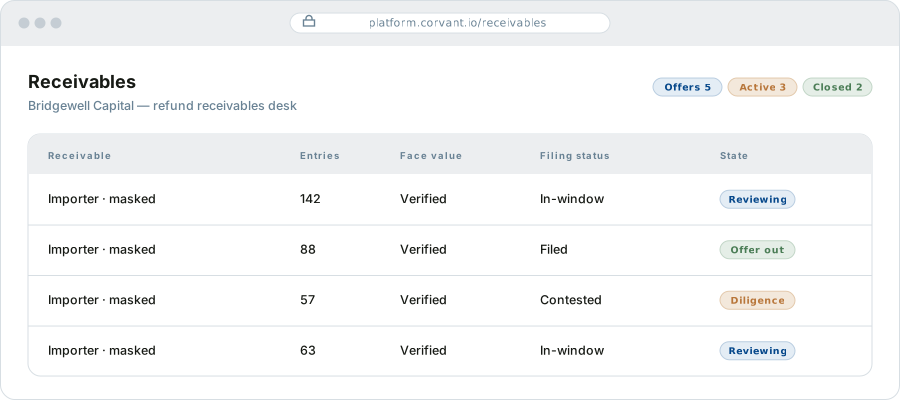
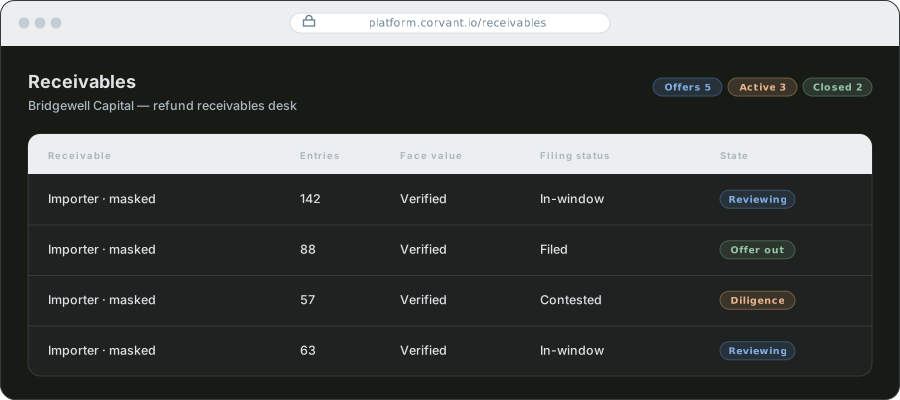
Corvant routes you a documented receivable instead of a blind number: real entries, real face value, filing status on record. You underwrite what you can see. The introduction is clean -- your terms, directly with the importer. Corvant doesn't sit in the transaction.
The hybrid reality
Most claims are mixed.
A single importer often has a CAPE-eligible portion a broker files fast, a contested portion that needs counsel, and a factoring option layered on for liquidity. Corvant keeps importer, broker, counsel, factor, and CPA on the same record and the same timeline -- surfacing every viable pathway instead of forcing one channel.
Clean, in-window entries a broker or importer files directly through the portal.
Contested classifications and multi-country exposure prepared as a documented matter a law firm can be offered.
Verified receivables an importer can borrow against while CBP pays out.
Partners & affiliates
Know importers who overpaid? Bring them in.
If you work with importers or brokers -- as a consultant, an advisor, or an association -- you can refer recovery work to Corvant and share in what it recovers. Every referral arrives on the same validated pipeline as any other claim, tracked to your account from first touch. You see what's in motion; we handle the filing.
Referral tracking
Meridian Trade Advisors -- partner account
| Referral | Introduced | Stage | Status |
|---|---|---|---|
| Importer - masked | Mar 2 | Validated | Filing |
| Importer - masked | Feb 18 | Engaged counsel | Recovered |
| Broker - masked | Feb 11 | Onboarding book | In review |
| Importer · masked | Jan 30 | Uploaded entries | Tracking |
Get started
Bring your book, or start filing.
Brokers apply to manage a book. Importers request access to file their own claims and invite their broker and CPA at no extra cost. Counsel and factors register to receive routed, verified work.