For importers
You paid tariffs that are now refundable.
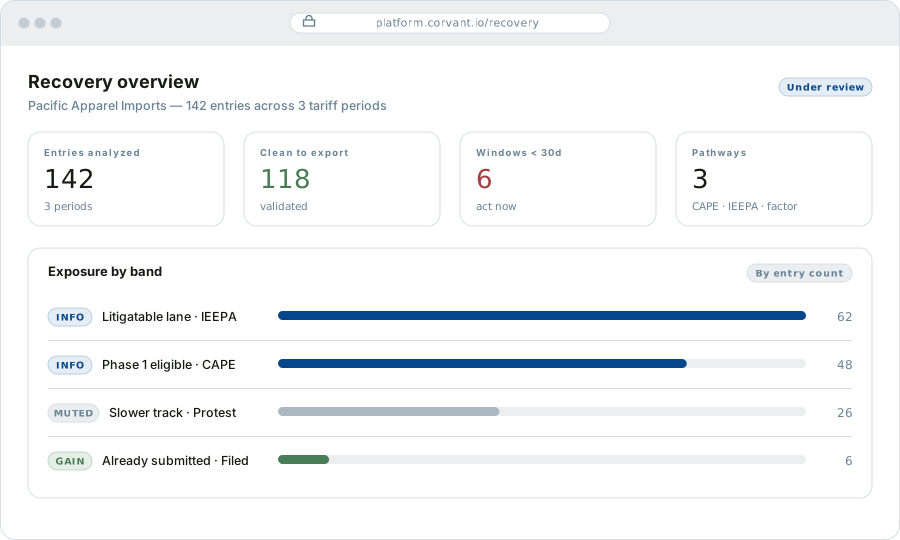
Upload your entries and see the number before anyone asks you for anything. Not what you paid -- what is actually refundable, entry by entry, with the deadline on each one. Then you pay once per filing pack, when you export. Resubmitting a corrected pack is free.
Uploading and working out the claim is free. You pay only when you export a pack to file.
Before anything else
CBP has warned importers about tariff-refund scams. They are right to.
Money this size attracts people who should not be near it. If someone has already called you about this, here are the three questions to ask them -- and our answers.
Who files? You do, as importer of record, or the broker who filed your entries does. CBP accepts a CAPE declaration from nobody else. Corvant prepares and validates the declaration; it does not file it and does not touch ACE on your behalf.
Who touches the refund? Not us. CBP pays by ACH directly into your own account. Corvant is never in the money path, and never shows you a recovered amount CBP has not confirmed.
What do you take, and when? A payment per filing pack, when you export it, with the price shown before you pay. Resubmitting a corrected pack is free, and nothing is taken from a refund. Our agreements are published for your own counsel to read before you sign anything.
The number
What you are owed is not what you paid.
Duty on an entry is layered. IEEPA duty is refundable. Duty assessed under Section 232, Section 301 or Section 122 is not, and it sits on the same entries. A figure that adds all of it together is a bigger number and a worse answer.
Corvant separates them line by line and shows you both -- what is recoverable under CAPE, and what is not. Where a trade-preference claim reduces what is refundable, the figure is reduced. One total, computed the same way every time you look at it.
Acceptance is not a refund. CBP states that refunds follow acceptance by 60 to 90 days. Corvant does not promise an outcome and cannot make CBP faster.
What quietly goes wrong
Three ways a good claim dies without anyone noticing.
None of these is exotic. Each one ends the same way: money you were entitled to, gone, with nothing to appeal.
01 - Wrong filer
Only two parties can file.
CBP accepts a CAPE declaration from the importer of record, or from the broker who filed the entry. Nobody else. A third party who never touched the entry is rejected, however the arrangement was described to you. Corvant prepares the declaration; the right filer submits it.
02 - Refund cannot land
The money has nowhere to go.
CAPE refunds pay by ACH only, and the banking has to be set up in ACE before the refund is issued. A claim that is accepted and then cannot be paid looks exactly like a claim nobody won. It is the quietest way to lose money you already earned.
03 - Two clocks
The cheap path closes first.
Once an entry liquidates, CBP may reliquidate it for 90 days (19 U.S.C. 1501) -- that is the administrative path. The protest window runs 180 days from liquidation (19 U.S.C. 1514). After that the only route is the Court of International Trade, which costs more than most claims are worth. Every entry runs its own clock from its own date.
Corvant checks the filer and the clocks before a pack can be exported, and reminds you to confirm ACH refund in ACE -- CBP pays by ACH only. An entry CBP has suspended, extended or placed under review is outside the administrative path entirely; Corvant marks it excluded with the reason rather than showing a countdown it does not have.
Pre-validation
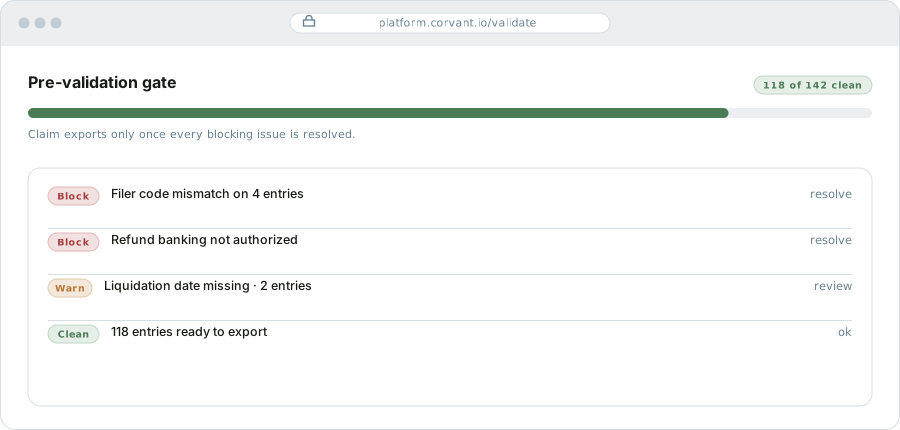
CBP returns the whole declaration on a single error.
Not the bad line. The whole thing. So the work is not submitting a claim, it is being right before you submit one.
Every entry runs through validation before anything leaves the platform. Blocking issues are shown per entry in plain language, you resolve them, and the pack only exports once it is clean. Catching the error before the portal does is the product.
How you pay
Two ways in. You see the number first.
Uploading and computing is free either way. Money only comes up at the point you export a pack.
On your own
Pay once per filing pack.
Upload free and see what you are owed. Pay once per filing pack when you export, with the price shown before you pay. Resubmitting a corrected pack is free.
Through your broker
Free through your broker.
If your customs broker works your entries on Corvant, you see your own entries, pre-validated, at no cost. When your broker files, the filing broker is billed -- never you.
Whichever way you come in, Corvant prepares the declaration and you file it. That is the one part the law reserves for you, and no arrangement can move it.
Already have a customs broker?
Then he has your entries, and that is the shortest way in.
The broker who filed your entries can pull them from ACE in one report. If he works them on Corvant, you see your own entries already validated, and when he files, he is billed -- not you.
If he is not on Corvant yet, upload your entries yourself and we will tell you who filed them, from the entry numbers. Send him the broker page. Nothing about this requires going around the relationship you already have.
Managed by
ConnectedNorthgate Trade Services
Customs broker - illustrative
Source of truth
Your own entries
Data check
All lines verified
Court rulings and clawback
A later ruling can reach lines you already filed.
These refunds exist because courts ruled the tariffs unlawful. That story is not over -- there are appeals and there are new cases -- and a decision that narrows the scope can reach back to entries that were already claimed.
The problem
You read it in the trade press, a week late, and it names nobody.
A decision is reported in terms of authorities and tariff codes. Whether it touches your entries is a question only someone holding your entries can answer, and by the time you work it out by hand the conversation has already started without you.
What Corvant does
It tells you your own number, or nothing at all.
When a court event is recorded, Corvant matches its scope -- tariff authority, HTS prefix, country of origin -- against the lines actually in your account and totals the duty exposed. If it touches you, you get one notice naming the ruling and your amount. If it does not, you hear nothing, because there is nothing to hear.
Court events are recorded by the Corvant team and maintained daily. This is not a news feed. What a ruling means for your business is a question for your own counsel; what it means for your entries is a question we can answer in figures.
CAPE phase timeline
Where CAPE stands, with the date on it.
The phase an entry sits in decides whether it can be claimed and how. This table is written by people and carries its own date. A stamp you can see is old is honest; an undated timeline that is quietly stale is not.
Phase 3 opened on October 6 for importers who are plaintiffs in an IEEPA refund case at the Court of International Trade with a court order to reliquidate. It is not open to importers without a court case.
When a claim is too small to litigate alone
Small is not the same as not worth it.
Entries past the administrative windows can only be pursued at the Court of International Trade. Only a few thousand importers have filed there, out of the hundreds of thousands who paid -- not because the small claims are wrong, but because preparing one has always cost more than it returns. That cost is the thing this machine exists to remove.
A court-track claim below the size a law firm would take on its own goes into a pool. Pooled claims are assembled into a matter whose combined total is measured against a firm's stated minimum. A matter can be offered to a firm; the firm accepts or declines; a decline returns the claims to the pool with the reason recorded and nothing lost. A claim above the threshold does not pool -- it can be offered on its own.
Your identity reaches a firm only on an engagement you have asked for. The request is the consent; there is no list of you being shopped.
Corvant is not a law firm and does not give legal advice. It does not promise that any firm will take a matter, that a class will be certified, or any result. The pool keeps a small claim prepared and countable. It does not decide it.
Start with the number.
Upload your entries, see what is recoverable and what is not, and decide after that. Nobody asks you for money to look.