For customs brokers
Manage your book. Not just your refunds.
Corvant reads your whole book from one ACE report, works out what every importer you file for is owed, and puts a clock on every entry. You file as broker of record. You bill your clients your way. We are the operating system underneath it -- a flat price per line, and never a percentage of your fee.
Founding brokersThe first ten customs brokers get 500 lines, free.Claim a founding place →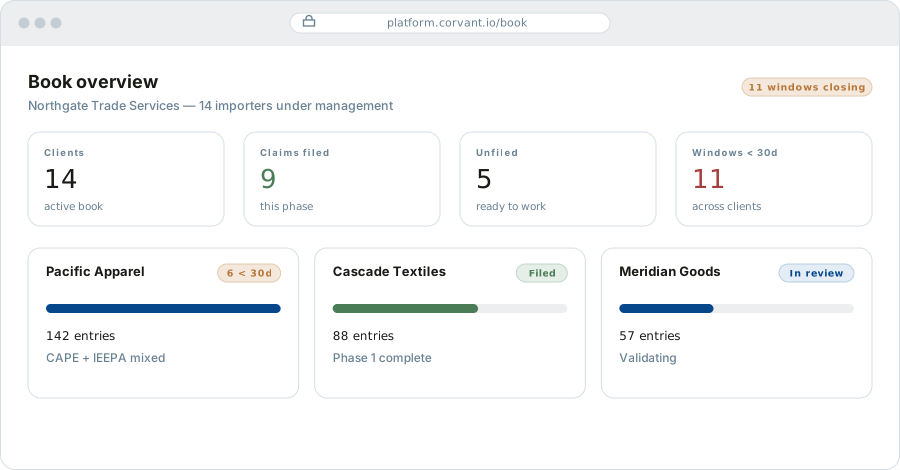
Before anything else
CBP has warned importers about tariff-refund scams. They are right to.
Money this size attracts people who should not be near it. So before we ask you for anything, here are the three questions worth asking anyone offering this service, and our answers.
Who files? You do, as broker of record -- or your importer does. CBP accepts a CAPE declaration from nobody else. Corvant prepares and validates; it does not file and does not touch ACE on your behalf.
Who touches the refund? Not us. CBP pays by ACH directly to the importer of record. Corvant is never in the money path.
What do you take? A flat price per line filed, published on our pricing page. No share of your fee and no share of a refund -- 19 CFR 111.36.
File. Manage. Bill.
Three jobs. One system.
This is the whole product, stated as the work you already do.
01 - File
One report in. CAPE-ready declarations out.
CAPE returns an entire declaration on a single error, and only two parties may file it: the importer of record, or the broker who filed the entry. So the work is not submission. The work is being right before you submit.
Export ES-003 from ACE by your filer code as CSV or Excel and upload it -- same result either way. Corvant reads it at tariff-line grain, validates every line against the rules the portal enforces, and exports a CAPE-ready declaration per client. Entries that need a second look are flagged with a reason. You file, as broker of record. That does not change and we do not want it to. Phase 3 is open. Entries that qualify show as ready to file, priced and counted like any other line. Entries CBP is still waiting on are held out of the file, and entries that need a court order are refused with the reason, so a declaration is never sent that CAPE would return.
02 - Manage
Every client, every entry, every clock.
A book is not one deadline. Each entry runs its own clock from its own liquidation date, and the cheap path closes first. Worked by hand, the entries that quietly expire are the ones nobody got to.
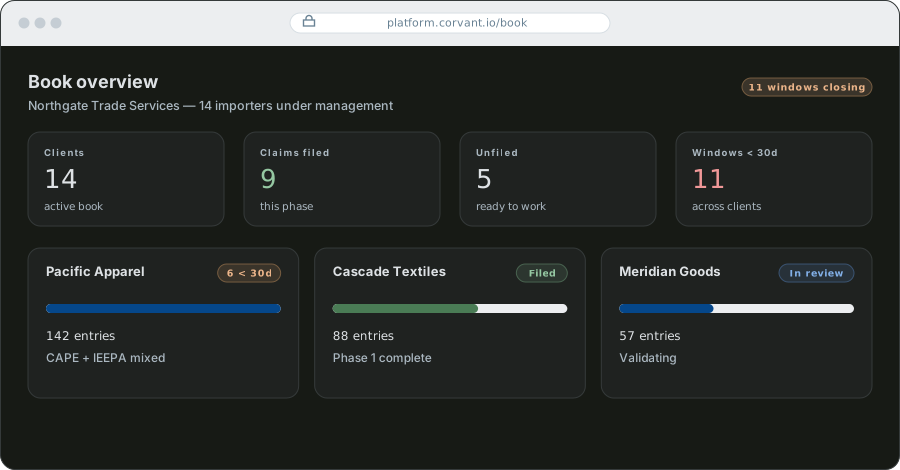
Every importer of record in your book becomes a client, sorted by exposure. Every entry carries its lane and the days left in it. Entries CBP has suspended, extended or placed under review are marked excluded with the reason instead of showing a countdown we do not have. The question you open the screen to answer is which client to call first.
03 - Bill
Your rate. Your shape. Your invoice.
Every platform in this market wants a slice of the recovery. On the broker side that is not a preference question, it is 19 CFR 111.36.
You bill your client the way you already do: a fixed fee, a percentage, or a fixed fee plus a per-line charge. Corvant is a flat cost per line underneath it and takes no share of what you charge. What you collect is yours.
The clocks
Six entries leave the cheap path in eleven days. Which client is that?
That is the question the product exists to answer, and it is the one a spreadsheet cannot.
Once an entry liquidates, CBP may reliquidate it for 90 days (19 U.S.C. 1501). That is the administrative path, and Corvant works it to day 80 so a filing is not lost to a weekend. After that the route is a protest, 180 days from liquidation (19 U.S.C. 1514). After that, the Court of International Trade.
Those clocks run per entry, not per client and not per company. A book of four hundred entries is four hundred deadlines, each anchored to its own liquidation date. Corvant places every entry on its own clock and sorts your book by what is closing, so the work goes where the money actually is.
An entry CBP has suspended, extended or placed under review is outside the administrative path. Corvant marks it excluded with the reason rather than showing a countdown it does not have.
Court rulings and clawback
A ruling lands. Which of your clients does it touch, and for how much?
These refunds exist because courts ruled the tariffs unlawful. That story is not over. There are appeals, and there are new cases, and a later ruling can reach lines that were already filed.
The problem
A newsletter tells you a week late, and names nobody.
Trade press reports the decision. It cannot tell you which of your importers is exposed, because it has never seen your book. So the work falls to you: read the scope, then go through entries by hand, client by client, while your phone starts ringing.
What Corvant does
It names the clients and totals the duty.
When a court event is recorded, Corvant takes its scope -- tariff authority, HTS prefix, country of origin -- and matches it against the lines actually in your book. It totals the duty exposed and sends one notice naming the ruling, the clients it touches and the amount. One notice per ruling, never one per line.
Court events are recorded by the Corvant team and maintained daily. This is not a news feed. Corvant does not predict rulings and does not tell you what one means for a particular client -- that is a question for counsel. It makes sure you are the one having that conversation first, with the numbers already in front of you.
What it costs
You buy lines. One line filed is one line burned.
Quantity sets the price per line and the curve is published. Uploading your book and working out what your clients are owed is free; you pay when you export a pack to file.
No subscription.
No billing period, no renewal, no overage. You buy a quantity of lines and they burn as filings happen. Recovery work comes in waves; your cost should too.
A line is charged once.
A line is charged when its filing pack is exported. A rejection does not refund it, and resubmitting the same line never charges it again. Six new lines on a resubmission charge six.
More lines can cost less money.
Crossing a price break reprices the whole order -- no proration, no split rates. If you are just under a break, the buy screen tells you the larger order is the cheaper one. If your exact quantity is already cheapest, it says that instead and shows no saving.
The rate you earn stays earned.
Your break is set by lifetime quantity purchased at the account, so volume you have already bought keeps counting toward your rate.
The firm buys, its brokers file.
Lines are owned at the account root. A brokerage buys once and every broker it invites files against the same balance.
A hard stop at zero, with warning.
A filing that would take the balance negative is refused with the buy-more path attached, and you are warned before you get there. Lines are not refundable; all sales are final.
On the roadmap - not built yet
Next: you stop going back to the portal to find out.
Today you file in ACE and you go back to ACE to learn what happened. Then you carry the result back to wherever you track the work. The loop is open, and it is open in the place where mistakes are most expensive.
What we are building next closes it. The result comes back into Corvant against the entries you filed -- what cleared, what bounced, and why -- so the next action is in front of you instead of in a portal. You fix the bounces, buy the lines you need, and file again.
We are saying this plainly because it is not built. It is the next thing we build, and the brokers in the first cohort decide what it looks like -- see founding brokers.
The broker tier - in design, not yet offered
We are built to sell through you, not around you.
Every platform that reaches your importers directly is a platform that can replace you. That is the real objection to all of this, and it deserves a straight answer rather than a reassurance.
We do not solicit your importers.
A written commitment about our own outbound, at and above a named tier.
An importer of yours who finds us is routed back to you.
He arrives, we recognise the filer code on his entries, and the filing goes to you as broker of record. If he chooses to go it alone anyway, that is his decision to make -- but it will not be one we asked him to make.
Your importers file without a filing fee of their own.
The filing is paid once, by your line. A client you hand over does not also pay to file.
This is the model we are building toward, stated as a model. The tier and its terms are not published yet, and we will not imply a commitment you cannot read.
Your clients, in the same system
Be the one who tells your client what he is owed.
Invite an importer with read-only or file-on-behalf access, whichever the relationship calls for. He sees the same entries you do, already validated, and he pays Corvant nothing to look.
The connection is explicit and consented on both sides, which is also what 19 CFR 111.24 requires of a broker sharing a client's records. The filing broker is billed; the importer is not.
Pacific Apparel - entries
Illustrative data
Put your book to work.
Uploading your book and working out what your clients are owed is free. You pay when you export a pack to file.