Table of contents
Share
IEEPA refund exposure for importers sourcing from Vietnam
Vietnam's role in U.S. import volume changed dramatically after 2018, when Section 301 tariffs on Chinese goods pushed a wave of manufacturers and importers to diversify sourcing away from China. Vietnam was one of the largest beneficiaries of that shift, becoming a major alternative source for electronics, apparel, footwear, and furniture that had previously been sourced predominantly from China.
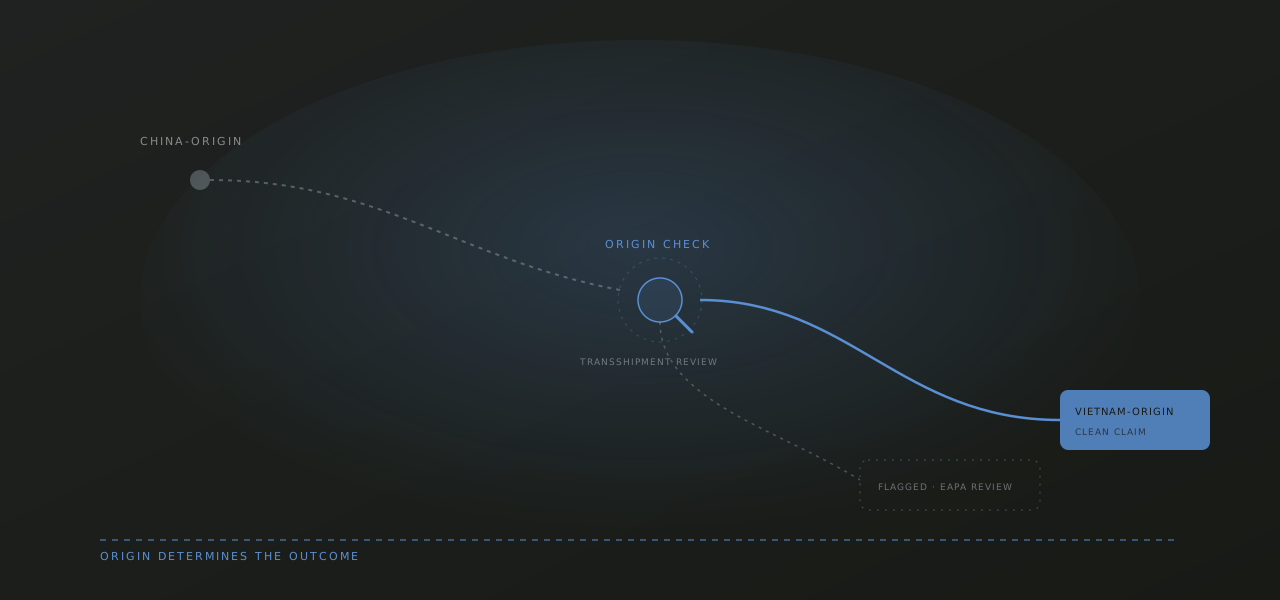
That growth is also why Vietnam-origin entries draw a specific kind of CBP scrutiny that most other sourcing countries don't face to the same degree: transshipment review, where CBP examines whether goods declared as Vietnam-origin actually underwent enough transformation in Vietnam to be considered Vietnamese, or whether they are substantially Chinese-origin goods routed through Vietnam to avoid Section 301 tariffs.
This article covers Vietnam's product concentration, what transshipment scrutiny means for a refund claim, and why an unresolved origin question can keep an otherwise clean-looking Vietnam claim from moving through CAPE smoothly.
Why Vietnam's import volume grew so fast
Vietnam's manufacturing base expanded rapidly after 2018, as importers who had built supply chains around China looked for alternatives that could avoid Section 301 tariffs while still offering low-cost, high-capacity manufacturing. Electronics assembly, apparel and textiles, footwear, and furniture production all grew substantially in Vietnam over the following years, much of it built specifically to serve U.S.-bound demand that was shifting away from Chinese sourcing.
That growth means Vietnam-origin entries make up a meaningful share of the current IEEPA refund population, concentrated heavily in those same categories. It also means Vietnam draws a level of CBP attention that has nothing to do with IEEPA specifically, but that shapes how cleanly a Vietnam refund claim moves through the system.
What CBP is actually checking for
Transshipment, in customs terms, refers to goods that undergo minimal processing in an intermediate country — just enough to change the paperwork, not enough to change the substance — specifically to disguise the true country of origin and avoid a tariff that would otherwise apply. Because so much of Vietnam's manufacturing growth was driven by China-plus-one sourcing strategies, CBP treats Vietnam-origin declarations with a higher baseline level of scrutiny than most other countries receive, particularly in electronics and certain textile and apparel categories where simple final assembly can be hard to distinguish from genuine manufacturing.
CBP's origin determinations look at where substantial transformation actually occurred, not just where a product was packaged or given final assembly, but where the meaningful manufacturing steps took place. A product that arrives in Vietnam as largely finished components from China, undergoes minor assembly, and is then exported as Vietnam-origin is a different case, from CBP's standpoint, than a product genuinely manufactured from raw or intermediate materials within Vietnam.
CBP's formal tool for pursuing specific allegations along these lines is the Enforce and Protect Act process, through which the agency investigates claims that imported merchandise evades a duty by misrepresenting its country of origin. An importer whose entries are, or have been, part of that kind of inquiry is dealing with a different and slower process than a standard refund filing.
How this affects a refund claim
For most sourcing countries, the origin of a good isn't seriously in question. The refund analysis focuses on rate, classification, and liquidation timing. For Vietnam, origin itself can be an open question on a subset of entries, and that changes the shape of the claim.
If CBP has flagged, or could plausibly flag, an entry for transshipment review, that entry isn't a clean single-country IEEPA claim until the origin question resolves. A refund claim built on the assumption of Vietnam origin can be delayed or contested if CBP's own records show a transshipment inquiry, or if the importer's documentation can't clearly establish where substantial transformation occurred. This is a different kind of complication than layered tariff authorities or origin-qualification thresholds, but it produces a similar practical effect: some Vietnam claims that look clean on the surface need more documentation work, or more careful handling, before they move smoothly through CAPE.
What separates a clean claim from a flagged one
Importers with genuine, well-documented Vietnamese manufacturing — real production facilities, supply chains for raw and intermediate materials sourced in Vietnam or from diverse countries, and manufacturing records that clearly show substantial transformation — generally have straightforward claims once the ordinary rate, classification, and timing questions are addressed. Importers whose Vietnam supply chain leans heavily on importing near-finished goods from China for final assembly should expect more scrutiny, and should be prepared to document the manufacturing process in more depth before filing.
Sorting your entries before you file
The practical first step for a Vietnam-sourcing importer is separating entries by how confidently the origin claim can be documented. Entries backed by clear manufacturing records move through the standard refund process. Entries where the origin picture is thinner, or where CBP has previously raised questions, need that documentation resolved — or need a professional who can navigate an origin dispute — before the refund claim itself can proceed.
What Corvant does
Corvant qualifies your Vietnam-origin entries by assessing origin documentation strength alongside the standard rate, classification, and timing factors, and flags entries where transshipment scrutiny is likely to complicate a claim — then connects you with the professionals suited to resolving origin questions or filing straightforward refund claims.