Table of contents
Share
IEEPA refund exposure for importers sourcing from the United Kingdom
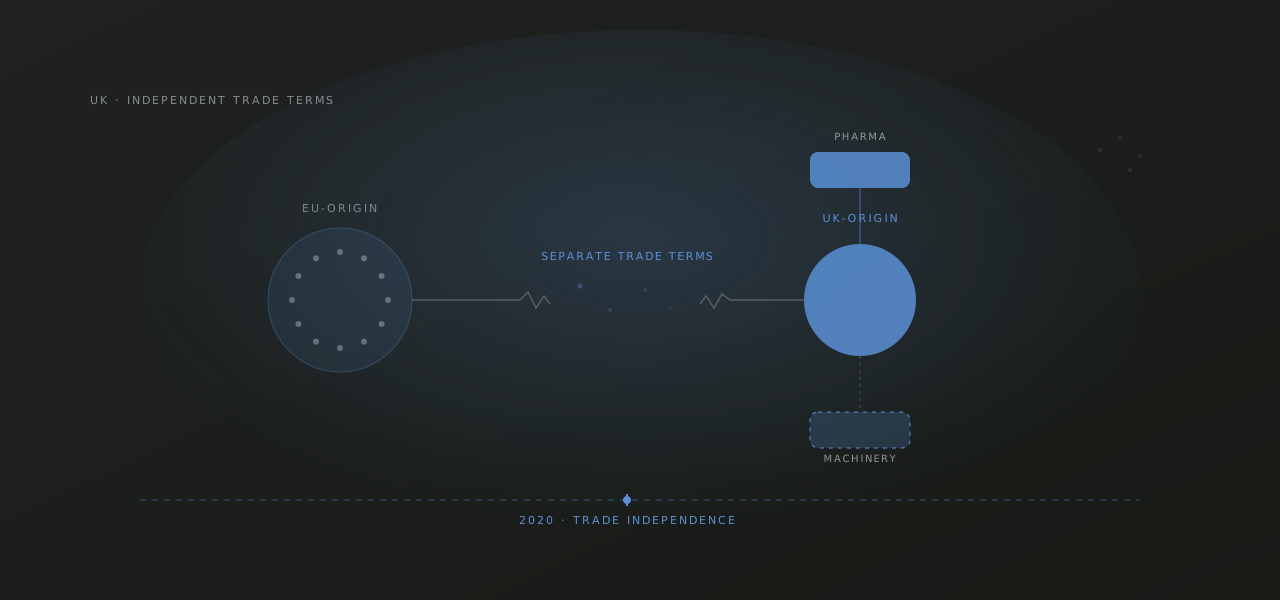
The United Kingdom sets its own trade policy, separate from the European Union, and has done so since it left the bloc. That independence matters directly for importers with UK sourcing: identical products can face different treatment under U.S. tariff authorities depending on whether they're of UK origin or EU origin, even when the goods themselves are functionally the same.
For businesses importing pharmaceuticals, machinery, and other UK-manufactured goods during the 2024-2025 IEEPA window, that independent treatment is the starting point for understanding what's recoverable — and why a UK claim shouldn't be evaluated the same way as a claim from an EU member state.
This article covers the UK's core export profile, why origin independence matters for your claim, and what that means practically for the refund estimate you should expect.
The UK's independent post-Brexit trade posture
Since its departure from the EU, the United Kingdom negotiates its trade relationship with the United States on its own terms, separately from Brussels. That's meant, at various points, dedicated bilateral arrangements covering categories like steel, aluminum, and automobiles under Section 232 — frameworks that apply specifically to UK-origin goods and have no EU equivalent, because the EU has negotiated its own, separate arrangements on the same categories.
The same independence applied during the IEEPA period. A UK-origin shipment and an EU-origin shipment of the same product, entering the U.S. in the same week, could have faced different tariff rates and different underlying legal treatment, because the two were never treated as a single trading bloc for U.S. tariff purposes to begin with. That's a structural fact about how the U.S. administers tariffs by country, not an artifact of any one administration's policy choices.
Pharmaceuticals and machinery: the UK's core export profile
The UK's largest categories of U.S.-bound trade are pharmaceuticals and industrial machinery, alongside meaningful volumes of aerospace components, specialty chemicals, and luxury automobiles. The UK's pharmaceutical sector is a major global exporter, home to some of the largest drug manufacturers in the world and a substantial base of active pharmaceutical ingredient production, with a significant share of that output destined for the U.S. market.
Each of these categories has its own classification conventions and its own history with U.S. tariff authorities outside of IEEPA. Pharmaceuticals have generally sat in a different tariff landscape than industrial goods, machinery classification can turn on relatively fine distinctions in HTSUS code, and aerospace components have historically been treated under trade arrangements distinct from general industrial goods. Scotch whisky is a smaller category by dollar volume but a good illustration of the same point: it was previously subject to a wholly separate tariff dispute — retaliatory duties tied to a long-running transatlantic aircraft subsidy dispute at the World Trade Organization, suspended by mutual agreement in 2021 — that had nothing to do with IEEPA and predates it entirely. Each of these product-specific histories affects how a refund claim involving that category is scoped.
Why UK-origin goods aren't treated like EU-origin goods
It's a common assumption that "European" sourcing gets uniform tariff treatment. It doesn't, and hasn't since the UK's exit from the EU. For refund purposes, this means an importer can't assume that guidance built around EU-origin claims applies directly to UK-origin entries, or vice versa. The applicable IEEPA rate, the presence or absence of overlapping Section 232 or Section 301 treatment, and the classification conventions that apply can all differ by origin country, even within what might look, from a sourcing perspective, like a single European supply chain.
Importers who source components or finished goods from both the UK and EU member states — a common pattern for machinery and pharmaceutical supply chains that draw on manufacturing sites across the region — should treat their entries as two distinct claim populations, not one European bucket. Attributing entries to the wrong bucket can produce an inaccurate refund estimate in either direction.
What this means for your refund claim
For most UK-sourcing importers, the practical claim shape is closer to a single-country profile than a multi-country one, which is a genuine advantage. Where the HTSUS classification is uncontested and the entry record is clean, UK-origin claims often fit CAPE Phase 1 without much complication. The work that does need attention is confirming your UK entries were correctly and consistently treated as UK-origin throughout the entry record, rather than folded into a broader European analysis that doesn't reflect the tariff authority that actually applied to those specific shipments.
That confirmation step matters more than it might sound like. Supply chains built before the UK's departure from the EU sometimes still carry paperwork habits from when UK and EU shipments were tracked less distinctly for trade-compliance purposes. An entry record that blurs that distinction can understate or overstate what's actually recoverable, simply because the origin attribution wasn't kept precise at the time of entry.
What Corvant does
Corvant qualifies UK-sourcing importers' entries on their own terms — confirmed as UK-origin, checked against the tariff authorities that actually applied, and matched to the recovery pathway that fits, separately from any EU-origin entries in the same supply chain.