Table of contents
Share
IEEPA refund exposure for toy and game importers
Toy and game imports are among the most heavily China-concentrated categories affected by the IEEPA tariffs, and among the most seasonal. Retailers and importers in this category don't bring goods in steadily throughout the year — they bring them in ahead of the holiday shopping season, in a compressed window that typically runs from mid-summer through early fall, so that inventory is on shelves well before the November and December selling period.
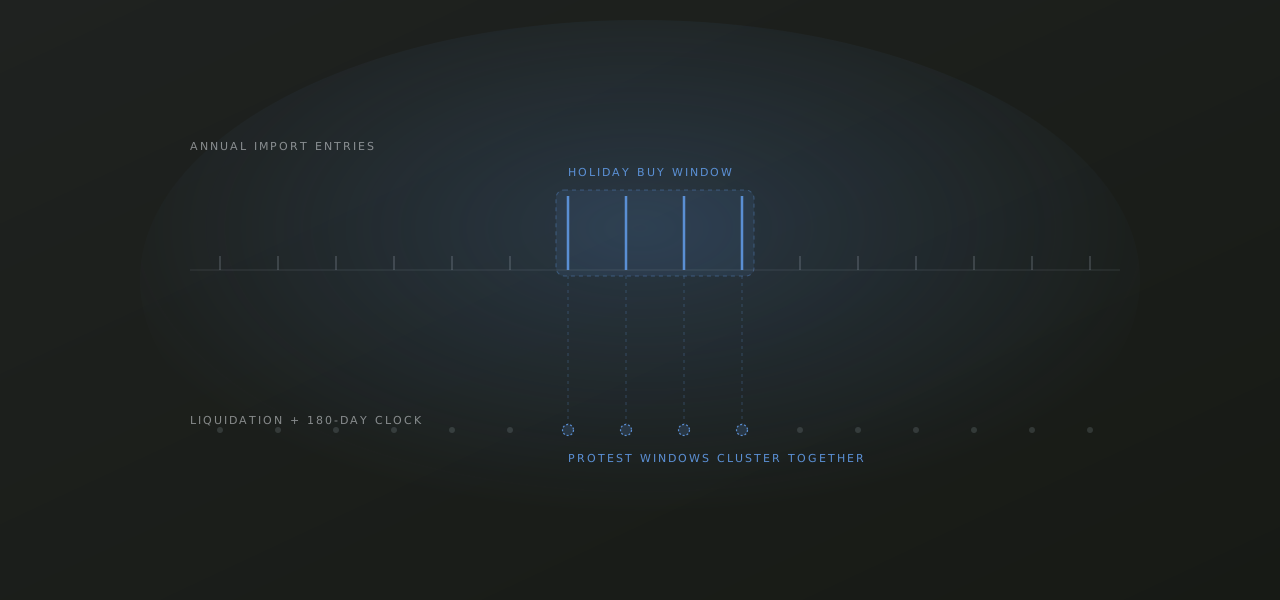
That seasonality is more than a supply chain detail. It shapes the entire refund timeline in a way that doesn't apply the same way to categories with steady, year-round import volume. When a large share of a company's annual entries land within a few months of each other, the downstream events tied to those entries — liquidation, and the 180-day Section 1514 protest window that follows — tend to land in clusters too, rather than trickling in evenly across the calendar.
This article walks through why the seasonal cadence matters for refund planning, what the clustering means in practice, and what toy and game importers should be watching for as their annual cycle repeats.
A category defined by concentration, not diversification
Toy and game sourcing has historically been overwhelmingly concentrated in China, reflecting decades of manufacturing specialization in molded plastics, electronics-embedded toys, and licensed merchandise production. Some diversification toward Vietnam and other Southeast Asian manufacturers has occurred in recent years, but for most toy and game importers, China remains the dominant or sole country of origin for the bulk of their entries.
That concentration is actually a simplifying factor for refund purposes. A single dominant sourcing country means a single applicable IEEPA rate schedule for most of a company's entries, rather than the multi-country attribution problem that diversified importers face. The complexity in this category comes from timing, not geography.
Why imports cluster before the holidays
Retail buying cycles for toys and games are built around a hard deadline: goods need to be in distribution centers and on shelves before the holiday shopping season begins in earnest. Working backward from that deadline, most importers place orders and receive shipments in a window roughly spanning midsummer through early fall, giving enough lead time for ocean freight, customs clearance, and distribution before peak retail demand hits.
The result is that a toy or game importer's annual entry volume isn't evenly distributed across twelve months — it's heavily weighted toward a few months, with comparatively thin volume the rest of the year. For refund purposes, this means the bulk of a given year's IEEPA-affected entries share a similar entry date, and therefore a similar eventual liquidation date roughly a year later.
What clustering means for the protest window
Because liquidation for most entries follows entry by roughly a year absent acceleration or extension, and the Section 1514 protest window runs 180 days from liquidation, a toy importer's protest deadlines tend to arrive in a wave rather than a steady drip. A large share of a given season's entries can end up sharing a liquidation window measured in weeks, which means the 180-day clocks on all of those entries expire close together as well.
That has two practical implications. The first is risk concentration: if a company misses the window on its holiday-season entries, it isn't losing a handful of scattered claims — it's potentially losing the bulk of a full season's refund exposure at once. The second is an opportunity: because the entries share similar dates, similar country of origin, and often similar or identical HTSUS classifications, they're well suited to being processed as a coordinated batch rather than handled one at a time.
Building a claim around the annual cycle
For a toy or game importer, refund planning works best when it's mapped against the company's own buying calendar rather than treated as a one-time cleanup exercise. Knowing which import season's entries are approaching their liquidation dates — and therefore their protest window — lets a company sequence its claim work around its actual annual cycle rather than reacting after a deadline has already passed.
This is also a category where earlier seasons carry more urgency than later ones. Entries from the earliest part of the IEEPA window are furthest along in the liquidation-to-protest-expiration timeline, and for a company with a concentrated holiday buying pattern, an entire season's worth of exposure can be riding on a single set of closely spaced dates.
The licensing and classification wrinkle
One added texture in this category: many toys are produced under license — a character, franchise, or brand attached to a physical product — which doesn't change the customs classification or duty treatment directly, but does mean the importer of record and the brand owner are sometimes different entities. Refund entitlement follows the importer of record on the entry, so companies with complex licensing or distribution arrangements should confirm which entity actually filed the entries before assuming who holds the refund claim.
What Corvant does
Corvant qualifies toy and game importers' refund exposure against their actual seasonal buying cycle, flags which season's entries are approaching liquidation and protest-window deadlines, and connects each situation with recovery professionals equipped to process concentrated, similarly dated claims efficiently.