Table of contents
Share
IEEPA refund exposure for importers sourcing from Thailand
Thailand has become one of the most common alternative sourcing destinations for importers moving supply chains away from China. It is not the only one, but Thailand's manufacturing base has its own shape, concentrated in electronics assembly and automotive parts rather than the apparel-heavy profile of some other alternative sourcing countries.
That shift matters for IEEPA refund claims for a specific reason: origin. When manufacturing capacity moves quickly into a country, and components continue to flow in from the country being diversified away from, the question of where a good actually originated — not just where it was assembled — becomes central to whether a refund claim is as clean as it looks.
This article walks through why Thailand-origin claims deserve a closer look at documentation before you assume single-country simplicity.
Thailand's role in the post-China supply chain shift
Thailand has built substantial manufacturing capacity in electronics assembly — including hard disk drives, printed circuit boards, and consumer electronics components — and in automotive parts and vehicle assembly, an industry large enough that Thailand is often described as a regional manufacturing hub for the sector. Both industries expanded meaningfully as global manufacturers diversified sourcing away from China over the past several years, and both rely on complex, multi-tier supply chains where components can originate from several countries before final assembly.
Thailand's electronics sector has held a leading global manufacturing share in storage components for decades, and has more recently added semiconductor testing and packaging capacity — a later stage of the chip supply chain than the wafer fabrication concentrated in Taiwan. The automotive sector follows a similar pattern: Thailand hosts large-scale vehicle assembly and parts manufacturing serving both the domestic Southeast Asian market and export to the United States and beyond. Both sectors grew in part because they offered an established, well-regulated alternative as manufacturers looked to reduce concentration in a single country.
Why origin matters more than usual here
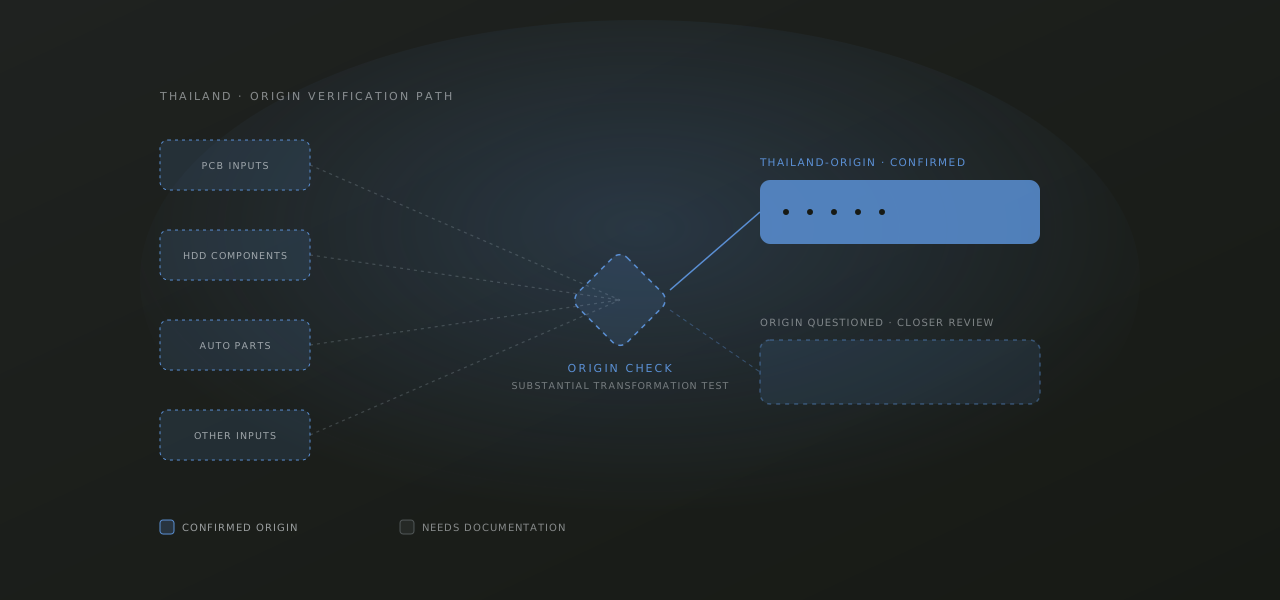
For a good to be treated as originating in Thailand for tariff purposes, the manufacturing or assembly that happens there generally needs to constitute a substantial transformation — a meaningful change in the nature of the good, not just a final assembly or packaging step performed on components that arrived largely finished from elsewhere.
Electronics assembly and auto parts manufacturing are industries where this question comes up often, precisely because they involve multi-country component sourcing by design. A circuit board assembled in Thailand from components manufactured in China is a different origin question than a circuit board fully fabricated in Thailand.
This isn't a hypothetical concern. U.S. trade authorities have previously made formal circumvention findings against goods assembled in Southeast Asian countries — including Thailand — from Chinese-origin inputs, in categories well outside electronics, when the assembly step was found insufficient to change the good's country of origin for duty purposes. That history means CBP's scrutiny of origin claims from Thailand is not a new posture, and it extends to the entries underlying refund claims, not just to import compliance going forward.
What this means for a refund claim
None of this means Thailand-origin claims are automatically complicated. Most importers with genuine Thailand manufacturing operations — real production lines, real value-add, documented supply chains — have straightforward, legitimate single-country claims. But the documentation that supports "this is genuinely Thailand-origin" is more load-bearing here than it would be for a country where the origin question rarely comes up.
The entries most likely to need a closer look are ones where the Thailand-based step in the process is minimal relative to the value of components arriving from elsewhere, or where a product's supply chain shifted through Thailand during the exact window the IEEPA tariffs were escalating.
It's also worth putting Thailand in context against other Southeast Asian sourcing destinations. Vietnam has drawn more sustained attention for transshipment and origin risk over the past several years, and much of the enforcement precedent in the region originates from cases involving Vietnam-based assembly. Thailand hasn't drawn the same volume of scrutiny, but the underlying legal test — a substantial transformation, not just a final processing step — is identical. An importer shouldn't assume Thailand-origin entries get a lighter review just because enforcement attention has concentrated elsewhere first.
How this interacts with CAPE eligibility
CAPE Phase 1 eligibility depends in part on the claim being administratively straightforward — unambiguous classification, clean liquidation records, and, implicitly, an uncontested origin determination. A Thailand-origin claim where the substantial-transformation question is genuinely clean fits that profile well. One where the origin determination could be challenged is a different profile — closer to the multi-country and classification-ambiguity claims that CAPE Phase 2 was built to handle, even though only one country is actually involved.
The practical difference is preparation. A Phase 1 claim needs the standard entry documentation. A claim where origin could be questioned needs the underlying bill of materials, supplier attestations, and process documentation that substantiate the transformation that happened in Thailand — assembled before the claim is filed, not produced reactively after CBP asks for it.
What Corvant does
Corvant qualifies Thailand-sourcing importers by reviewing entry patterns, product categories, and the timing of supply chain shifts to flag where an origin question is likely to surface, and where it isn't. We connect you with the recovery partner suited to your actual documentation position, whether that's a straightforward administrative filing or one that benefits from counsel experienced in origin determinations.
If you import from Thailand, try the demo or view pricing to understand where your claim stands on origin and eligibility.