Table of contents
Share
IEEPA refund exposure for textile and fabric importers
Most discussion of apparel-sector tariff refunds centers on finished clothing — shirts, jackets, and other retail-ready goods imported by the brands and retailers that sell them. Textile and fabric importers sit one step upstream of that conversation, and it's a step that changes the refund analysis in ways a typical apparel discussion doesn't cover. Raw and semi-finished materials — greige fabric, yarn, technical textiles, denim — move through a different set of hands before they become a finished product, sourced heavily from China, India, and Turkey.
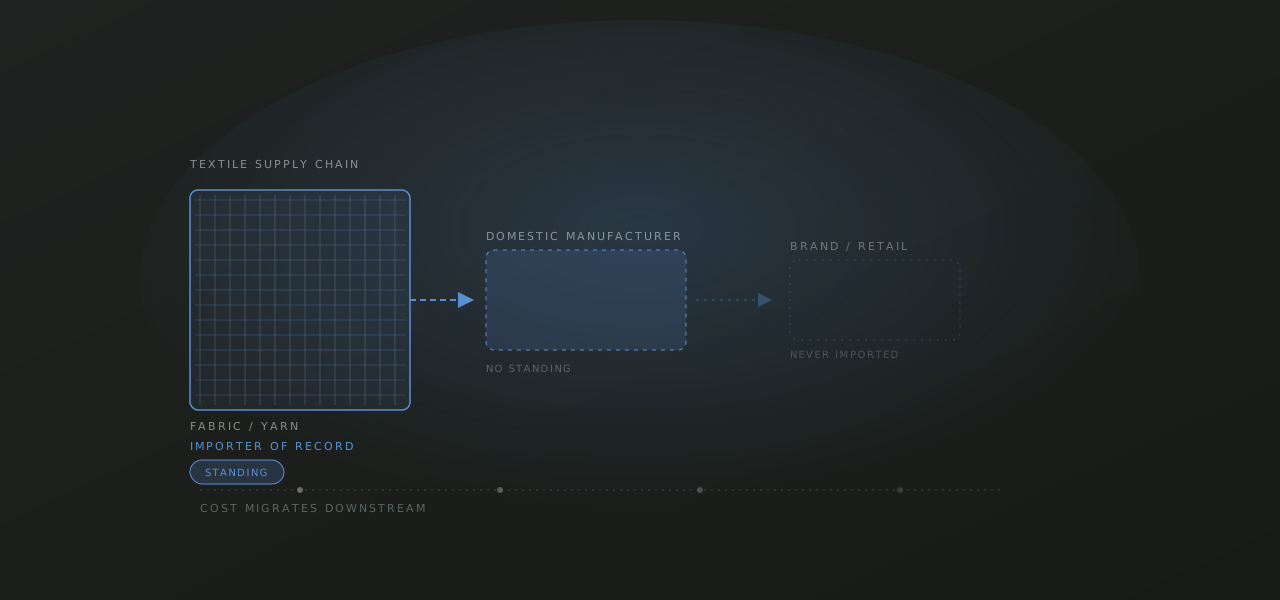
That difference matters because a textile importer is frequently not the company that eventually sells a finished good to a consumer. Fabric and yarn importers commonly supply domestic cut-and-sew manufacturers, who take imported material and turn it into finished garments or other textile products inside the United States. That supply chain structure changes who actually bore the tariff cost at entry, and — more importantly for a refund claim — who has the legal standing to file for it back.
This article covers how the textile supply chain differs from finished apparel, why importer-of-record status is the central question for standing, and what that means for a textile importer working through refund exposure.
Textiles sit upstream, and that's a distinct claim population
Fabric and yarn imports are classified separately from finished apparel under the tariff schedule, and they move through a different commercial path. A textile mill or trading company importing bulk fabric typically sells that fabric to a domestic manufacturer, who cuts and sews it into a finished product. The retailer or brand that ultimately sells that finished product to consumers may never have imported anything directly — the material did the crossing, not the finished good.
That structure means the population of textile importers is largely distinct from the population of apparel importers, even though both categories are commonly discussed together. A refund review built around finished-goods assumptions — one importer, one product, one point of sale — doesn't map cleanly onto a fabric importer supplying multiple downstream manufacturers.
Why the importer of record holds the claim
U.S. Customs and Border Protection assesses duty against, and refunds duty to, the importer of record on a given entry — the party legally responsible for the customs transaction, not whoever eventually uses or profits from the goods. For a textile importer, that's usually the mill, converter, or trading company that brought the fabric into the country, not the domestic cut-and-sew manufacturer that bought the fabric afterward, and not the brand that eventually sold the finished garment.
That distinction has real consequences. A domestic manufacturer who paid a higher price for fabric because its supplier passed through the cost of an IEEPA tariff did not, in most cases, pay that tariff directly to CBP and generally does not have standing to file a refund claim on that entry. The importer of record does — whether or not that party is the one who ultimately absorbed the economic cost.
Pass-through pricing complicates who's actually owed
Tariff costs on imported fabric rarely stop with the importer. They typically get built into the price charged to the domestic manufacturer, who in turn builds it into the price of the finished product. Economically, the cost migrates down the chain. Legally, the refund does not automatically follow it.
This creates a practical wrinkle specific to textiles: the party that felt the financial impact of an invalidated tariff and the party entitled to recover it are often not the same business. Contracts between fabric importers and their manufacturing customers occasionally address this directly, with tariff pass-through or surcharge clauses that could bear on who's economically entitled to a refund. But legal standing to file still sits with the importer of record unless a claim has been formally assigned.
Sourcing geography shapes the rest of the picture
China, India, and Turkey each supply meaningfully different segments of the textile trade. China remains a dominant source of bulk fabric, yarn, and technical textiles, and carries the same layered Section 301 and IEEPA exposure that affects most other Chinese-origin goods. India is a major source for cotton textiles and denim, generally without the Section 301 overlay that applies to Chinese goods, which tends to produce a cleaner single-authority claim. Turkey supplies significant volumes of denim and technical fabrics, with its own distinct tariff history separate from either.
An importer sourcing fabric from all three countries is, in practice, running three separate refund analyses with three different baseline duty pictures, layered under the same general IEEPA window.
Trade program overlays add another wrinkle
Textiles carry their own set of preferential trade programs that don't map onto finished apparel the same way. Rules of origin written specifically for yarn and fabric — commonly requiring the yarn itself, not just the finished weaving or knitting, to originate within a qualifying region — determine preferential treatment under agreements like USMCA, separate from the value-content tests used elsewhere. A shipment that qualifies under a yarn-forward rule may have avoided IEEPA exposure entirely; a similar-looking shipment that fails the test was fully exposed. Confirming which applied is often a documentation exercise in its own right, one that has to be resolved before an importer can say whether an entry was ever exposed at all.
What Corvant does
Corvant qualifies textile and fabric importers' refund exposure by confirming importer-of-record status alongside sourcing geography and classification, then connects the right party in the supply chain with the recovery professionals suited to filing the claim.