Table of contents
Share
IEEPA refund exposure for importers sourcing from Taiwan
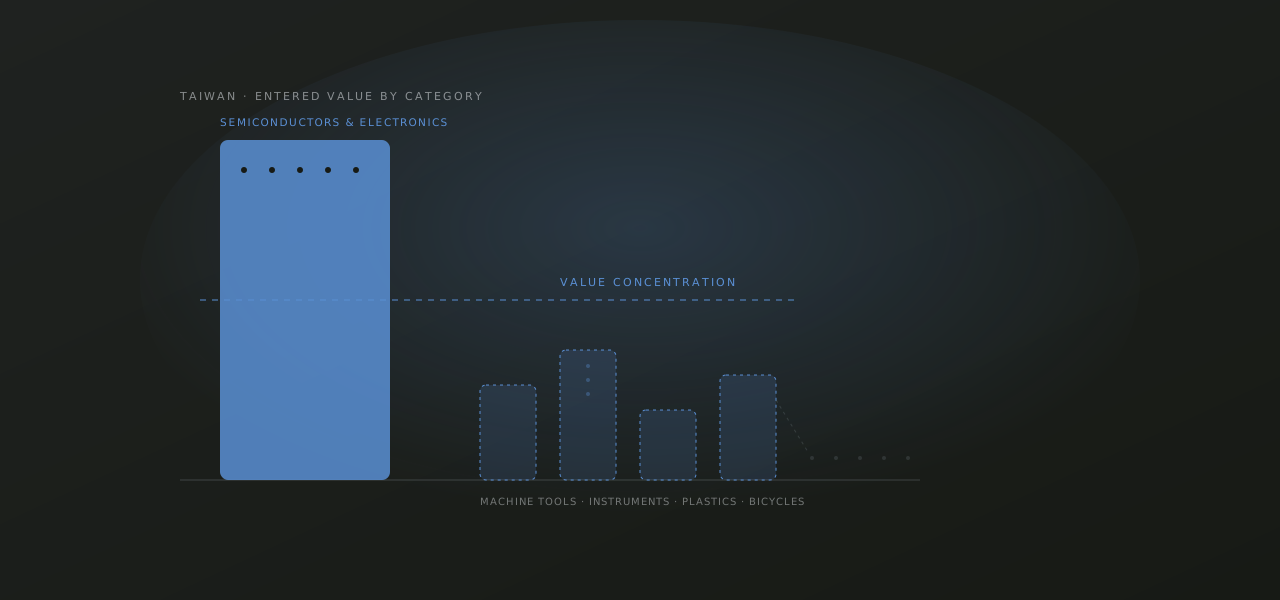
Most of the IEEPA refund population sources across a mix of product categories from a mix of countries. Taiwan-origin exposure tends to look different. Importers who bring in goods from Taiwan are disproportionately concentrated in a single category — semiconductors, integrated circuits, and the broader electronics and computing hardware supply chain that Taiwan has built its export economy around.
That concentration changes the shape of the refund analysis. Instead of a portfolio of products spread across dozens of HTSUS headings, a Taiwan-sourcing importer's claim often comes down to a small number of tariff lines carrying a large share of the total entered value. Understanding what that means for your claim starts with understanding why Taiwan's export profile looks the way it does.
Why Taiwan-origin exposure concentrates in one category
Taiwan is home to the world's most advanced semiconductor foundry capacity, and its trade relationship with the United States reflects that. Integrated circuits, computer components, networking equipment, and related electronics routinely account for the majority of Taiwan's exports to the United States by value. Demand for advanced computing hardware — driven in large part by data center and AI infrastructure buildout — has only deepened that concentration in recent years.
For an importer whose supply chain runs through Taiwan, this usually means the bulk of entered value sits in a handful of HTSUS headings rather than being spread across a diversified catalog. That is a meaningfully different claim shape than an importer sourcing furniture from one country, textiles from another, and electronics from a third.
High per-unit value changes the math
Semiconductors and finished electronics carry some of the highest per-unit and per-shipment values of any traded goods. A single container of networking hardware or server components can carry entered value that would take dozens of containers of lower-value consumer goods to match.
The practical consequence is that Taiwan-sourcing importers do not need high shipment volume to have meaningful refund exposure. A business with a modest number of entries, concentrated in high-value electronics, can have a recoverable amount comparable to a much larger importer of lower-value goods. Volume is not the right proxy for exposure here — value concentration is.
Where classification precision matters more than usual
Because so much of the entered value sits in a small number of tariff lines, the accuracy of the HTSUS classification on those lines matters more for a Taiwan-sourcing claim than it would for a diversified importer. A classification question that shifts a modest fraction of entered value for a diversified importer can shift a much larger dollar amount when that same fraction applies to a concentrated, high-value electronics claim.
This cuts both ways. A clean, uncontested classification on your core electronics tariff lines is good news — it likely supports a straightforward, single-country claim. A classification that is arguable, or that has shifted over the entry period as products or sourcing changed, deserves closer review before you assume the claim is simple.
Layered authorities are a live question for electronics
Semiconductors and related electronics have also been the subject of tariff actions under authorities separate from IEEPA, including Section 232 national-security tariff actions aimed at the semiconductor supply chain specifically. Where a Taiwan-origin entry was subject to both an IEEPA tariff and a separate Section 232 duty during the same period, isolating the refundable IEEPA portion from the non-IEEPA portion requires the same layered-authority analysis that applies to any multi-authority claim — it just shows up more often in electronics than in most other categories.
This doesn't necessarily mean a Taiwan-sourcing claim is complex overall. Many entries have a clean, single-authority IEEPA tariff with no overlay. But electronics is a category where checking for a second authority is worth doing before assuming a claim is Phase 1 simple.
Not every Taiwan claim is electronics-only
Taiwan's export base isn't exclusively semiconductors and computing hardware. Machine tools, precision instruments, plastics, and specialty manufactured goods — including a well-established bicycle and cycling-component industry — also move through Taiwan-origin supply chains. An importer with a mixed catalog that includes both electronics and one of these other categories has a genuinely blended claim: the electronics portion carries the value-concentration and layered-authority considerations described above, while the non-electronics portion behaves more like a conventional single-country claim with no special category-specific wrinkles.
Recognizing which part of your catalog is which matters for sequencing. The non-electronics portion, if classification is clean, can often move through a streamlined filing without waiting on the more careful electronics review to finish.
What this means for your claim
A Taiwan-sourcing importer's refund claim is often single-country, which is the easier half of the CAPE eligibility question. The harder half is confirming that the classification is uncontested and that no second tariff authority is layered on top. Once those two questions are answered, most Taiwan-origin claims resolve cleanly — and given the value concentration, the resolution is often worth more per entry than it would be for a diversified importer with the same entry count.
What Corvant does
Corvant qualifies Taiwan-sourcing importers by reviewing entered value concentration, classification consistency across your core tariff lines, and whether any layered tariff authority applies to your electronics entries. We connect you with the recovery partner suited to your actual claim profile, whether that's a streamlined administrative filing or something that needs a closer look first.
If you import from Taiwan, try the demo or view pricing to see where your electronics-heavy claim actually stands.