Table of contents
Share
IEEPA refund exposure for steel and aluminum importers
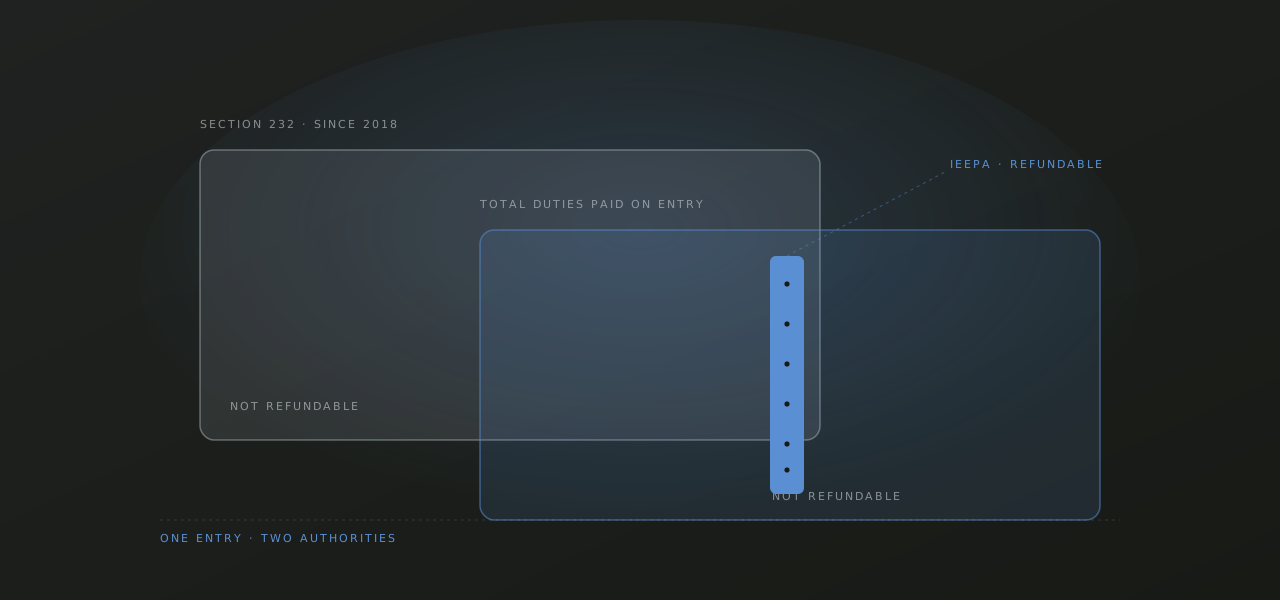
Steel and aluminum importers are working through the same post-SCOTUS refund landscape as everyone else, but they're starting from a different position than most categories. Long before the Court struck down the IEEPA tariffs, steel and aluminum entries were already carrying separate duties under Section 232 of the Trade Expansion Act of 1962 — an authority that has nothing to do with IEEPA, and one the ruling did not touch.
That layering is the reason this category is more likely than most to need CAPE Phase 2 treatment or specialized recovery counsel rather than a straightforward broker filing. Figuring out what portion of the duties paid on a given entry is refundable under IEEPA, and what portion remains owed under Section 232, is a genuine question of legal analysis, not a documentation exercise.
This article walks through why the Section 232 backdrop changes the math for steel and aluminum importers, where the apportionment problem gets harder, and what that means for how these claims typically get worked.
The Section 232 backdrop
Section 232 duties on steel and aluminum have been in place since 2018, imposed by presidential proclamation on national security grounds under an authority that predates IEEPA by years. The scope has expanded over time to cover a wide range of countries of origin, with periodic exemptions and quota arrangements for specific trading partners. As a statutory matter, Section 232 stands entirely apart from IEEPA — different underlying law, different stated basis, and never part of the tariff program the Supreme Court reviewed.
Canada and Mexico, two of the largest suppliers of steel and aluminum to the United States, were also among the first countries subject to IEEPA tariffs when that program began in February 2024. For importers sourcing from either country, that means entries were often carrying Section 232 duties well before IEEPA duties layered on top of them — and those entries are now among the oldest in the refund population, with protest windows further along than most.
Two authorities, one entry
For most categories, the refund question is close to "was this entry overtaxed, and by how much." For steel and aluminum, the question is narrower and harder: of the total duties paid on a given entry, which dollars trace back to the invalidated IEEPA rate, and which trace back to Section 232 duties that remain owed regardless of the ruling?
Because Section 232 and IEEPA duties were calculated independently — often at different rates, and sometimes applied at different points as exemptions or country arrangements changed — reconstructing the split requires going back to the entry summary and rebuilding the duty calculation, not simply totaling what was paid. For an importer with entries spanning multiple countries and multiple time periods, that reconstruction has to be done consistently across the whole entry population, not as a one-off exercise on a sample entry.
Where derivative products add another layer
The apportionment problem doesn't stop at raw steel and aluminum. Many downstream products made substantially of these metals — fasteners, structural components, certain hardware and appliance parts — have separately been subject to Section 301 duties tied to country-of-origin tariff actions, layered again with IEEPA on the same entries. Three overlapping authorities on a single entry is not unusual in this category, and classification of derivative metal articles under the relevant HTSUS provisions can itself be a contested question, independent of the tariff-authority analysis.
Why this is a legal question, not a paperwork task
A capable customs broker can assemble entry records and confirm what was paid. But determining which authority governs which dollar — especially where Section 232 exclusions, quota-based relief, or product-specific exemptions applied to particular entries — usually requires someone who can read the interplay between the statutes, not just the transaction history. This is precisely the profile CAPE Phase 1 was not built for. Clean, single-authority claims move quickly through Phase 1. Layered-authority claims, which describe most steel and aluminum situations, typically need Phase 2 review or direct engagement with recovery counsel experienced in trade remedy law.
What this means for your entries now
The practical risk is assuming that total duties paid on an entry equal the refundable amount. For steel and aluminum importers, that assumption is usually wrong, and correcting it after a claim is filed is harder than getting the split right up front. The Section 1514 protest window — 180 days from liquidation — runs on the same schedule regardless of how layered the entry is, so the sorting work benefits from starting early rather than being done under deadline pressure.
What Corvant does
Corvant qualifies your steel and aluminum entries for the layered-authority analysis they actually require, and connects you with recovery professionals experienced in separating IEEPA exposure from Section 232 duties on the same entries. If a claim also touches Section 301 on derivative products, that gets folded into the same qualification.
If you're an importer, try the demo or view pricing to see what's actually recoverable across your entries.