Table of contents
Share
IEEPA refund exposure for importers sourcing from South Korea
South Korea sourcing concentrates in semiconductors and electronics, automobiles and auto parts, and steel. All three categories carried IEEPA tariffs during the emergency period, and Korean-sourcing importers have the same refund rights as importers sourcing from anywhere else in the affected population. Korean-origin goods have grown as a share of U.S. electronics and auto imports over the past decade, making the country a significant piece of many importers' overall refund exposure.
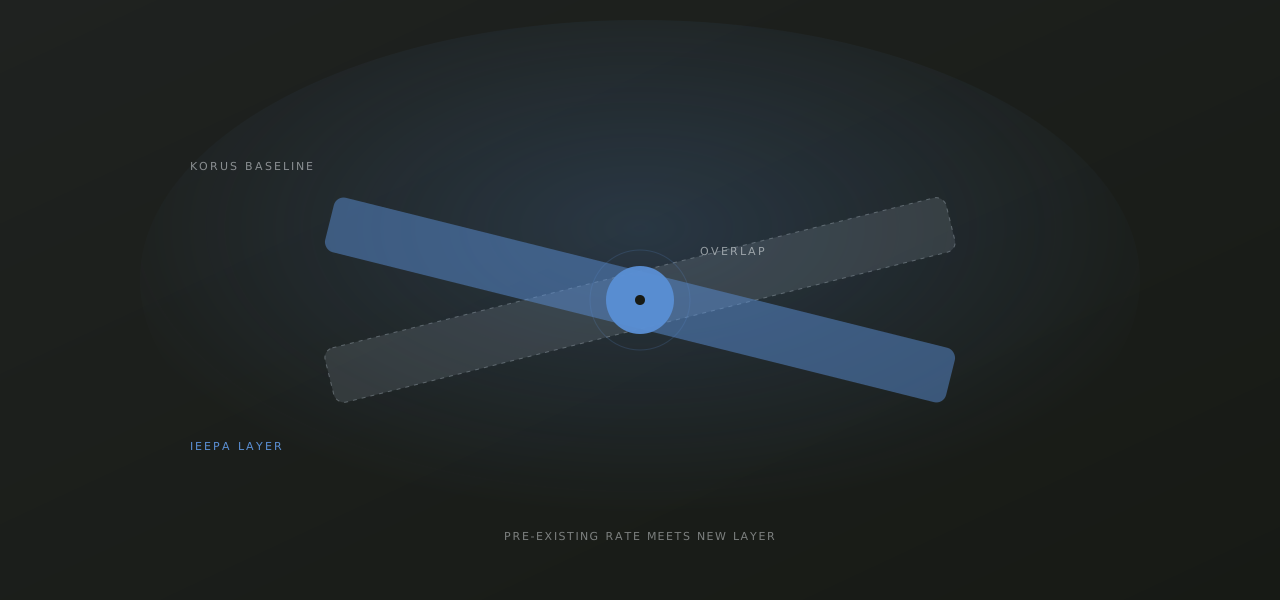
What makes Korea-origin claims distinct is the Korea-U.S. Free Trade Agreement, known as KORUS, which has governed a large share of qualifying Korean trade since well before IEEPA existed. Many Korean-origin goods that meet KORUS rules of origin enter the U.S. duty-free or at a reduced preferential rate. IEEPA tariffs were layered on top of that existing framework, not in place of it — which raises a question that doesn't come up the same way for non-FTA countries: what was the baseline duty for this specific entry actually supposed to be, and did it actually receive the preferential treatment it was entitled to at the time it entered?
This article walks through why that question matters and where it shows up hardest.
KORUS and the baseline question
For an entry that properly qualified for KORUS preferential treatment, the baseline duty before IEEPA was often zero. For an entry that didn't qualify — because it failed a rules-of-origin test, lacked proper documentation, or simply wasn't claimed under KORUS at the time of entry even though it could have been — the baseline was the standard MFN rate instead.
Both entries could have paid the identical IEEPA tariff. But the refund's significance relative to what the importer was otherwise paying is very different depending on which baseline applied. Reconstructing that baseline, entry by entry, is foundational to understanding what a Korean-origin claim is actually worth, and it's a step that simply doesn't exist for imports from countries without a comparable trade agreement in place. Importers who never tracked KORUS eligibility at the entry level, relying instead on a broker's blanket assumption at the time of filing, are often the ones who need this reconstruction done most carefully now.
Semiconductors and electronics
Korea is among the largest suppliers of semiconductors and electronic components to the U.S. market. Much of this trade already moves at low or zero MFN duty under longstanding multilateral information-technology tariff commitments, independent of KORUS. That's a second reason many Korean electronics entries had close to no baseline duty before IEEPA — two separate frameworks both pushing toward the same result, which is worth confirming rather than assuming applies uniformly across every product line in this category.
For these entries, IEEPA was frequently the whole tariff bill, and the refund claim looks similar in shape to a straightforward, single-authority profile once the applicable baseline is confirmed. Confirming which specific tariff line a given component falls under, and whether that line carried a zero rate independent of KORUS, is worth doing before assuming the whole category behaves the same way.
Automobiles and auto parts
Korean automakers and their parts suppliers are a major presence in U.S. auto imports, and vehicles are exactly the category where KORUS rules of origin get more demanding — regional value content requirements mean not every Korean-assembled vehicle or component automatically qualifies for preferential treatment. Some entries did; some didn't, and the difference often comes down to where specific components in the vehicle were actually manufactured.
Auto entries are also where Section 232 duties can apply alongside IEEPA, adding a second authority to attribute correctly on top of the KORUS question. Confirming both — whether the entry qualified for KORUS and whether Section 232 also applied — is necessary before the IEEPA refund amount can be calculated with confidence.
Steel: a baseline set by quota, not by rate
Korean steel occupies its own category. Rather than paying the standard Section 232 steel tariff outright, Korean steel exports have for years operated under a negotiated quota arrangement, limiting volume rather than assessing the full duty. That's a different baseline structure than steel from a country paying the standard 232 rate, and it needs to be accounted for separately when identifying what IEEPA added on top of an already unusual starting point. Because the quota arrangement replaces the tariff rather than reducing it, an importer reviewing Korean steel entries needs a different starting assumption than one reviewing steel from a country that paid the standard duty in full.
Why origin documentation is the crux
Across all three categories, the recurring theme is the same: knowing what an entry would have owed without IEEPA requires knowing which preferential or negotiated framework actually applied to it — KORUS, information-technology tariff treatment, the steel quota arrangement, or none of the above. That's entry-specific documentation work, not a country-wide assumption, and it's the piece that makes Korean-origin claims take more care than a comparable claim from a country without overlapping preferential arrangements.
What Corvant does
Corvant qualifies Korean-sourcing importers' exposure by reconstructing the correct baseline for each entry — KORUS-qualified, standard MFN, or quota-governed — before determining what the IEEPA refund is actually worth. We connect you with the recovery partners suited to untangling that layered picture.