Table of contents
Share
IEEPA refund exposure for plastics and rubber importers
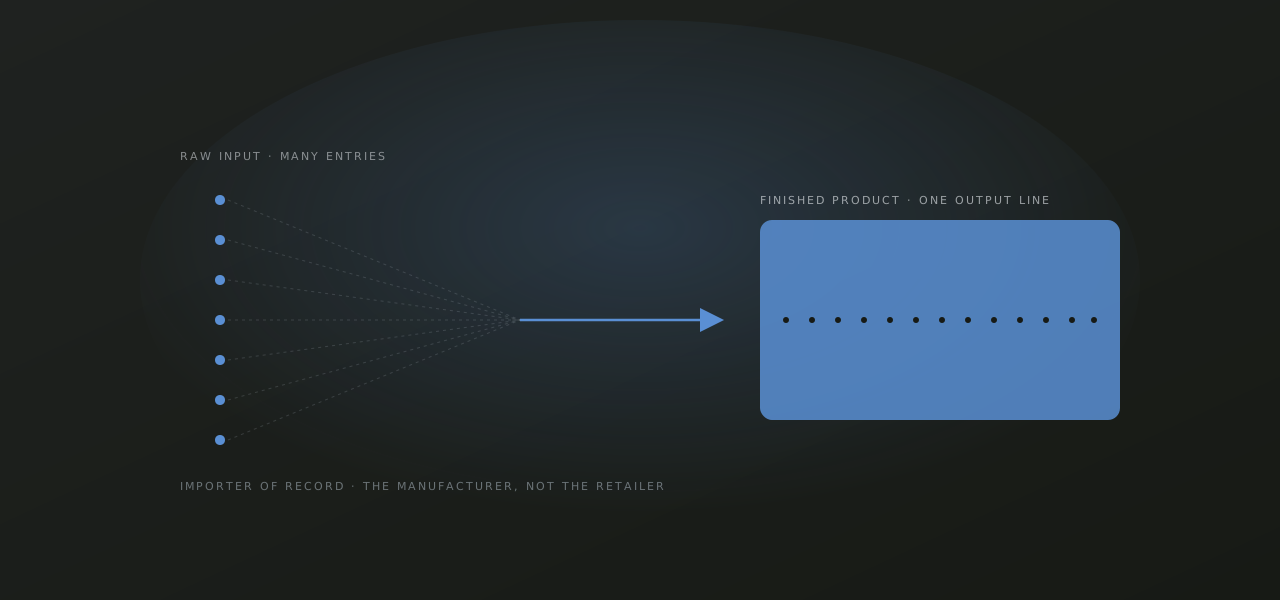
Plastics and rubber are among the broadest intermediate-goods categories affected by the IEEPA tariffs. The category spans raw and compounded resins, molded and extruded components, gaskets and seals, and finished products like tires — sourced heavily from China alongside a growing share from Southeast Asia. What sets this category apart isn't the tariff mechanics so much as who's actually holding the entry: a large share of plastics and rubber importers are manufacturers buying inputs for their own production lines, not retailers importing a finished good to resell as-is.
That distinction changes the shape of the refund conversation. A retailer importing a finished plastic product has one clear question: was the tariff paid, and is it refundable. A manufacturer importing resin, compound, or molded components has that same question, plus a second one that retailers rarely face — what happened to that added cost between the time it hit the balance sheet and the time the finished product went out the door.
This article covers why the input-buyer position matters, what it means for how a claim gets built, and where the real complexity in this category tends to concentrate.
A category built on inputs, not finished goods
Unlike categories where the imported item is the retail product, plastics and rubber imports are frequently one step removed from anything a consumer ever sees. Polymer resins, rubber compounds, injection-molded components, and extruded parts get incorporated into a domestic manufacturer's own output — automotive parts, packaging, consumer goods, industrial equipment. Tires are a partial exception, since a tire is often close to a finished product itself, but even there, a meaningful share of imports are being installed as original equipment rather than sold directly.
This matters for refund purposes because the entry records that establish the tariff paid are tied to the raw input, not the finished good the company eventually sells. Building a claim means going back to procurement and receiving records for the input itself, which can be a very different — and often much larger — set of documents than a finished-goods importer would need to assemble.
Volume and entry count work differently here
A retailer importing a finished product might have a manageable number of large entries per year. A manufacturer buying resin or rubber compound as a continuous input to a production line often has a much higher volume of smaller, more frequent entries spread across the year. That has practical consequences for claim-building: aggregating hundreds of individual entries into a coherent refund position takes more documentation work than a handful of large ones, even when the total dollar exposure is comparable.
It also means liquidation and protest-window tracking is a rolling, ongoing exercise rather than a handful of dates to watch. Entry-by-entry timing discipline matters more in a high-volume input category than in a category with fewer, larger shipments.
Does a passed-through cost still get refunded to the importer
Manufacturers who absorbed the IEEPA tariff as a cost increase sometimes assume that if they raised their own prices to cover it, the refund question becomes murkier — that somehow the money is now "owed" to whoever ultimately paid the higher price downstream. That's not how customs refund entitlement works. The refund is tied to who is the importer of record on the entry, not to whether the added cost was absorbed, passed through in pricing, or somewhere in between. A manufacturer who paid the tariff and later adjusted prices to reflect it is still the party entitled to the refund on that entry.
That said, the pass-through question is still worth thinking through internally — not because it changes who's owed the refund, but because it affects how a business should think about the refund's role in its own margin recovery, particularly if pricing changes made during the tariff period are still in effect.
China concentration, with a shifting edge
China remains the dominant single-country source for finished and semi-finished plastics and rubber goods, which means for many importers in this category, the refund calculation is genuinely a single-country, single-rate-schedule exercise — a favorable profile for streamlined administrative processing. But sourcing has been diversifying, with a growing share of molded components and rubber goods now coming from Vietnam, Thailand, and other Southeast Asian producers, often at different rates and on different timelines. An importer who shifted part of their supply chain mid-period may find their claim spans two or more country-rate schedules rather than one.
Where the real complexity concentrates
The most involved plastics and rubber claims tend to combine high entry volume with multi-country sourcing and, in some cases, components that fall under different tariff and trade-remedy histories than the base resin itself — certain rubber and tire products have longstanding, separate trade-remedy orders that predate the IEEPA period entirely and need to be kept distinct from the IEEPA-specific refund analysis. Sorting out which portion of a manufacturer's total duty burden is IEEPA-related, refundable, and distinct from unrelated antidumping or countervailing duty obligations is exactly the kind of work that benefits from an experienced reviewer rather than a spreadsheet exercise.
What Corvant does
Corvant qualifies plastics and rubber importers' refund exposure with attention to entry volume, sourcing concentration, and any overlapping trade-remedy history, then connects each situation with recovery professionals equipped to handle high-volume, input-heavy claims rather than treating them like a single finished-goods filing.