Table of contents
Share
IEEPA refund exposure for pharmaceutical importers
Pharmaceutical importers occupy an unusual spot in the post-SCOTUS refund landscape. Most other categories caught up in IEEPA tariffs were already paying duties under Section 301 or Section 232 before the IEEPA layer was added on top. Pharmaceuticals mostly weren't. Finished dosage forms and active pharmaceutical ingredients have long entered the United States at or near a zero most-favored-nation rate, which means for a lot of importers in this category, the IEEPA tariff wasn't an increase — it was the first tariff they'd ever paid on these goods.
That distinction matters for how a pharma importer should think about their refund claim. A clean, isolated tariff layer is a fundamentally different claim profile than one where an invalidated IEEPA rate has to be disentangled from other duties still legitimately owed. It also means the dollar exposure, while proportionally large relative to what these importers normally pay in duty, can be easy to overlook if a company's finance team associates "customs" with "a rounding error" and never revisits that assumption.
This article walks through why the baseline matters, where the sourcing geography adds real complexity back in, and what a pharma-specific refund claim actually looks like.
Why pharmaceuticals sit at or near a zero baseline
Since the mid-1990s, most major trading economies have participated in tariff-elimination arrangements covering pharmaceutical products — commitments made through the Uruguay Round and periodically expanded since. The practical result is that a large share of HTSUS Chapter 30 tariff lines, covering finished dosage forms and many active pharmaceutical ingredients, carry a "Free" general duty rate. Importers bringing in tablets, capsules, injectables, and many bulk APIs have historically paid little or no ordinary customs duty on those entries.
This baseline also meant pharmaceuticals were frequently treated differently than other sectors when broader tariff actions were layered on in prior years — public health considerations made blanket tariff treatment of medicines politically and practically fraught in a way that didn't apply to, say, furniture or apparel.
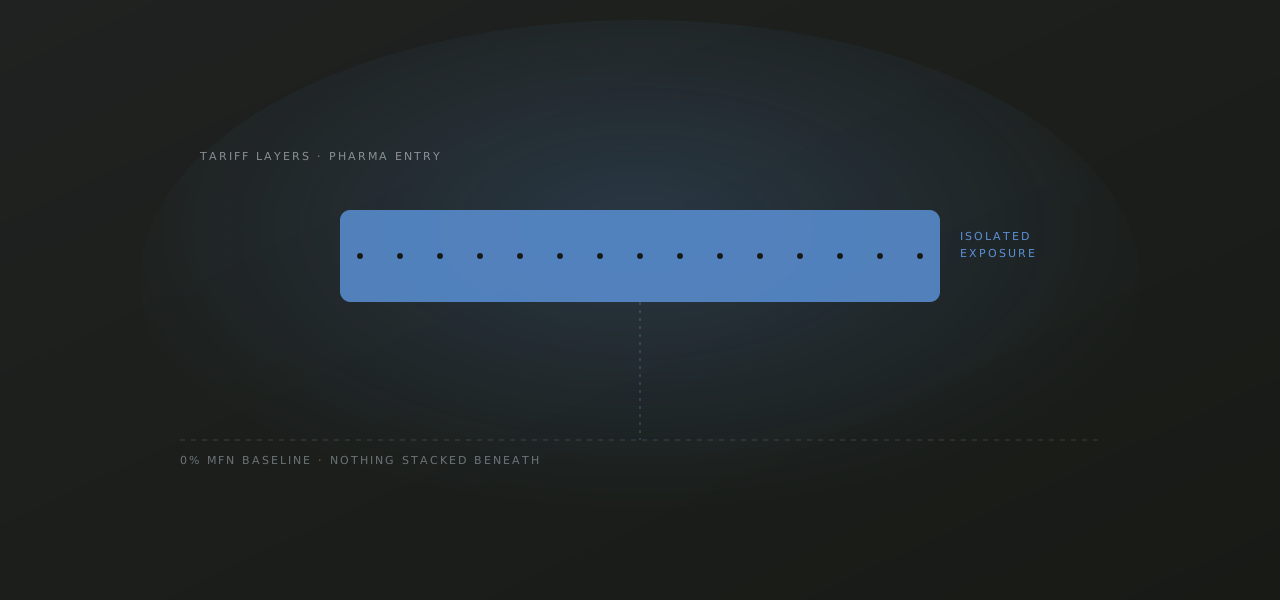
An isolated exposure, not a stacked one
That history is what makes the IEEPA period different for this category. Where a steel importer or an electronics importer might have IEEPA duties sitting on top of preexisting Section 301 or Section 232 layers — and refund calculations turn on figuring out which portion of the total duty belongs to which authority — a pharma importer with a Chapter 30 baseline of zero often has a much simpler equation. If the entry's only duty was the invalidated IEEPA rate, the refund is that rate times the entered value, full stop.
This is a meaningfully better fit for CAPE's streamlined administrative track than the layered-tariff situations that push other categories toward Phase 2 review or litigation. Clean math, uncontested classification, and no competing duty authority to sort out are exactly the profile Phase 1 was built to handle quickly.
Where the sourcing geography adds it back
The simplicity has limits, and they show up in sourcing. Pharmaceutical supply chains draw heavily from India, which supplies a large share of the world's generic finished doses and active ingredients; from Ireland and Switzerland, both long-established hubs for branded and biologic manufacturing; and from Germany, a major source for specialty pharmaceuticals and precision chemical inputs. Each of those countries faced its own IEEPA rate, on its own schedule, during the tariff window.
A company sourcing generics from India and biologics from Switzerland doesn't have one refund calculation — it has at least two, on different rate schedules, and possibly more if its supplier base is broader than those four countries. The per-country attribution problem that shows up across every IEEPA claim shows up here too, even though the underlying duty structure is cleaner than in other sectors.
Where genuine complexity remains: origin across a multi-stage supply chain
Pharmaceutical manufacturing is rarely a single-country affair. It's common for an active ingredient to be synthesized in one country, formulated into a finished dosage form in a second, and packaged for market in a third. Country-of-origin determination for customs purposes generally follows where the last substantial transformation occurred — and for pharmaceuticals, reasonable people can disagree about which manufacturing step counts as substantial enough to shift origin.
That question isn't academic for a refund claim. If an importer's entry records list one country of origin but the actual manufacturing chain suggests a different one, the applicable IEEPA rate — and therefore the refund amount — can change. This is the kind of question that benefits from a second, informed look rather than an assumption that the original entry paperwork settled it correctly.
The mixed portfolio reality
Larger pharmaceutical importers rarely have a single, uniform product line. A company bringing in finished generics that fall cleanly under a zero-baseline Chapter 30 code may also import lab equipment, diagnostic devices, or specialty chemical inputs that sit under entirely different tariff histories — some with preexisting Section 301 exposure, some without. A single company's refund claim can easily be a mix of clean, fast-moving entries and more involved ones that need closer review.
Treating the whole portfolio as one undifferentiated claim usually means either overpaying for review work the clean entries don't need, or under-scrutinizing the entries that do.
What Corvant does
Corvant qualifies pharmaceutical importers' refund exposure against their actual baseline duty status, sourcing geography, and classification history, then connects each situation with the recovery professionals suited to it — fast administrative filing for the clean entries, closer review where origin or classification questions remain open.