Table of contents
Share
IEEPA refund exposure for importers sourcing from Mexico
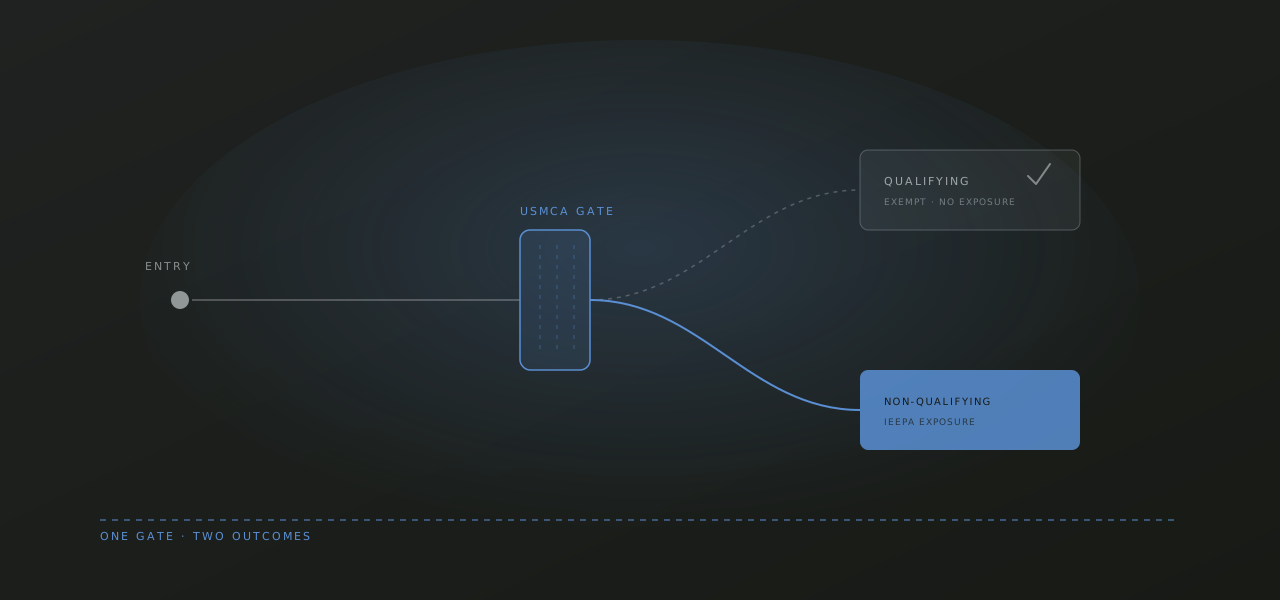
For importers sourcing from Mexico, the first question in a refund review usually isn't "how much IEEPA tariff did I pay." It's "did this shipment owe IEEPA tariff in the first place." A large share of Mexico-origin trade moves under USMCA preferential treatment, and goods that qualify under USMCA's rules of origin are generally exempt from tariff actions like the IEEPA tariffs that applied to non-qualifying trade. That exemption is exactly why Mexico claims turn on a different question than most other countries' claims.
For China or Vietnam, the central refund question is usually how much duty was paid and how much of it is recoverable. For Mexico, the central question is often whether a shipment was ever IEEPA-exposed at all — which depends on an origin qualification determination, not a straightforward calculation.
This article covers what USMCA qualification means for IEEPA exposure, why disputed or undocumented origin creates exposure that clearly-qualifying goods don't have, and what determines whether a Mexico claim is a documentation exercise or something more involved.
USMCA and the qualification question
USMCA, the trade agreement that succeeded NAFTA in 2020, established rules of origin that let qualifying goods move between the U.S., Mexico, and Canada without ordinary tariff treatment — including, generally, without exposure to country-specific tariff actions like IEEPA. A shipment of Mexican-origin goods that met USMCA's regional value content and origin requirements, and was properly certified as such at entry, was in most cases not subject to IEEPA tariffs at all.
That single fact reframes the refund conversation for Mexico-sourced importers. If your goods genuinely qualified under USMCA and were certified correctly, you likely didn't pay IEEPA tariffs on them in the first place. There's nothing to recover, because there was no exposure to begin with. Your refund review, in that case, is short.
Where the exposure actually sits
Importers with real Mexico-origin IEEPA exposure generally fall into one of a few categories. Goods that don't meet USMCA's rules of origin — insufficient regional value content, or a component sourced from outside North America that pushes the good below the required threshold — were IEEPA-exposed like any other non-qualifying import. Goods that would likely have qualified but weren't properly certified at the time of entry, with missing or incomplete certificates of origin, may have been assessed IEEPA duty even though the underlying goods could support a qualification claim once the documentation is reconstructed. And goods with genuinely contested origin — assembled in Mexico from components sourced across multiple countries, where the regional value content calculation sits close to the threshold — occupy a gray zone that requires a real determination, not just a records check.
Why this makes a Mexico claim a documentation exercise first
For most other sourcing countries, the refund calculation is largely arithmetic: entered value times the applicable rate, adjusted for whatever other tariff layers apply. For Mexico, the arithmetic usually comes second. The first question is whether USMCA qualification applies, and answering it requires the same documentation used to support a USMCA claim in the first place — bills of materials, supplier certifications, regional value content calculations, and certificates of origin.
An importer who kept rigorous origin documentation at the time of entry has a straightforward path: confirm non-qualification, or confirm qualification alongside an erroneous IEEPA assessment, then calculate the refund. An importer whose origin documentation is thin or missing faces a reconstruction project before the refund question can even be answered, because CBP will not process a claim premised on an origin determination it can't verify.
The Mexico product mix
Mexico-origin imports concentrate heavily in a handful of categories: automotive vehicles and parts, consumer electronics and appliances, agricultural products, and industrial machinery. Automotive supply chains are often the most complex to evaluate, because a single finished vehicle or major component can incorporate content from dozens of suppliers across several countries, with regional value content calculated across the full bill of materials rather than any single part. Importers in these categories should expect the origin analysis to take real work, not a quick lookup.
Agricultural goods and lower-complexity manufactured products, by contrast, more often have a cleaner origin picture — fewer components, more straightforward regional value content — which tends to make the qualification determination, and therefore the refund exposure, faster to resolve either way.
What determines your pathway
Whether a Mexico-origin claim fits a fast administrative review or needs more involved work comes down almost entirely to documentation quality and how close the origin determination sits to the qualifying threshold. Clean, well-documented non-qualifying goods are close to a standard IEEPA refund claim once the exemption question is settled. Goods near the qualification threshold, or with gaps in the origin paper trail, need someone who can rebuild or defend the origin analysis before the refund conversation can proceed.
What Corvant does
Corvant qualifies your Mexico-origin entries by first resolving the USMCA origin question, then calculating what IEEPA exposure remains once qualifying goods are excluded — and connects you with the professionals suited to reconstructing origin documentation or filing the refund claim, whichever your situation needs.