Table of contents
Share
IEEPA refund exposure for importers sourcing from Malaysia
If your business imports electronics, semiconductor-related components, medical-grade rubber products, solar equipment, or palm oil derivatives from Malaysia, there's a good chance a meaningful share of what you paid under the 2024-2025 IEEPA tariffs is recoverable. Malaysia sits inside the affected-country list, and Malaysia-origin entries follow the same underlying refund mechanics as any other IEEPA-period import — the same window, the same CAPE pathway, the same Section 1514 protest clock.
What differs is the shape of the claim. Malaysia's role in the global supply chain — heavy on electronics assembly and finished-goods manufacturing, lighter on upstream component fabrication — produces a distinct mix of clean entries and complicated ones. Some of what you imported is probably a straightforward refund. Some of it may need closer documentation before CBP will release the money.
This article covers what makes Malaysia's exposure profile distinct, and where those entries tend to land once a claim moves into CAPE.
Malaysia's role in the electronics and consumer goods supply chain
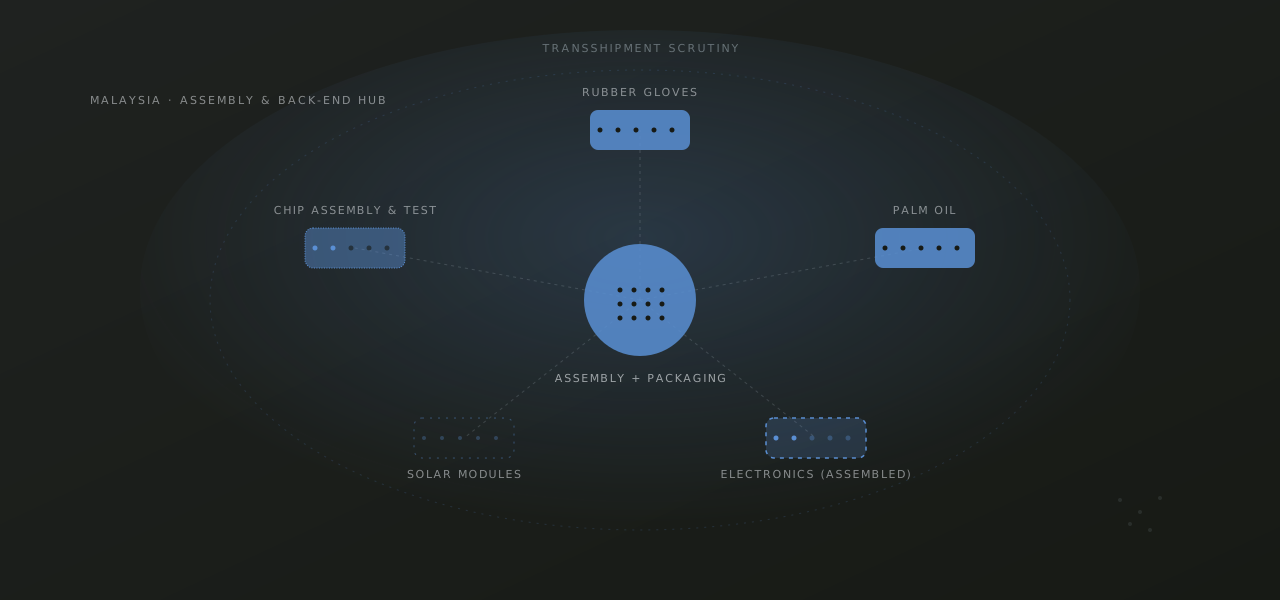
Malaysia has spent decades building one of the world's most established electronics back-end manufacturing bases — chip assembly, testing, and packaging concentrated around Penang, alongside a broader base of consumer electronics, semiconductor production equipment, and printed circuit board assembly. Malaysia is also the world's largest producer of medical-grade rubber gloves, a major palm oil exporter, and a growing base for solar cell and module manufacturing.
That mix matters for how a refund claim reads. Where Taiwan's exposure concentrates in wafer fabrication and South Korea's concentrates in memory chip production — both upstream, component-heavy categories — Malaysia's exposure skews toward assembly and finished or near-finished goods. The distinction shows up directly in HTSUS classification: components enter under one set of codes, and finished electronics assembled from those components enter under another, often with different duty treatment.
Why assembly-heavy sourcing raises different classification questions
A finished device assembled in Malaysia frequently draws on components sourced from several countries — a chip fabricated in Taiwan, a display panel from South Korea, a battery from elsewhere, with final assembly and testing done in Malaysia. Under U.S. customs rules, the country of origin for tariff purposes is generally wherever the last substantial transformation occurred, not simply wherever the finished product was packed and shipped.
For a clean refund claim, that determination needs to be uncontested. If your entries were classified as Malaysia-origin finished goods and that classification is defensible, the claim is straightforward. If the substantial-transformation analysis is genuinely close — say, the Malaysia-side work was closer to final packaging than true manufacturing — the origin question itself can affect which tariff treatment applied, and in turn, what's actually refundable.
Solar equipment is a useful example of how this plays out. U.S. trade authorities have previously scrutinized solar cells and modules assembled in Malaysia and neighboring countries using wafers sourced from China, treating the assembly step as insufficient to establish independent origin in some cases. That history predates IEEPA and involves a separate tariff authority, but it illustrates the same underlying question a Malaysia refund claim has to answer: how much manufacturing actually happened in Malaysia, and does it hold up as the true country of origin.
Transshipment scrutiny and what it means for your claim
Malaysia has also been a documented transshipment point more broadly — goods substantially made elsewhere, routed through Malaysia to obscure origin and avoid country-specific duties. That history means CBP applies a higher baseline level of scrutiny to origin claims on Malaysia-origin entries generally, independent of whether any individual importer's supply chain is actually implicated.
Practically, this means Malaysia-origin refund claims tend to draw more documentation requests than a comparably sized claim from a country without that scrutiny history. Importers with clean, well-documented manufacturing relationships in Malaysia aren't at any legal risk, but they should expect closer review of bills of material, manufacturing records, and country-of-origin certifications before a refund is approved.
Where Malaysia entries tend to land in CAPE
In practice, most Malaysia-sourcing importers end up with a mixed claim. Palm oil derivatives, rubber gloves, and other single-material, single-origin entries usually fit CAPE Phase 1 cleanly — the classification is uncontested and the origin isn't in question. Finished electronics and solar products assembled from multi-country components are more likely to land in Phase 2, where CBP's more thorough review process is built to handle exactly this kind of classification and origin complexity.
The practical move is to sort your entries by category before filing anything. Treating your simple, single-origin claims separately from your assembled-goods claims lets the clean dollars move quickly while the more document-heavy portion gets the attention it needs, rather than letting one slow category hold up an entire filing.
What Corvant does
Corvant qualifies Malaysia-sourcing importers' entries by product category, origin complexity, and CAPE phase fit, then connects you with the recovery professionals suited to each part of your claim — a broker or accountant for the clean administrative filings, more specialized support for the entries where origin or classification needs a closer look.