Table of contents
Share
IEEPA refund exposure for machinery and equipment importers
Machinery and equipment is one of the broadest product categories in the entire IEEPA refund population. It spans industrial presses, packaging equipment, specialized components, pumps, motors, and countless other pieces of capital equipment, sourced from Germany, Japan, and China among others. That breadth means there is no single classification story or single country story that describes the category as a whole — every importer's entry mix looks different.
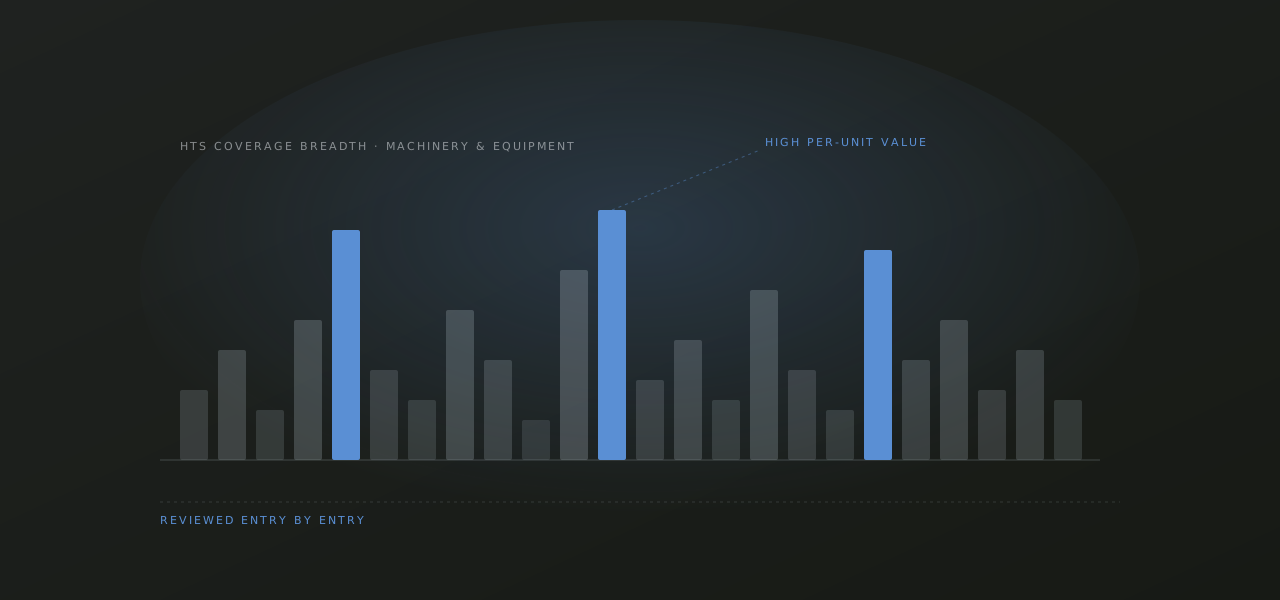
What does unify the category is per-unit value. A single machine or piece of equipment can be worth what dozens or hundreds of entries in a consumer goods category are worth combined. That changes the arithmetic of refund recovery: an importer with a relatively small number of affected entries can still be looking at a substantial claim, simply because each entry carries so much value.
This article looks at why breadth and per-unit value make machinery and equipment a category that rewards careful, entry-by-entry review rather than a broad estimate applied across the whole population.
A category too broad for one classification story
Machinery and equipment covers an unusually wide range of HTSUS provisions, and the tariff history attached to any given machine depends heavily on what it is, where it was made, and what it's used for. A German-made industrial component and a Chinese-made packaging machine can have entirely different tariff pictures even if they arrived in the same month. Some entries in this category carry only IEEPA exposure. Others, particularly those sourced from China, may carry Section 301 duties on top of IEEPA, similar to the layering seen in other categories with a significant China sourcing history.
Because the category is so heterogeneous, generalizing from one entry to the rest of an importer's history is riskier here than in more uniform categories. A component sourced from a longtime supplier under a stable classification may have a straightforward IEEPA-only profile, while a newer piece of equipment from a different supplier, classified differently, may sit under a completely different combination of authorities — even if both arrived in the same shipment.
Why per-unit value changes the recovery math
In many refund categories, the recoverable amount scales roughly with entry count — more entries, more exposure, in a fairly linear way. Machinery and equipment doesn't follow that pattern as cleanly. A single high-value entry can represent a meaningful share of an importer's total exposure, which means the accuracy of the analysis on that one entry matters disproportionately.
An estimate built on averages, applied across a machinery and equipment importer's entry history, can be badly wrong in either direction. It can understate exposure if it doesn't properly weight the handful of high-value entries that actually drive the total. It can overstate exposure if it assumes every entry looked like the largest one. Either error is more consequential here than in a category where entries are numerous and individually small.
Sourcing concentration and what it implies
Germany and Japan are long-standing, high-volume sources of machinery and equipment for U.S. importers, and China is a major source as well, particularly for a wide range of industrial and packaging equipment. China was among the original countries subject to IEEPA tariffs when the program began in February 2024, while other major machinery-sourcing countries were added as the program expanded. That means a machinery and equipment importer's entry history can include some of the oldest entries in the refund population alongside some of the newest, depending on where each shipment originated.
Why broad-brush estimation undersells the category
A rough estimate scaled from total import spend — a reasonable shortcut in categories with many similar, lower-value entries — tends to break down for machinery and equipment. The category's value concentration means the gap between a rough estimate and an accurate one, on just a handful of entries, can be larger than an entire year's exposure in a lower-value category. An importer who relies on a broad-brush number here is more likely to either miss real recoverable value sitting in one or two large entries, or build expectations around a total that doesn't hold up once the underlying entries are actually reviewed.
Neither outcome serves the importer well, and both are more likely in a category built around a small number of high-value transactions than in one built around many small, similar ones. The sample-and-extrapolate approach that works reasonably well for a category with thousands of near-identical low-value entries simply has less to work with here — there may not be enough entries in the sample to represent the population accurately, and the entries that matter most are often the outliers a sample is least likely to catch.
What careful per-entry review looks like here
For machinery and equipment, the more reliable approach is to work through the entry history individually — confirming classification, country of origin, applicable tariff authority, and liquidation status for each entry rather than sampling a subset and extrapolating. Given how much value a single entry can carry, the time spent on that level of review is proportionate to what's at stake. A missed classification detail or an overlooked Section 301 overlay on one large entry can matter more to the total recovery than the same oversight repeated across dozens of smaller entries in a lower-value category.
What Corvant does
Corvant qualifies your machinery and equipment entries individually rather than by category average, accounting for per-unit value, tariff-authority overlap, and country-specific timing, then connects you with recovery professionals suited to the entries that matter most.
If you're an importer, try the demo or view pricing to see what your actual entry-by-entry exposure looks like.