Table of contents
Share
Liquidation status, protest windows, and the recovery timeline
If you've started to look into tariff refund recovery, you've probably encountered a handful of terms — liquidation, protest windows, suspension, extension — that can feel procedural and abstract. They are not abstract. Each of them governs a real date on which something either becomes possible or becomes impossible for your refund.
Understanding the timeline matters because the timeline is not waiting for you. Each entry your business has made carries its own clock, and those clocks are running.
This article walks through the entry lifecycle from import to recovery, in plain language, with attention to the decisions and deadlines that actually shape your refund.
The lifecycle of an entry
When your goods arrive at a U.S. port, your customs broker files an entry summary with CBP. This is the document that declares the goods, their classification, their country of origin, and their value. Duties are paid at this point, based on the applicable tariff rates.
Filing an entry is not the same as resolving an entry. For weeks or months after filing, the entry sits in CBP's records as filed but not finalized. During this period, CBP may review the entry for accuracy, request additional documentation, or take no action at all.
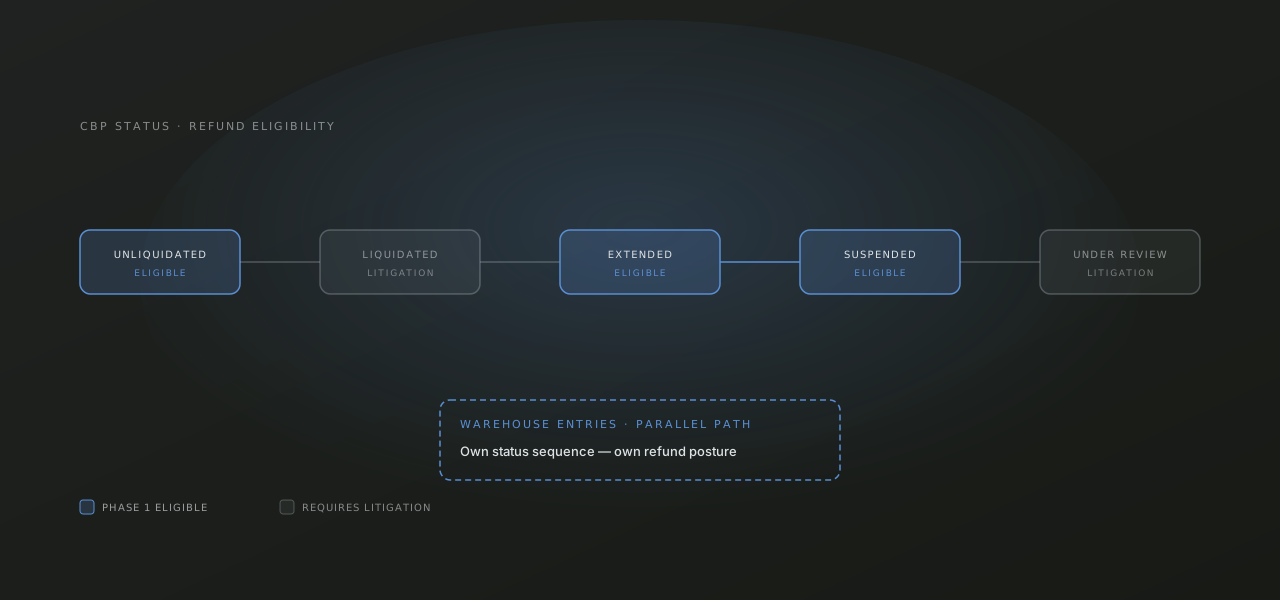
At some point, CBP liquidates the entry. Liquidation is the formal moment when CBP's determination of duties owed becomes final. Most entries liquidate by operation of law — meaning they automatically liquidate after a defined period (typically about a year from entry) if CBP has taken no other action. Some entries liquidate earlier, on an accelerated basis. Some are extended, where CBP formally pushes the liquidation date out. A small subset are suspended, typically pending some external determination.
Once an entry liquidates, a 180-day clock starts. This is the Section 1514 protest window — the period during which you can formally challenge CBP's determination of duties owed. After 180 days, the liquidation becomes final and the administrative refund pathway for that entry generally closes.
What this means for IEEPA refunds
Most importers paid IEEPA tariffs across many entries spread over more than a year. Each entry liquidates on its own schedule, and each carries its own protest window. The cumulative effect is that your refund opportunity is not a single deadline — it is a rolling series of deadlines that started months ago and continues for many more.
Entries from the earliest IEEPA period, in early 2024, generally liquidated in early to mid-2025. The 180-day protest windows on those entries have closed or are about to. Entries from later in 2024 are scattered across the protest window now. Entries from 2025 are in earlier stages — many are still pending liquidation, with protest windows that have not yet opened.
For most mid-sized importers, the dollars at stake in the earliest entries are often the largest, because those entries occurred during periods when IEEPA rates were highest and the affected country list was most concentrated. Letting the protest windows close on those entries by inaction is the most common — and most expensive — mistake in the current recovery landscape.
How CAPE interacts with the timeline
CAPE, the streamlined administrative process CBP rolled out for post-SCOTUS refund claims, runs alongside the protest window mechanism rather than replacing it. CAPE-eligible claims can be filed within the active CAPE phases, but the underlying entry-by-entry protest windows still apply.
The practical effect is that filing a CAPE claim well within your protest window is straightforward. Filing one when the window is about to close is difficult and risky — you may run out of administrative time before the claim processes, and depending on the specific situation, you may need to convert the claim to a formal Section 1514 protest filing to preserve your rights.
CAPE makes the administrative work faster. It does not make the underlying deadlines disappear.
The shape of the recovery itself
Once a refund claim is properly filed and accepted, the actual refund processing varies by pathway. CAPE Phase 1 claims, for clean situations, typically pay out within weeks to a few months after acceptance. CAPE Phase 2 claims, with more complex profiles, run longer — typically several months. Claims that escalate to litigation at the Court of International Trade can run a year or more before resolution.
Throughout the recovery period, the legally substantiated refund amount is sitting between you and CBP, not in your bank account. This is part of why many importers explore factoring options — particularly for the longer-dated portions of a mixed claim, where waiting twelve to eighteen months for the litigation portion to resolve would meaningfully impact operations.
What Corvant does
Corvant analyzes your refund situation against the entry-by-entry timelines, identifies which entries are approaching critical windows, qualifies the recovery pathways that fit your situation, and connects you with the professionals who can act on the timeline you actually have.
The clock is running on entries you've already imported. Knowing where you stand is the first step.