Table of contents
Share
IEEPA refund exposure for importers sourcing from Japan
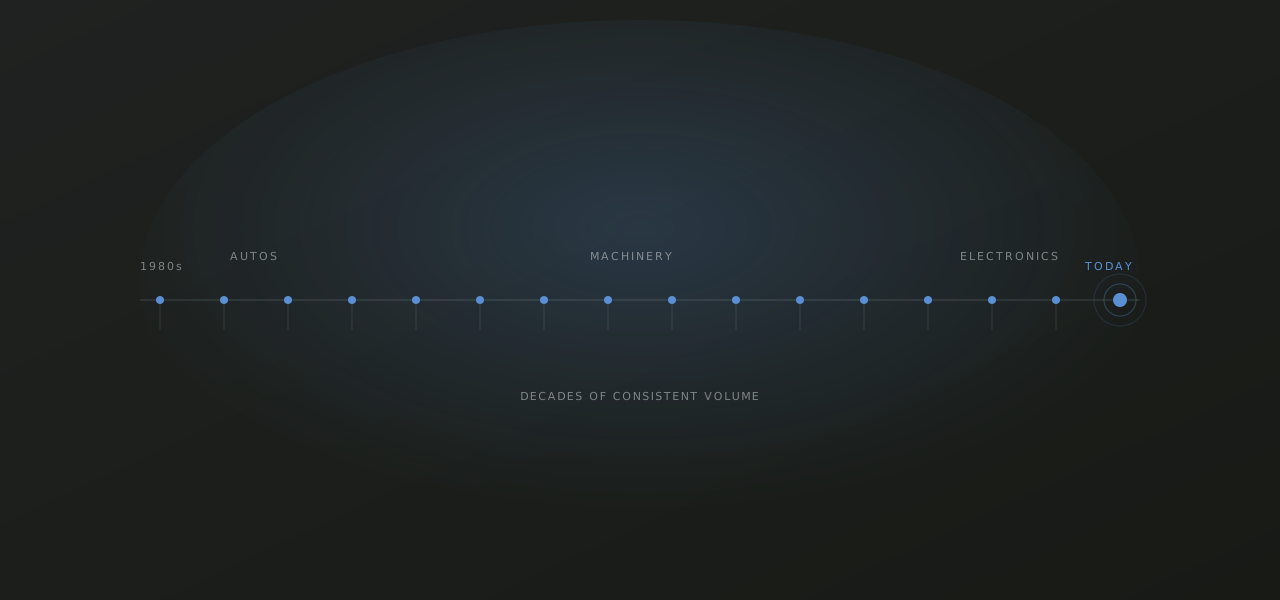
Japan is one of the longest-standing, highest-volume trade relationships in the U.S. import base, built over decades around automobiles, industrial machinery, and precision electronics. The relationship stretches back to the earliest years of postwar U.S.-Japan trade and has stayed consistently high-volume ever since. That history matters for how Japan-origin refund claims look compared to newer or more complex sourcing relationships, and it changes where the real work in a claim actually sits.
Long-established trade lanes tend to produce well-documented entries. Classification precedent is deep, origin is rarely ambiguous, and the kind of multi-country component chains that complicate claims elsewhere are less common in Japan-origin trade. On paper, a lot of Japan-sourcing importers sit closer to the cleanest end of the refund population than to the complex end.
That doesn't make the exposure small. It makes it large and orderly at the same time — which creates its own set of things worth getting right, starting with what "mature" actually buys an importer and what it doesn't.
A mature, well-documented trade relationship
Decades of consistent trade between the U.S. and Japan mean that classification questions for the core categories — vehicles, industrial equipment, precision instruments — have largely been settled for years. Disputes over HTSUS treatment are less common here than in newer or more complex sourcing relationships, and origin determinations are typically unambiguous, since Japan-origin goods are more often manufactured start to finish within Japan than assembled from components sourced across several countries.
That maturity is a genuine advantage when building a refund claim. It doesn't eliminate the work, but it removes a category of complication — contested classification and disputed origin — that drives much of the difficulty in claims from less-established trade relationships. An importer preparing a Japan-origin claim is rarely litigating what something is; the work is confirming what was actually paid, on which entries, during which period. Brokers and compliance teams on both sides have handled the same categories of goods for so long that entry paperwork is typically complete and internally consistent, which matters when CBP is reconciling a refund claim against its own liquidation records.
Autos, machinery, and electronics: high volume, high value
Japan's core export categories to the U.S. — passenger vehicles and auto parts, industrial and factory automation machinery, and precision electronics and instruments — are also high per-unit value categories. Factory automation and robotics equipment in particular has grown as a share of this trade, and it carries the same high per-unit value as the more traditional machinery categories. A single entry can represent a substantial duty amount, and Japan-sourcing importers typically have a large number of such entries spread across years of continuous shipping activity.
That combination of volume and value means the aggregate IEEPA exposure for a Japan-sourcing importer can be very large in absolute dollar terms, even when each individual entry is straightforward to evaluate. Clean does not mean small. A mid-sized importer with a long-running Japan supply relationship can easily have more total dollars at stake than a smaller importer juggling several less-established, more contested sourcing countries.
Why precision still matters at scale
A clean claim profile lowers the risk of disputed classification or origin, but it doesn't lower the cost of a calculation error. Applying the wrong IEEPA rate or period to even a small share of a large entry population compounds quickly. An error that would be a rounding difference on a handful of entries becomes a meaningful discrepancy across thousands of them.
Accuracy at volume is a different discipline than accuracy on a small, complex file. It rewards careful systematic review — confirming the applicable rate for each entry period, checking liquidation status across the full population, and reconciling CBP's records against the importer's own — over the kind of case-by-case legal analysis that a smaller number of contested entries would require. Reconciling liquidation dates across a large entry population is its own project: the Section 1514 protest window runs per entry, not per importer, and a large Japan-sourcing importer may be tracking hundreds of individual liquidation dates at once.
Where complexity still shows up
Japan-origin trade isn't entirely uniform. Some auto and auto-parts entries carry Section 232 duties alongside IEEPA, requiring the same authority-by-authority attribution that applies in other major auto-exporting countries. And some component-level supply chains — particularly for auto parts and electronics subassemblies — draw on inputs from other countries in the region even when the finished good is classified as Japanese-origin, which can raise origin questions at the margins.
These are the exceptions rather than the rule for Japan-sourcing importers, but they're worth identifying early rather than assuming the entire file is uniformly clean. A systematic review that separates the high-volume, single-authority entries from the smaller subset that needs closer attention is usually the fastest path to an accurate claim.
What Corvant does
Corvant qualifies Japan-sourcing importers' exposure with an eye toward scale — confirming rate and period accuracy across high-volume entries, while flagging the smaller subset that carries Section 232 layering or origin questions. We connect you with recovery partners suited to volume-driven administrative work and, where needed, the more specialized review those exceptions require.