Table of contents
Share
IEEPA refund exposure for importers sourcing from Indonesia
Indonesia has grown into one of the more significant alternative sourcing destinations for labor-intensive manufacturing that once concentrated heavily in China — particularly textiles and apparel, footwear, and furniture. Unlike some other alternative-sourcing countries, Indonesia's manufacturing base in these categories tends to involve less multi-country component assembly, which means the origin picture on most Indonesia claims is comparatively clean.
That's the good news. The complication for Indonesia-origin claims sits somewhere else: in the tariff schedule itself. Footwear in particular carries some of the most unusual duty structures in the entire U.S. tariff schedule, and that complexity doesn't disappear just because the IEEPA layer on top is conceptually simple.
Indonesia's export profile
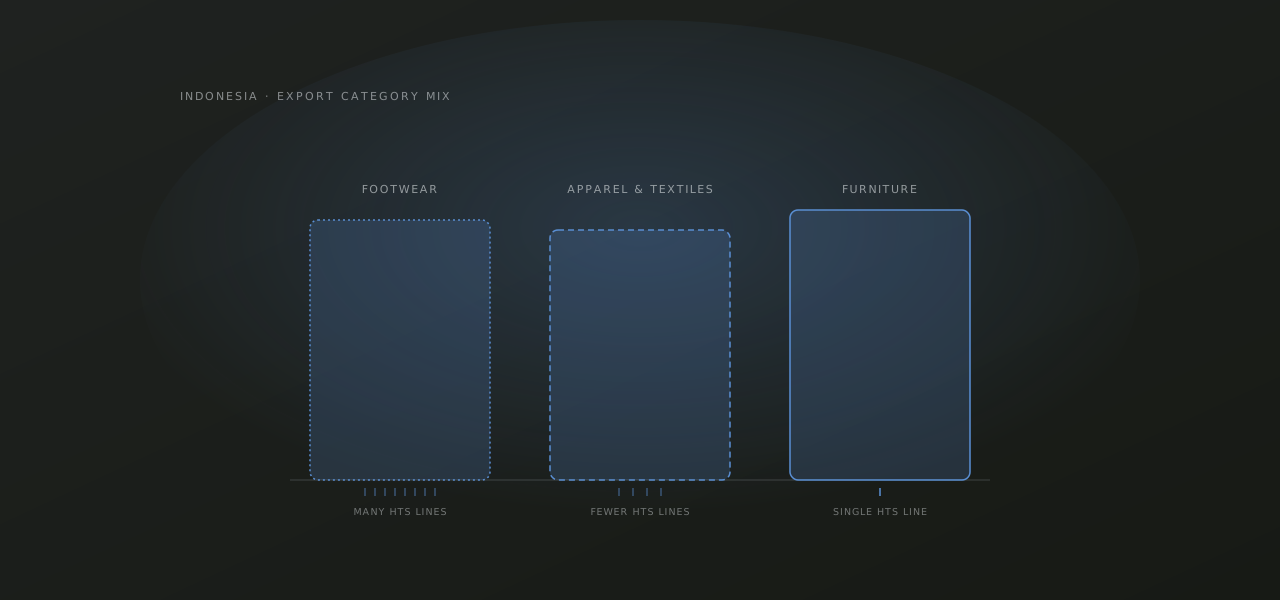
Indonesia's exports to the United States are concentrated in footwear, apparel and textiles, and furniture — categories built on labor-intensive manufacturing that has moved to Indonesia as costs and trade conditions shifted elsewhere in the region. Athletic and casual footwear is a particularly large share of that trade, with a number of global footwear brands running significant production in Indonesian factories. Furniture, especially wood and rattan furniture, and other home goods make up another meaningful share, built on Indonesia's position as one of the world's largest sources of raw rattan and tropical hardwoods.
These categories share a common thread: they are industries where Indonesia typically controls the manufacturing process from raw or semi-finished material through to a finished, exportable good, rather than importing largely-finished components for a final assembly step. That's a structurally different supply chain than the electronics and auto parts assembly common in some neighboring countries, and it's part of why origin questions come up less often in Indonesia-sourced claims.
Why footwear is a special case
The U.S. tariff schedule treats footwear differently from almost any other consumer goods category. Footwear tariff lines under the harmonized system are unusually granular — duty rates vary by the material of the upper (leather, rubber, textile, synthetic), by the material of the outer sole, by construction method, and in some lines by the declared value per pair. Two pairs of shoes that look nearly identical to a non-specialist can sit on different tariff lines carrying meaningfully different baseline rates, and many footwear categories carry baseline duty rates well above what most other consumer goods face — a legacy of decades-old tariff schedule decisions that were never modernized even as most other categories saw their baseline rates come down over time.
That baseline complexity exists independent of IEEPA. It was there before the IEEPA tariffs were imposed and it remains there after the Supreme Court invalidated them. The IEEPA refund only ever applied to the IEEPA layer — the additional emergency tariff assessed on top of the existing duty structure — not to the underlying baseline duty, which was never in dispute.
Where the refund math gets more careful
For most single-country claims, isolating the refundable IEEPA amount is direct: entered value times the invalidated rate. For Indonesia footwear entries, the entry's total duty is typically the product of several stacked components — the baseline duty specific to that footwear line, plus the IEEPA layer, calculated against the value basis appropriate to each. Getting the refundable portion right means correctly separating what was always owed from what was only ever owed because of the invalidated tariff.
This is a classification and computation question, not an origin question. It's usually more mechanical than the origin-verification issues that show up in claims from some other Southeast Asian sourcing countries, but it still requires care. The wrong assumption about which portion of a footwear entry's total duty was IEEPA can meaningfully overstate or understate a refund claim.
It also means footwear entries typically need a line-by-line review rather than a portfolio-level estimate. Two footwear shipments entered a week apart, from the same supplier, can sit on different tariff lines if the material composition or construction differs even slightly — and each line's baseline duty needs to be separated from its IEEPA layer independently. An estimate built from average rates across a footwear catalog will tend to be directionally right and specifically wrong, in ways that only show up once CBP or a reviewing professional checks the underlying entry data line by line.
Textiles and furniture are more straightforward
Apparel, textile, and furniture entries from Indonesia generally don't carry the same duty-stacking complexity as footwear. Most fit a more conventional single-country, single-authority claim profile, closer to the Phase 1 CAPE population, assuming classification is otherwise uncontested and liquidation records are clean.
What this means for your claim
An Indonesia-sourcing importer with a mixed catalog — some footwear, some apparel, some furniture — likely has a mixed claim in the sense that different product lines need different levels of duty-computation scrutiny, even though the country-of-origin picture is consistent across all of them. That's a different kind of mixed claim than the multi-country or origin-contested claims that usually drive that label, and it's worth treating differently when you're sequencing what to file first.
What Corvant does
Corvant qualifies Indonesia-sourcing importers by reviewing product mix, isolating footwear entries that need duty-stack computation review, and confirming which portions of your catalog fit a straightforward administrative filing. We connect you with the recovery partner suited to the actual complexity of each part of your claim.
If you import from Indonesia, try the demo or view pricing to see how your footwear, apparel, and furniture entries break down.