Table of contents
Share
IEEPA refund exposure for importers sourcing from India
India has become one of the fastest-growing sourcing destinations for U.S. importers over the past several years, as companies diversify away from concentrated single-country supply chains. Pharmaceuticals, textiles and apparel, and specialty chemicals make up a large share of that trade, and each category came from a different starting point in the U.S. tariff schedule long before IEEPA existed. Indian-origin entries were subject to the same IEEPA tariffs as entries from any other affected country during the emergency period, and importers who paid them have the same refund rights everyone else does.
But the shape of that exposure looks different for India than it does for many other sourcing countries, because of what the tariff bill actually looked like before IEEPA arrived. The product mix matters here more than it does almost anywhere else, and getting the baseline right for each category changes what a refund is actually worth.
This article walks through why India-origin claims split so cleanly along product lines, starting with the category where the difference is most pronounced: pharmaceuticals.
Why India's baseline tariff picture is unusual
Most sourcing countries in the refund population had at least one other tariff authority already layered onto their trade before IEEPA showed up — Section 301 duties on Chinese goods being the clearest example, where importers already had a stacked tariff bill before the emergency tariffs added another layer on top.
India generally wasn't subject to that kind of pre-existing overlay. Section 301 targeted Chinese-origin goods specifically, and most Indian export categories fell outside the product scope of Section 232's steel, aluminum, and auto tariffs as well. For a large share of Indian-origin trade, IEEPA wasn't an increment on an existing tariff structure — it was, in practical terms, the entire new tariff bill.
Pharmaceuticals: the clearest case
A large share of pharmaceutical products — finished dosage forms and many active pharmaceutical ingredients alike — enter the U.S. duty-free under longstanding multilateral tariff commitments that predate IEEPA by decades. Indian pharmaceutical exporters, among the largest suppliers of generic drugs to the U.S. market, generally benefited from that duty-free baseline.
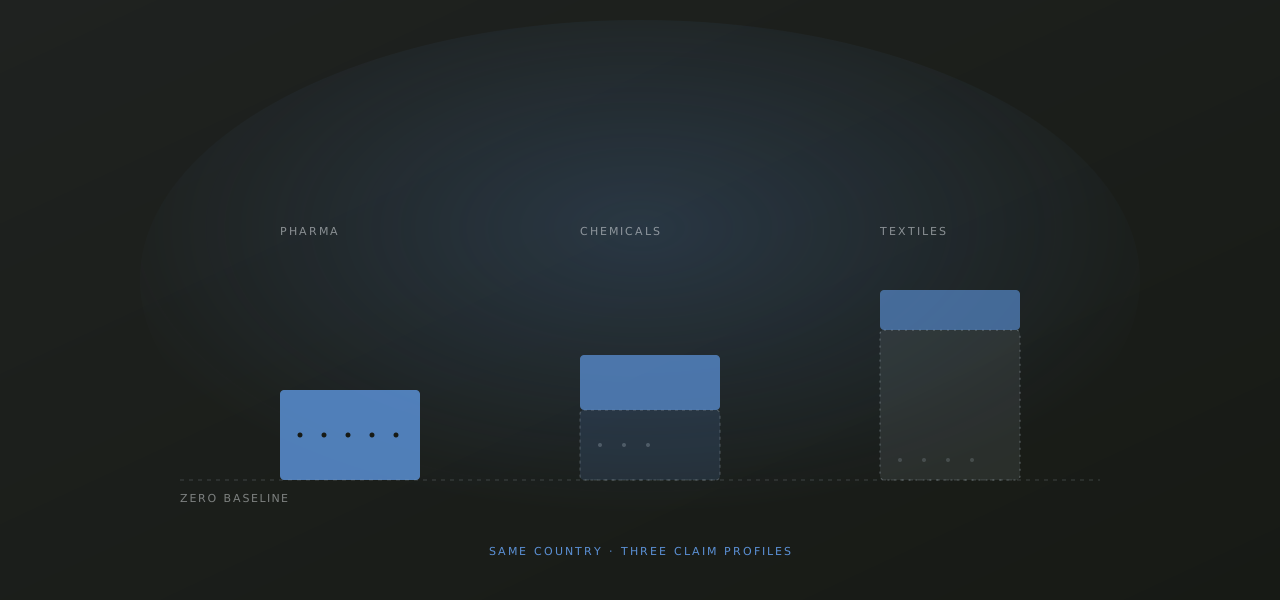
When IEEPA tariffs applied to Indian-origin pharmaceutical entries, there was no other authority to disentangle and no pre-existing duty to net against. The refund calculation is close to the simplest version CAPE was built to handle: one country, one rate, a classification that is rarely in dispute, and a refund that restores close to the entire duty paid on the entry — not a slice of it.
The one wrinkle worth flagging: bulk active pharmaceutical ingredients and chemical intermediates sometimes classify differently than finished dosage forms, and an importer with both in its supply chain should confirm each is treated correctly before assuming the whole pharma book behaves identically.
Textiles and apparel carry a different baseline
Textiles and apparel look different. These categories have historically carried some of the highest MFN duty rates in the U.S. tariff schedule, often well into double digits depending on fiber content, construction, and garment type. Indian apparel exporters were already paying meaningful duty before IEEPA existed, and importers in this category are typically no strangers to classification complexity — fiber blends and garment construction have long made apparel one of the more contested corners of the tariff schedule, independent of anything IEEPA-related.
For these entries, the IEEPA refund recovers the invalidated increment, not the underlying duty the importer was already paying and will continue to pay. Importers sourcing apparel from India should expect a real but proportionally smaller recovery relative to total landed cost than an importer whose exposure sits mostly in pharmaceuticals.
Specialty chemicals sit in the middle
Specialty and fine chemicals imported from India fall between the two extremes. Baseline MFN duty varies widely by specific chemical classification — some lines are duty-free, others carry standard rates — and the correct HTSUS classification for a given chemical formulation is genuinely more contestable than it is for a finished pharmaceutical or a bolt of fabric. Chemical structure, intended use, and purity level can all affect which tariff line applies.
That classification sensitivity means specialty chemical claims often benefit from review by someone familiar with the chemical schedule specifically, even though there's still no competing tariff authority to untangle the way there is with more heavily layered countries.
One importer, three different claim profiles
A company that sources pharmaceuticals, textiles, and specialty chemicals from India isn't filing one refund claim — it's effectively filing three, each with a different baseline, a different proportional recovery, and a different level of classification scrutiny required. That's a meaningfully different shape than a single-country importer whose entries are uniformly complex, or uniformly simple, across the board.
Many India-sourcing importers find it makes sense to sequence the work: the pharma-heavy entries can typically move fastest, since there's no layered authority to sort out and classification is rarely contested. The textile and chemical portions take longer to prepare properly, but they can proceed in parallel rather than waiting on the simpler claims to clear first.
What Corvant does
Corvant qualifies India-sourcing importers' refund exposure product line by product line, rather than treating a company's entries as a single undifferentiated claim. We identify which portions of your entries fit a clean, high-recovery profile, which carry a smaller proportional recovery against an existing duty baseline, and which need closer classification review — then connect you with the recovery partners suited to each part of the claim.