Table of contents
Share
What is the IEEPA tariff refund opportunity?
If your business imported goods into the United States between early 2024 and late 2025, there is a meaningful chance the federal government collected tariffs from you that it had no legal authority to impose. The Supreme Court has now said so. The question for your business is no longer whether those tariffs were valid — that has been settled. The question is what portion of what you paid is recoverable, how to get it back, and on what timeline.
This article is a starting point for understanding the opportunity.
What IEEPA tariffs actually means
The International Emergency Economic Powers Act, usually shortened to IEEPA, is a federal statute that allows the President to regulate international commerce during a declared national emergency. Beginning in early 2024, the prior administration used IEEPA to impose a series of broad tariffs on imports from a wide range of countries — initially Canada, Mexico, and China, then expanding to dozens more.
Importers paid these tariffs at the point of entry, just like any other duty. Over the following eighteen months, the affected universe grew to roughly 330,000 U.S. businesses, and the total collected has been estimated at well over $61 billion.
Then, in 2025, the Supreme Court ruled that the President's use of IEEPA to impose those tariffs exceeded the statute's authority. The tariffs were invalid. Importers who paid them are entitled to refunds — with interest.
What's actually recoverable
The headline number is large, but the recoverable portion for any individual business depends on several factors that vary case by case.
The first is the date range of your entries. Tariffs imposed under IEEPA between February 2024 and February 2025 are the core refundable population. Entries before or after that window may be subject to different legal authorities — for example, Section 122 tariffs imposed in early 2026 use a different statute and are not refundable on the same basis.
The second is the country of origin and tariff rate that applied to your shipments. Different countries faced different IEEPA rates at different points in time. A shipment from China in mid-2025 may have been subject to a different layered rate than a shipment from Vietnam in early 2025.
The third is liquidation status. U.S. Customs and Border Protection formally liquidates an entry to finalize the duties owed. After liquidation, an importer has 180 days to file a protest under Section 1514 of the Tariff Act if they want to challenge the duties paid. Once that window closes, the entry is generally beyond administrative recovery.
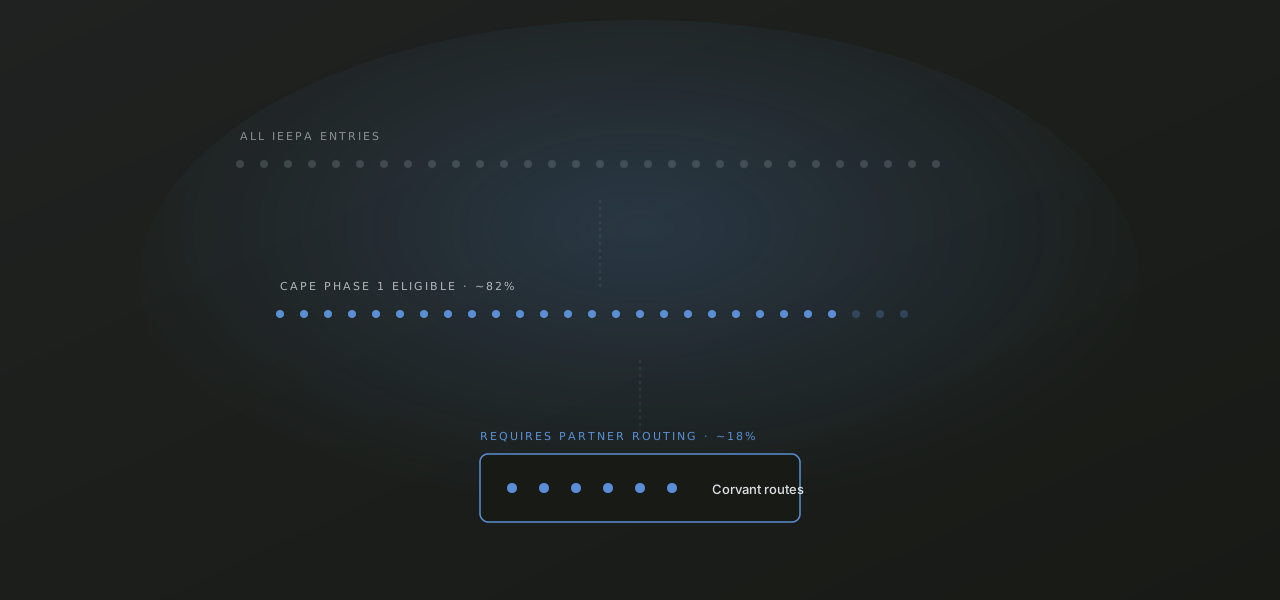
The fourth is whether your situation fits CAPE eligibility. CAPE — the Consolidated Administrative Process for Entries — is the streamlined refund pathway that CBP rolled out to handle the volume of post-SCOTUS refund claims. CAPE Phase 1 covered the simplest profiles; Phase 2 expanded the eligible universe. Whether your entries fit CAPE, or whether you need a more involved legal recovery process, shapes your timeline and the professionals you'll work with.
For many importers, the recoverable amount is significant. For some, especially mid-sized businesses with consistent inbound from affected countries, it can be the largest single recovery opportunity their accounting team has ever seen.
The hybrid reality
Most refund situations are not pure CAPE or pure IEEPA. Most are mixed.
A typical mid-sized importer might have a portion of their entries that fits CAPE cleanly — a customs broker or accountant can file those claims quickly. Another portion may involve contested classifications, multi-country exposure, or complex tariff stacking that requires a recovery attorney. And throughout the recovery window — which can run months or years — many importers explore factoring options to access liquidity now rather than waiting for the government to pay.
Understanding your refund profile means understanding which pathways apply, in what proportions, and in what order.
Why this is time-sensitive
Refund recovery is not open-ended. Each entry carries its own liquidation timeline, and the 180-day Section 1514 protest window runs from the date CBP liquidates that entry. Entries from your earliest IEEPA-period imports are already approaching, or past, that cutoff. Entries from later in 2025 still have meaningful runway.
The practical implication: even a modest delay can convert recoverable dollars into expired ones. Importers who wait for the dust to settle often discover that their earliest entries — frequently the largest — have already aged out of administrative recovery.
What Corvant does
Corvant is a recovery exchange. We use AI-assisted analysis across public records, regulatory filings, and licensed trade data to identify importers with refund exposure and qualify each situation by complexity, urgency, and recoverable amount. When the math is meaningful, we connect you with the right recovery partners — a law firm for complex claims, a broker or accountant for CAPE-eligible filings, a factoring partner for immediate liquidity, or some combination based on what your situation actually requires.
We don't represent you. We don't file your claims. We make sure the professionals who do that work are qualified, available, and matched to your situation.
The first step is understanding what's on the table.