Table of contents
Share
IEEPA refund exposure for importers sourcing from Germany
Germany is one of the most established trade relationships in the U.S. import base, concentrated in machinery, automobiles and auto parts, and pharmaceuticals. Entries from Germany were subject to the same invalidated IEEPA tariffs as entries from every other affected country, and German-sourcing importers have the same refund rights as anyone else in the post-SCOTUS population. Machinery and vehicles typically make up the largest share of German-origin trade value for most importers, with pharmaceuticals a smaller but still meaningful piece of the picture.
What makes German-origin claims distinct is Section 232. The national security tariff on imported vehicles and auto parts is authorized under a different statute entirely — the Trade Expansion Act, not IEEPA — and it sits alongside IEEPA for a large share of German trade. Because it rests on separate legal authority, Section 232 duties were not touched by the Supreme Court's ruling. That means the easy assumption — that the whole tariff on a German import was struck down — is often wrong, and getting the split right is the central question for a big share of this country's claim population.
This article covers where that layering shows up, where classification precision becomes its own separate issue, and where the two problems can compound in the same entry.
Autos and auto parts: where IEEPA meets Section 232
Germany is one of the largest sources of finished vehicles and auto parts imported into the U.S. Passenger vehicles, engines, transmissions, and a deep bench of specialized component suppliers all move through this trade lane in volume, much of it from manufacturers with decades of established production and shipping relationships into the U.S. market.
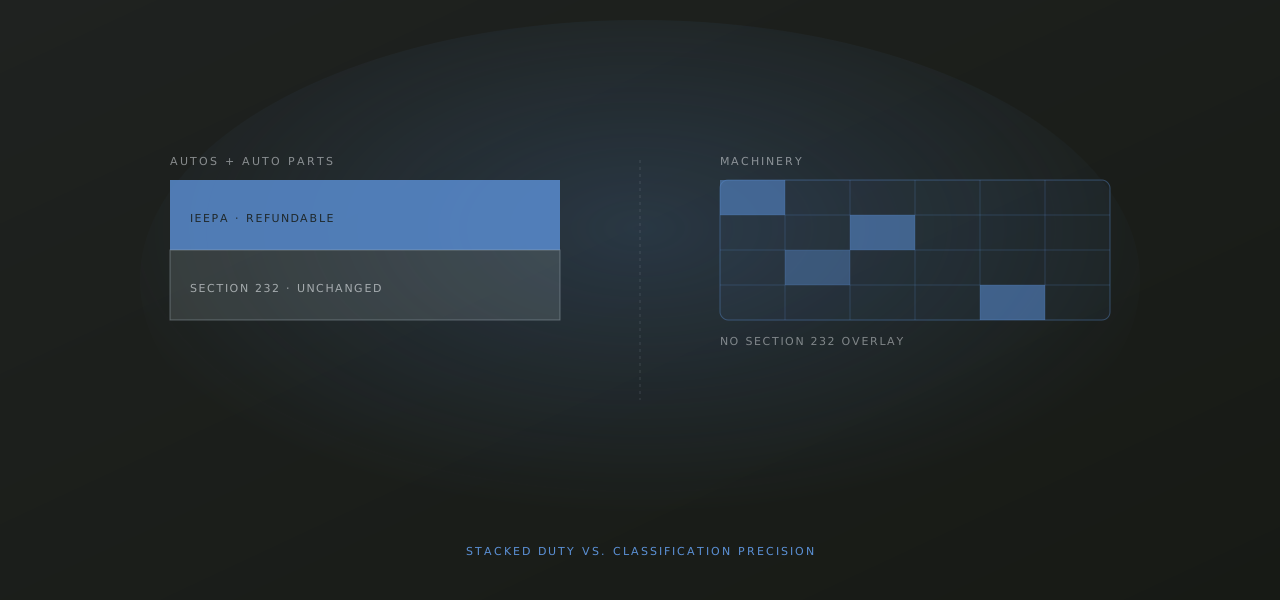
Many of those entries carried both an IEEPA tariff and a Section 232 tariff on autos and auto parts during the same period. Only the IEEPA portion is affected by the invalidation — the Section 232 duty remains a valid, separately assessed authority. A refund claim on a German auto or auto-parts entry has to isolate exactly what was collected under which authority before it can determine what's actually recoverable. Treating the full tariff line as refundable overstates the claim; treating none of it as refundable understates it. Getting this wrong in either direction creates a problem — an overstated claim invites additional CBP scrutiny, and an understated one leaves real money unclaimed. The Section 232 auto tariff applies broadly across most vehicle-exporting countries, not just Germany, but Germany's volume means the dollar impact of getting the attribution wrong is larger here than it is for smaller auto-exporting countries.
Machinery: a classification problem, not a layering problem
Germany's industrial machinery exports — engineering equipment, machine tools, specialized manufacturing systems — present a different kind of complexity. The HTSUS schedule for machinery is unusually granular, with thousands of specific subheadings distinguishing equipment by function, capacity, power source, and design, and equipment that looks similar on a factory floor can sit under materially different tariff lines.
For most machinery entries there's no competing tariff authority to disentangle the way there is with autos. The issue instead is precision: the correct classification for a highly engineered piece of equipment is not always obvious, and a defensible-but-contestable classification can change the refundable amount even when the layering question doesn't apply at all. An importer with a broad machinery catalog may find that some lines classify cleanly while others genuinely warrant a second look before a claim is filed. A careful review typically starts by pulling the full entry list and mapping each HTSUS code against the tariff schedule that applied at the time of entry, rather than assuming one classification decision covers the whole catalog.
Pharmaceuticals: a smaller but genuine slice
Germany is also a significant pharmaceutical exporter. As with other countries' pharmaceutical trade, much of this category enters the U.S. under a duty-free MFN baseline, which means IEEPA was frequently the primary tariff these entries carried — closer to a clean, single-authority claim than the auto or machinery portions of a German-sourcing importer's book. It's typically a smaller share of total trade value for most importers, but the claim itself tends to be the most straightforward part of the file to prepare.
The hybrid reality for German-origin claims
Most importers sourcing meaningfully from Germany have entries across more than one of these categories, and each category needs a different kind of review. The auto and auto-parts entries need authority-by-authority attribution against Section 232. The machinery entries need classification-level scrutiny. The pharmaceutical entries, if there are any, are usually the most straightforward part of the file.
Treating a German-sourcing importer's entire claim as one uniform profile — whether assuming it's all clean or all complicated — misses how differently each category actually behaves, and it risks either leaving recoverable dollars unclaimed or submitting a claim that overreaches on duties that were never part of the invalidated tariff in the first place. Many German-sourcing importers find it practical to start with the pharmaceutical and non-232 entries, since those move fastest, while the auto and machinery lines go through the additional layer of review in parallel.
What Corvant does
Corvant qualifies German-sourcing importers' exposure by product line, distinguishing entries that need Section 232 attribution from entries that need classification review from entries that fit a cleaner single-authority profile. We connect you with the recovery partners suited to each part of the claim, so the auto-parts portion and the machinery portion don't get forced through the same process.