Table of contents
Share
IEEPA refund exposure for furniture importers
Furniture importers rarely have a clean, single-authority refund story, because furniture sourcing has been shaped by tariff policy for years before IEEPA existed. China has long been the dominant supplier of furniture to the United States, and furniture was one of the product categories specifically named in earlier Section 301 tariff actions — meaning many furniture entries were already carrying 301 duties well before IEEPA duties arrived on the same entries.
Vietnam has grown into the other major furniture sourcing base over that same period, in part as manufacturers and importers diversified away from China. That two-country concentration, with two different tariff histories attached to it, is the reason furniture claims usually need more careful sorting than a typical single-country category.
This article looks at why furniture's Section 301 history matters for IEEPA refund exposure, how the China-Vietnam split changes the analysis entry by entry, and where this category resembles — and differs from — other product lines with a similar layered-tariff problem.
Furniture's tariff history predates IEEPA
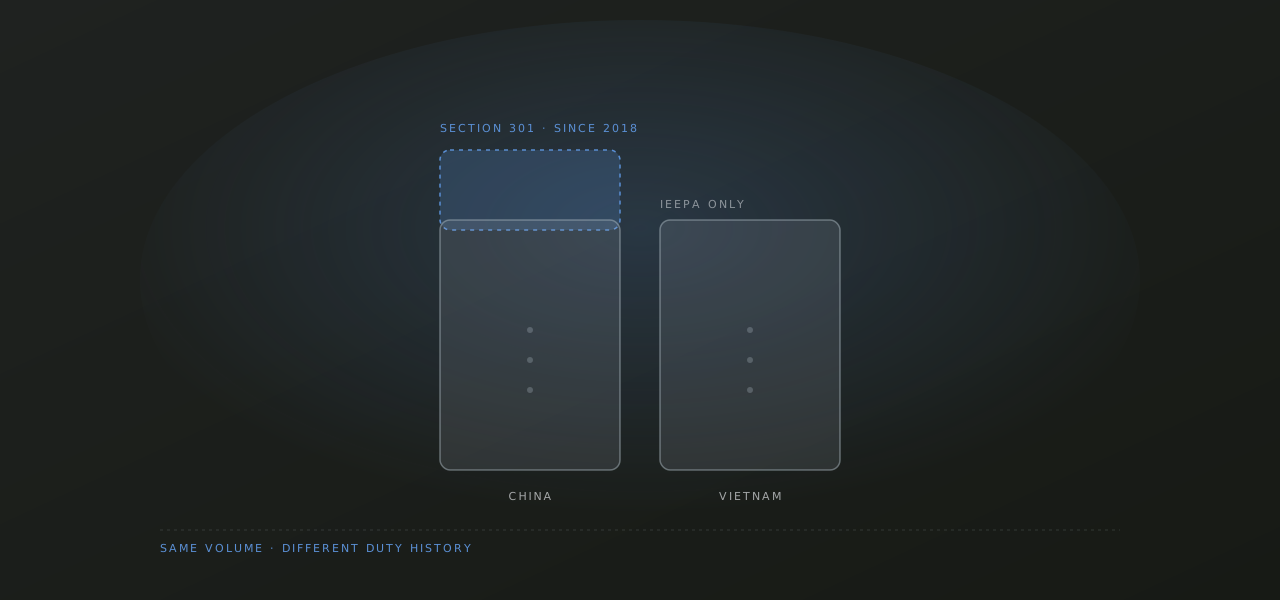
Section 301 tariffs on Chinese goods, including specific furniture lines, were imposed in stages starting in 2018, well before the IEEPA tariffs at the center of the current refund opportunity. China was also among the original group of countries subject to IEEPA tariffs when that program began in February 2024. The practical result is that a furniture entry from China during the IEEPA period could be carrying two separate duty layers at once: a Section 301 duty tied to the product's tariff classification, and an IEEPA duty tied to the country of origin and the entry date.
Only one of those layers was addressed by the Supreme Court's ruling. Section 301 duties remain a separate legal matter, governed by separate authority, and are not automatically refundable just because the IEEPA layer on the same entry is. An importer who simply totals the duties paid on a China-sourced furniture entry, and treats the full amount as recoverable, will typically overstate the refund by whatever portion traces back to the 301 duty rather than the invalidated IEEPA rate.
The China-to-Vietnam shift changes the mix
Vietnam does not carry the same Section 301 history that China does for furniture. An importer who has shifted volume from Chinese suppliers to Vietnamese ones over the past several years often ends up with two distinct entry populations: older or continuing China-sourced entries carrying both 301 and IEEPA duties, and Vietnam-sourced entries carrying IEEPA exposure without the 301 layer underneath it.
That split matters for claim structuring. The Vietnam-sourced entries, without the 301 complication, are more likely to fit a clean, single-authority profile — the kind of claim CAPE Phase 1 was built to handle quickly. The China-sourced entries usually need the same layered-authority analysis that applies to other categories with a 301-and-IEEPA overlap, and often benefit from CAPE Phase 2 review or recovery counsel rather than a standard broker filing.
For furniture importers who have shifted sourcing gradually rather than all at once, the two populations can also overlap in time — some entries from the transition period may include both a supplier that was mid-shift and a classification history that still reflects the older 301 treatment. Sorting by country alone isn't always sufficient; the shift date matters too.
Similar in kind to electronics, different in history
Furniture importers often hear this compared to electronics, another category where Section 301 and IEEPA duties frequently sit on the same entries. The comparison is fair in kind — both categories can require separating a pre-existing 301 duty from a later IEEPA duty on the same entry — but the specifics differ. The furniture 301 tranches, the product lines they covered, and the pace of diversification toward alternate sourcing countries all followed a different timeline than electronics did. Treating the two categories as interchangeable for refund purposes risks misapplying assumptions that don't transfer cleanly.
Why classification adds a further wrinkle
Furniture also carries more classification variation than it might first appear. Upholstered furniture, wooden furniture, metal furniture, and furniture parts sit under different HTSUS provisions, and the Section 301 exposure has not applied uniformly across all of them. Two furniture entries from the same supplier, in the same shipment, can carry different 301 histories depending on how each line item was classified — which means the refund analysis often needs to happen at the line-item level, not just the entry level.
What this means for furniture importers now
The practical takeaway is that a furniture importer's entry history usually isn't one story — it's at least two, split by country and often further split by classification. Sorting entries by sourcing country and by whether a 301 duty applies is a useful first step before assuming what portion of any given entry's duties are refundable under IEEPA.
What Corvant does
Corvant qualifies your furniture entries by country, classification, and tariff-authority overlap, separating the entries that fit a clean administrative path from the ones that need deeper review for a 301-and-IEEPA split — and connects you with the recovery professionals suited to each.
If you're an importer, try the demo or view pricing to see how your entries actually break down.