Table of contents
Share
IEEPA refund exposure for footwear importers
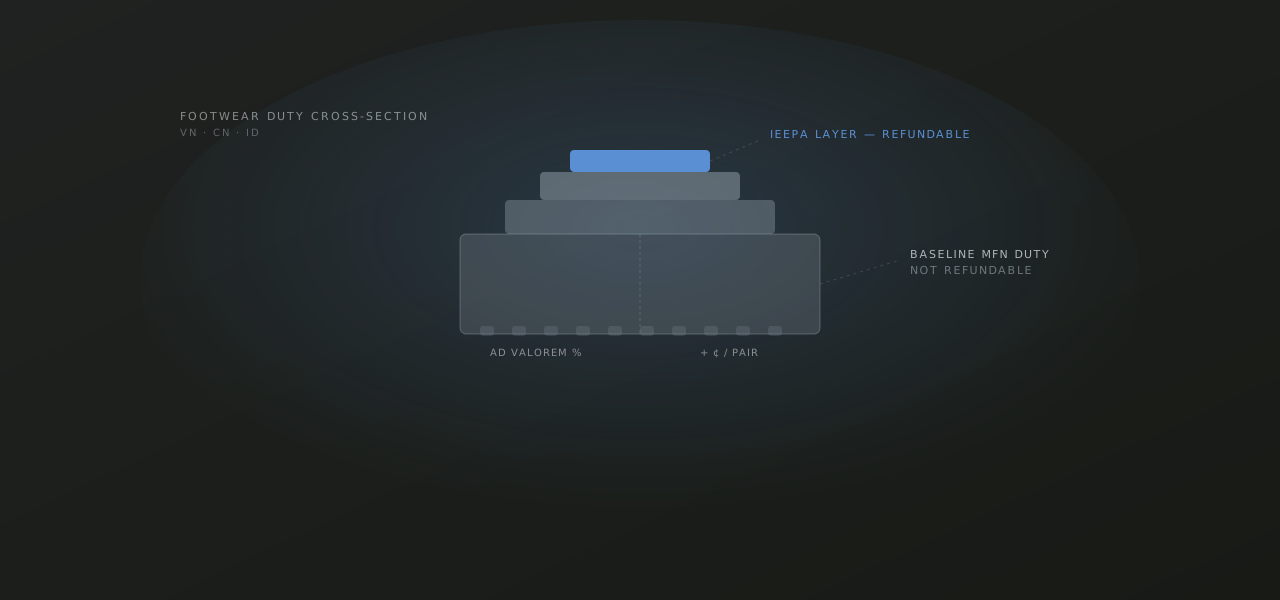
Footwear importers face a calculation problem that's different in kind from most other categories: the baseline duty rate on many footwear products was already high before the IEEPA tariffs ever applied. Some footwear categories carry among the highest Most Favored Nation duty rates in the entire U.S. tariff schedule — a legacy of decades-old protections that long predate the current tariff disputes. When the IEEPA layer stacked on top of that baseline, footwear importers ended up paying some of the largest total effective tariff rates of any product category.
That combination — high baseline plus invalidated overlay — is what makes footwear refund claims distinctive. The IEEPA portion is refundable; the baseline MFN duty is not. Separating the two accurately is the central calculation question for nearly every footwear claim.
This article covers where footwear sourcing concentrates, why the baseline rate runs so high, and how that interacts with the refundable IEEPA portion.
Where footwear sourcing concentrates
Vietnam has become the largest single source of U.S. footwear imports, having absorbed much of the production that moved out of China over the past several years. China remains a major source in its own right, particularly for certain categories. Indonesia supplies a meaningful and growing share, especially for athletic and outdoor footwear.
All three faced IEEPA tariffs during the affected period, with rates that varied by country and by time — the same per-country, per-period attribution problem that shows up across every affected category. What makes footwear different is what those rates were added on top of.
Athletic and outdoor footwear typically fall under different tariff provisions than dress or casual footwear, each with its own baseline rate structure. An importer that sources both categories, which is common for footwear brands with broad product lines, is effectively running two separate baseline calculations in parallel, on top of the country and timing attribution every category has to do.
Why the baseline rate runs so high
The U.S. tariff schedule's footwear provisions are a holdover from an earlier era of trade protection, and they were never meaningfully reformed even as rates in most other consumer goods categories came down over decades of trade liberalization. Depending on the specific construction — rubber or plastic outer soles, certain textile uppers, specific value bands — baseline MFN duty rates on footwear can run well into double digits, among the highest of any consumer goods category in the schedule, with some categories running higher still. Some footwear tariff lines even apply a compound structure: an ad valorem component plus a fixed cents-per-pair charge, rather than a single value-based rate.
This baseline applies regardless of IEEPA. It was true before the invalidated tariffs existed and it remains true after they're struck down. It is not refundable under the SCOTUS ruling — only the additional IEEPA-period layer is.
Many footwear tariff lines also apply different baseline rates depending on the per-pair value declared at entry, with lower-value pairs sometimes carrying a different rate than higher-value pairs of otherwise similar construction. Reconstructing the correct pre-IEEPA baseline for a historical entry sometimes means confirming the declared value band actually matches the rate that was applied, not just pulling the HTSUS code off the entry summary.
The stacking problem
For an importer of footwear from an IEEPA-affected country, the total duty paid at entry was the baseline MFN rate plus the IEEPA rate applicable at that time. A refund claim has to isolate the IEEPA increment specifically, without touching the baseline portion that was, and remains, properly owed.
This sounds straightforward in principle but gets complicated in practice when entry paperwork doesn't clearly break out each layer, when rates changed mid-period, or when a given shipment's classification affected which baseline rate applied in the first place. Footwear classification itself is its own specialty — sole material, upper material, and construction method all affect which subheading, and which baseline rate, governs a given pair.
Component sourcing adds an origin question of its own
Footwear assembly often draws on components from more than one country — uppers cut and stitched in one location, soles molded in another, with final assembly happening somewhere else entirely. As with other product categories, origin for tariff purposes generally follows where the last substantial transformation occurred, which is usually the country of final assembly. But when a factory shifts a specific component's source country mid-contract without changing where the shoe itself is assembled, the origin conclusion can stay the same even though part of the supply chain changed underneath it — a distinction that matters when reconstructing exposure years later from purchase-order-level detail rather than a current supply chain map.
Why the numbers can look larger than expected
Because the baseline is already high, footwear importers sometimes assume their entire duty burden is IEEPA-related and overstate what's refundable — or, in the opposite direction, underestimate their exposure because they're mentally netting out the baseline rate without doing the actual per-entry math. Both errors are common enough that a careful line-by-line reconstruction, rather than an estimate based on total landed cost, is usually necessary to get the refundable amount right.
What Corvant does
Corvant qualifies footwear importers' refund exposure by separating the baseline MFN duty from the refundable IEEPA-period layer, country by country and entry by entry, and connects each situation with the recovery professional suited to the work. try the demo or view pricing to see what your footwear exposure looks like.