Table of contents
Share
IEEPA refund exposure for food and agriculture importers
Most of the IEEPA refund conversation assumes a shipment cadence built around durable goods: containers arriving on a predictable schedule, entries that sit for a while before anything happens, and protest windows that open at a manageable pace. Food and agriculture importers don't work on that cadence. Perishable goods move through customs quickly, shipments repeat weekly or more often, and that changes how the 180-day protest window plays out against a real calendar rather than an abstract one.
The underlying refund exposure works the same way for a shipment of produce as it does for a shipment of machine parts — the same IEEPA rates, the same liquidation mechanics, the same Section 1514 protest deadline. What's different is how quickly the clock moves and how many clocks are running at once.
This article looks at why the entry lifecycle tends to run faster in this category, what that means for managing protest windows across a high volume of entries, and where sourcing concentration adds its own wrinkle.
A faster entry lifecycle
Perishable goods are built for speed at every stage of the supply chain, and customs processing is no exception. Shipments of produce, seafood, and other perishable food products are generally structured to clear quickly — importers and brokers in this category have strong incentive to avoid the kind of prolonged review that would leave a perishable shipment sitting at the port. In practice, many food and agriculture entries tend to be simpler than average: single country of origin, standard classification, few of the admissibility disputes that can slow other categories down.
That simplicity often means these entries move toward liquidation without the delays that more complex categories experience. An importer who assumes their protest window will open on the same rough timeline as a durable-goods importer's may find their food and agriculture entries liquidating, and their windows opening, earlier than expected.
This isn't universal — an entry held up by an admissibility question, a labeling dispute, or a documentation gap can still take the long way to liquidation like any other entry. But as a general pattern, the category skews toward faster resolution, and a recovery plan built on a slower assumption will consistently underestimate how much runway is actually left on the oldest entries.
Why the volume problem is different here
A durable-goods importer might have a few dozen entries over an eighteen-month period. A food or agriculture importer shipping weekly or biweekly from the same supplier can easily have several hundred entries over the same period. Each entry carries its own liquidation date and its own 180-day protest clock.
That volume changes the practical challenge. It's not one large decision about one large claim — it's a rolling series of smaller decisions, each with its own deadline, arriving on a cadence that mirrors how often the business actually imports. Managing that well requires tracking liquidation status at the entry level, on an ongoing basis, rather than doing a single retrospective review months after the fact.
Sourcing concentration and timing
Food and agriculture imports concentrate heavily in a handful of countries — Mexico, Brazil, and Canada among others. Mexico and Canada were part of the original group of countries subject to IEEPA tariffs when the program began in February 2024, which means food and agriculture importers sourcing from either country are often sitting on some of the oldest entries in the entire refund population.
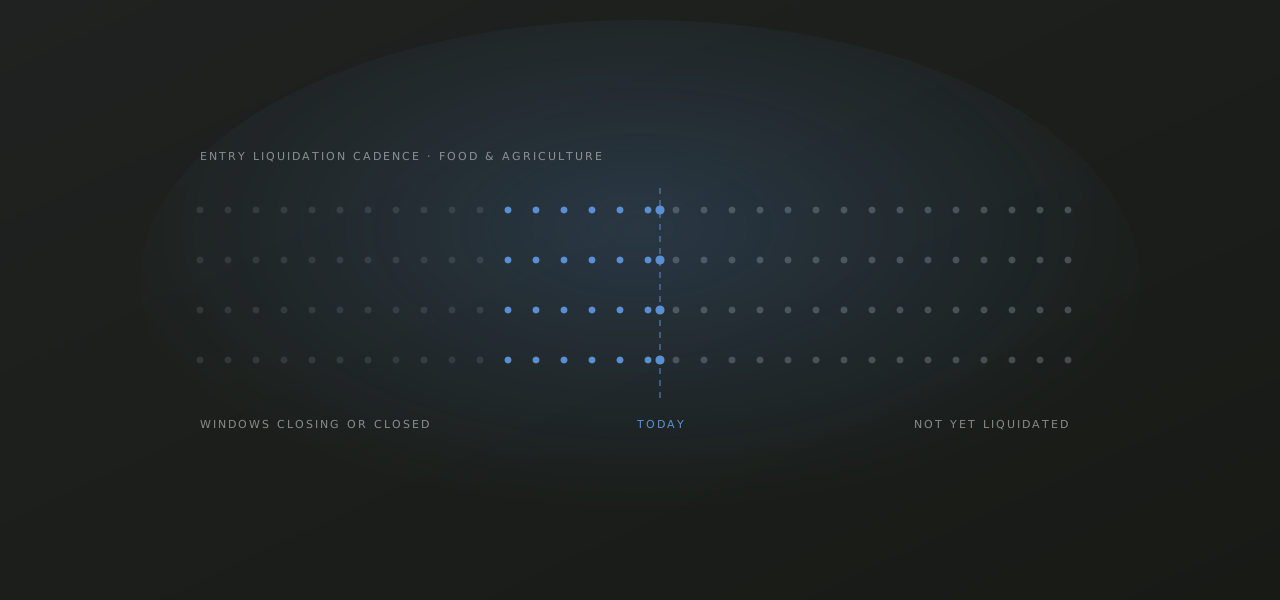
Combined with the faster liquidation cadence common to this category, that means a meaningful share of food and agriculture importers' protest windows may already be closed, closing soon, or open only briefly. Entries sourced later, or from countries added to the program afterward, carry more runway — but the mix within a single importer's entry history can span both ends of that range at once.
Why a single snapshot isn't enough
Because entries in this category liquidate on a rolling basis and in high volume, a one-time review of "where do we stand" goes stale quickly. An assessment done today may already need updating in a few weeks, once the next batch of entries liquidates and starts its own 180-day clock. Food and agriculture importers benefit from a recovery approach that treats entry monitoring as ongoing rather than a single point-in-time exercise — otherwise it's easy to miss a window that opened and closed between reviews.
A business importing produce weekly from the same handful of suppliers might reasonably assume its entries are uniform enough that one review covers the whole picture. In practice, small differences in classification, country mix, or shipment timing mean the entries aren't as uniform as they look, and the protest windows attached to them don't all move in lockstep either.
What this means in practice
For most food and agriculture importers, the fix isn't more complex analysis — it's faster, more frequent analysis matched to how often the business actually ships. Identifying which entries are approaching their windows, on a cadence that keeps pace with weekly or biweekly shipments, matters more here than in categories where entries are larger and less frequent.
What Corvant does
Corvant qualifies your food and agriculture entries against liquidation status on an ongoing basis, flags the ones approaching their protest windows before they close, and connects you with recovery professionals who can move at the pace your shipment cadence actually requires.
If you're an importer, try the demo or view pricing to see where your entries stand today.