Table of contents
Share
IEEPA refund exposure for energy and battery importers
Battery and energy storage imports sit inside one of the fastest-moving corners of U.S. trade policy, and that pace is exactly what makes refund exposure in this category harder to pin down than in most others. Lithium-ion cells, packs, and the materials that go into them are sourced overwhelmingly from China, South Korea, and Japan, and the tariff treatment applied to each of those origins — and to different sub-products within the category — has shifted more often, and more specifically, than in more settled categories like furniture or hand tools.
That pace matters for a refund claim because IEEPA exposure wasn't the only thing changing during the tariff window. Separate trade actions targeting battery products moved on their own schedule, sometimes month to month, which means the applicable duty on a given battery shipment can depend on the exact week it entered, not just the country it came from or the general product type. Getting the refund calculation right starts with getting that timeline right.
This article covers where battery sourcing concentrates, why the policy environment around this category moved faster than most, and what that means for calculating what's actually refundable.
Where battery sourcing concentrates
Three countries account for most of the battery and energy storage products entering the United States. China supplies the largest share of finished lithium-ion cells and battery packs, along with much of the upstream material — refined lithium compounds, processed cobalt and nickel, and the graphite used in battery anodes, much of which is processed in China even when mined elsewhere. South Korea is home to several of the world's largest cell manufacturers, supplying both automotive and grid-scale storage customers. Japan has a long-standing base in cell chemistry and manufacturing, particularly for premium and specialty battery applications.
Each of those three countries faced its own IEEPA tariff rate, on its own schedule, during the tariff window — the same per-country attribution problem that shows up in every multi-country claim. What sets batteries apart is what sat alongside that IEEPA layer.
A policy environment that moved faster than the category
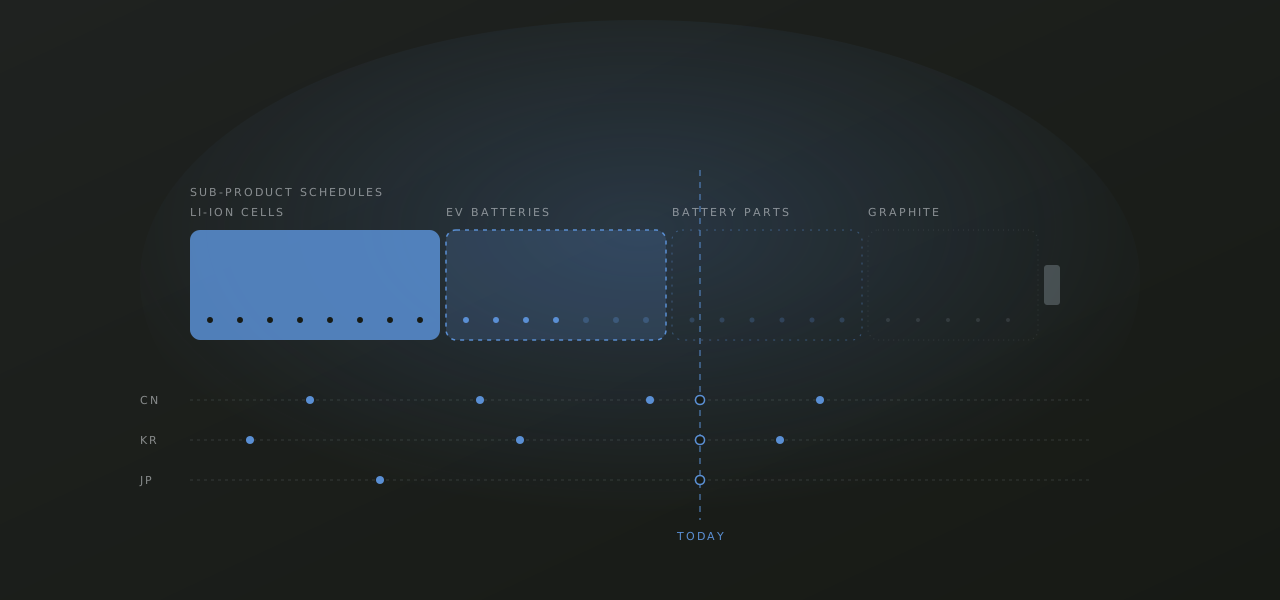
Battery products were also targeted by tariff actions entirely separate from IEEPA, rolled out in stages rather than all at once. Electric vehicle batteries, non-vehicle lithium-ion batteries, battery parts, and battery-grade critical minerals like natural graphite were treated as distinct product groups, with rate changes taking effect on different dates as each action was phased in. An importer bringing in finished EV battery packs and one bringing in raw graphite anode material were not necessarily on the same tariff timeline, even if both shipments arrived from China in the same general period.
Layer the IEEPA tariff window on top of that, and a battery importer's total duty picture on any given entry depends on a combination of factors that each moved independently: country of origin, the specific battery sub-product, and the exact date of entry relative to several separate rate-change schedules.
Why entry-date precision matters more here than elsewhere
For most product categories, a refund review can reasonably start from the assumption that "goods from Country X during the IEEPA window" is a single, mostly uniform bucket. Battery importers don't have that luxury. A shipment of finished cells entered a few weeks apart from a materially similar shipment can carry a different combined duty picture, even from the same supplier, because a separate rate action took effect in between.
That means an accurate refund calculation for this category has to work at the level of the individual entry rather than the level of the general product line. Pulling entry-by-entry records — classification, country, exact entry date — isn't optional diligence here; it's the only way to know which rate schedule actually applied to a given shipment.
Materials versus finished products add another layer
Battery imports also span a wide range of processing stages, from raw and refined materials to finished cells to fully assembled packs and integrated storage systems. Each stage tends to sit under a different tariff classification, with its own duty history independent of the others. An importer bringing in refined battery-grade materials for domestic cell manufacturing faces a different classification and rate history than one importing finished packs ready for installation, even when both are sourced from the same country.
Companies that do both — importing raw materials for domestic processing alongside finished components — often need to treat those as two separate refund reviews rather than one combined claim.
The multi-country, multi-product portfolio
Most sizable battery and energy storage importers don't source from a single country or import a single stage of product. A typical portfolio might combine finished cells from South Korea, packs assembled in China, and specialty materials from Japan, each entering across different months of the tariff window under different classification lines. Treating that portfolio as one undifferentiated claim risks averaging away real differences between entries that were, and weren't, refund-eligible at the rates actually in effect when they arrived.
What Corvant does
Corvant qualifies battery and energy storage importers' refund exposure at the entry level — mapping country of origin, product sub-type, and exact entry date against the tariff schedules that actually applied — then connects each situation with the recovery professionals suited to the result.