Table of contents
Share
IEEPA refund exposure for electronics importers
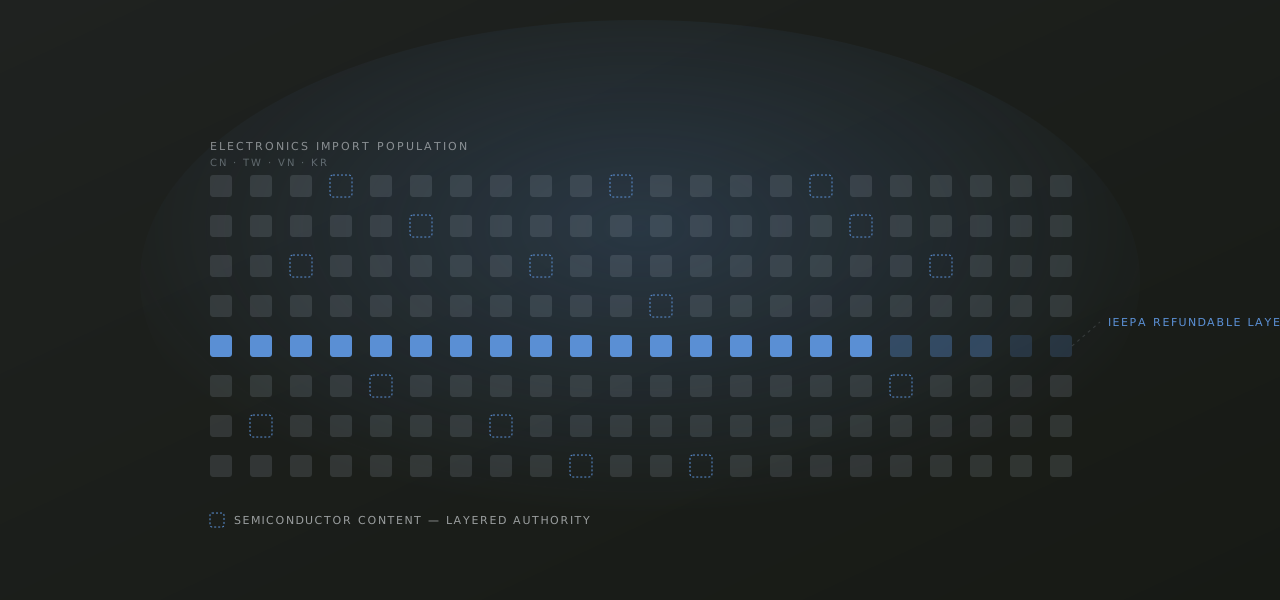
Electronics is one of the largest categories by dollar exposure in the post-SCOTUS refund population. Consumer electronics, components, and finished devices move through U.S. ports in enormous volume, sourced overwhelmingly from a small set of countries — China, Taiwan, Vietnam, and South Korea — that were squarely inside the invalidated IEEPA tariff regime. High unit values compound with high shipment volume to produce refund claims that are frequently larger, in absolute dollar terms, than equivalent claims in most other product categories. That population includes importers of finished devices, replacement parts, and accessories alike, not just companies that identify as electronics manufacturers.
But size isn't the only thing that sets electronics apart. Semiconductors — whether imported as standalone components or embedded in finished devices — carry a tariff history of their own that predates IEEPA by years. That history interacts with the invalidated tariffs in ways that make electronics claims some of the most likely of any category to require layered-authority analysis, regardless of which specific country a given shipment came from.
This article walks through why electronics exposure runs large, why semiconductors specifically complicate the picture, and what that means for how a claim should be filed.
Why the exposure is concentrated
Electronics sourcing is unusually concentrated by design. Contract manufacturing for consumer devices — phones, laptops, networking equipment, displays, appliances — clusters in a handful of countries with the assembly infrastructure and component supply chains to support it at scale. China remains the largest single origin for finished consumer electronics. Taiwan supplies a disproportionate share of the world's advanced semiconductors. Vietnam has absorbed a growing share of assembly work as manufacturers diversify away from single-country dependence. South Korea supplies memory chips, displays, and finished devices. A meaningful share of electronics volume also moves through direct-to-consumer e-commerce channels alongside traditional wholesale import, adding another set of entries a recovery claim needs to account for.
All four faced IEEPA tariffs during the affected period, at rates that varied by country and by time. An importer with a diversified electronics supply chain — which describes most mid-sized and larger electronics importers — likely has exposure across several of these origins simultaneously, each with its own rate history to reconstruct.
The semiconductor complication
Semiconductors are not a clean IEEPA-only story. Chips and semiconductor manufacturing equipment from China have been subject to Section 301 tariffs since well before the IEEPA tariffs existed, layered on top of ordinary duties as part of a longer-running trade dispute. Separate national-security tariff actions targeting semiconductors have also applied at various points, independent of the IEEPA authority the Supreme Court invalidated.
The practical effect: a shipment that includes semiconductor content may carry duties assessed under two or three separate authorities simultaneously, only one of which — the IEEPA portion — is affected by the ruling. Sorting out which portion of the total duty paid is refundable requires identifying, line by line, which authority assessed which piece. That analysis doesn't go away because a device was assembled in Vietnam rather than shipped directly from China; the semiconductor content inside it may still carry the older layered history.
Multi-country origin questions
Modern electronics rarely have a single country of origin in any meaningful sense. A device assembled in Vietnam may contain a processor from Taiwan, memory from South Korea, and a display module built from components sourced in China. For tariff purposes, origin is determined by where the last "substantial transformation" occurred — a legal standard that is not always obvious for a multi-component device with inputs from four countries.
Where the origin determination is contested or unclear, the refund calculation depends on getting that determination right first. This is a different problem than a single-country apparel or furniture claim, where origin is rarely in dispute.
Classification adds another layer
Multi-function electronic devices — a phone that is also a camera and a computer, a router that also handles security functions — are classified under harmonized tariff rules that assign a single HTSUS code based on the device's "essential character." Reasonable classifiers can disagree about what that essential character is, and the classification chosen affects which duty rate, and which tariff layer, applied at entry.
For electronics importers, classification disputes are common enough that they show up independent of the IEEPA question, but they interact with it directly: the wrong classification can misstate both the baseline duty and the refundable IEEPA portion.
Why this usually isn't a simple filing
Put together — multi-country sourcing, layered semiconductor authorities, contested origin determinations, and classification complexity — electronics claims frequently fall outside the cleanest, fastest CAPE processing track. That doesn't mean electronics importers face litigation by default. Many portions of a typical electronics claim are administratively straightforward. But the layered-authority pieces, especially anything touching semiconductor content, usually benefit from a more experienced review before filing, so the claim is structured correctly the first time.
In practice, this often means an electronics importer's claim splits along a line similar to the general CAPE structure: the cleanest single-country, single-layer entries may fit Phase 1 processing on their own merits, while the semiconductor-heavy and multi-country portions typically need Phase 2 review, or escalation further where the authority question is genuinely contested.
What Corvant does
Corvant qualifies electronics importers' refund exposure across sourcing countries, semiconductor content, and classification status, and connects each situation with the recovery professional suited to it — administrative filing for the clean portions, more experienced counsel where layered authorities or origin disputes are in play. try the demo or view pricing to see what your electronics exposure looks like.