Table of contents
Share
IEEPA refund exposure for clothing and apparel importers
Apparel importers make up one of the largest segments of the affected import population, with sourcing spread across China, Vietnam, Bangladesh, and India. What sets apparel apart from most other categories isn't just where it comes from — it's how granular the underlying tariff schedule already is before the IEEPA question ever enters the picture. Duty rates for what looks, to a non-specialist, like the same garment can vary substantially based on fiber content, blend composition, and whether the fabric is knit or woven.
That granularity matters for refund claims in a specific way. An apparel claim carries two independent risks that have to be resolved separately: whether the IEEPA-period rate was calculated correctly, and whether the underlying tariff classification the IEEPA rate was applied to was correct in the first place. Get the second one wrong, and the first is built on the wrong base.
This article looks at where apparel sourcing concentrates, why classification disputes are unusually common in this category, and what that means for building an accurate claim.
Where apparel sourcing concentrates
China remains a major source for U.S. apparel imports, but the industry has diversified more aggressively than most categories over the past decade. Vietnam has grown into a primary apparel manufacturing hub. Bangladesh supplies a large share of basic and mid-tier garments. India supplies both finished apparel and significant textile and fabric inputs.
Each of these countries faced its own IEEPA tariff rate, at its own schedule, during the affected period. An apparel importer with a diversified sourcing base — which describes most mid-sized and larger apparel brands and retailers — typically has exposure spread across three or four countries, each requiring its own rate reconstruction.
Many apparel importers also bring in fabric, trim, and other textile inputs separately from finished garments. Each input follows its own classification and country-of-origin path, which means a single brand's exposure often spans raw materials as well as finished goods, not just the visible end product.
Why classification is unusually contested
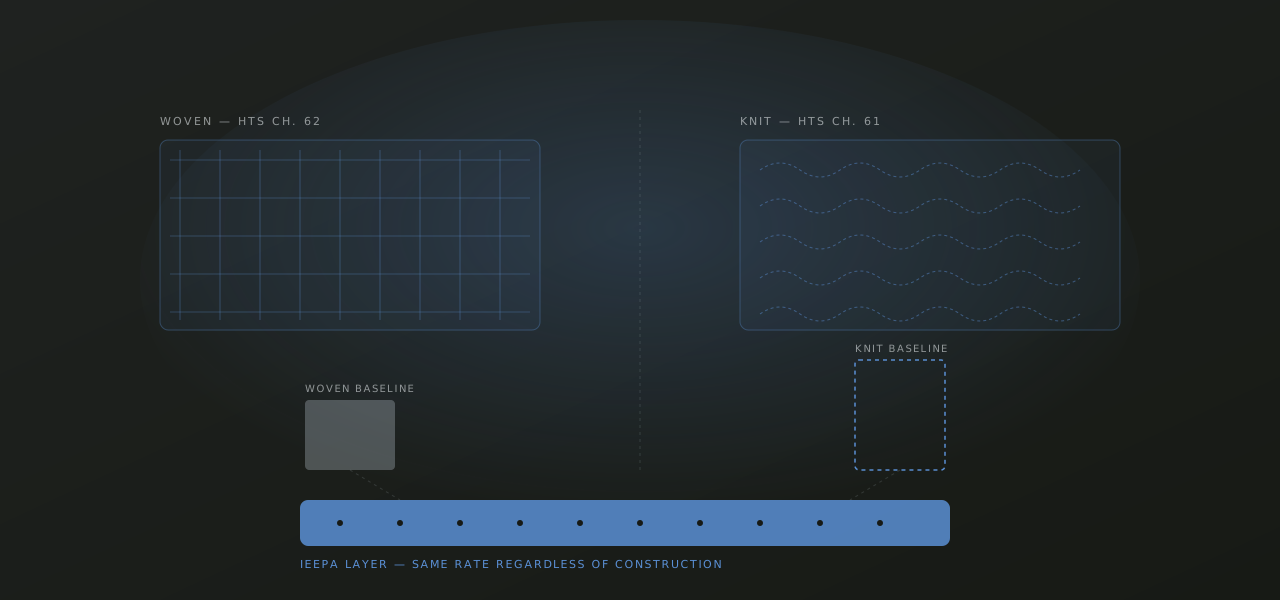
The Harmonized Tariff Schedule treats apparel with a level of granularity that few other product categories match. Duty rates differ based on the garment's fiber content (cotton, polyester, wool, silk, and dozens of blend combinations), its construction method (knit fabric and woven fabric occupy entirely separate chapters of the tariff schedule), and specific garment features that trigger different subheadings.
Two garments that look identical off the rack can carry meaningfully different baseline duty rates because one is majority cotton with a polyester blend and the other is majority polyester with a cotton blend. That difference isn't an IEEPA question at all — it's a classification question that exists independent of anything the Supreme Court ruled on. But it directly affects the dollar base the IEEPA rate was applied to.
The schedule also differentiates by end use and wearer — men's, women's, and children's versions of what is functionally the same garment sometimes carry different baseline rates. Private-label programs that source near-identical styles across multiple market segments can end up with inconsistent classification histories across styles that, from a design standpoint, should be treated the same.
The blended-fiber problem
Blended-fabric garments are classified according to which fiber predominates by weight — a rule that sounds simple but is not always straightforward to apply. Fiber content labels on garments are sometimes imprecise, blends can vary between production runs of the same style, and resolving a genuine dispute sometimes requires laboratory fiber-content testing rather than relying on the entry paperwork alone.
For apparel importers pursuing a refund claim, this matters because the original classification on file with CBP may not survive scrutiny. If a garment was declared under one fiber-content classification but the actual blend supports a different one, correcting that classification changes the applicable duty rate — and with it, the dollar amount the IEEPA refund calculation should be measured against.
Why a reclassification changes the math
This isn't a hypothetical edge case. Apparel classification disputes are common enough in ordinary customs practice that CBP has extensive guidance, and a body of prior rulings, addressing fiber-blend and construction-method questions. For a refund claim, a favorable reclassification can either increase or decrease the refundable amount, depending on which direction the correction runs. Getting this analysis right before filing avoids both underclaiming and the delays that come with a claim CBP later disputes.
Multi-country timing adds another layer
Apparel brands frequently shift production of a single product line between countries across seasons, chasing cost, capacity, and lead-time advantages. That means even one style number may have entries from two or three different countries across the affected period, each carrying a different IEEPA rate and, potentially, a different classification history if fabric sourcing shifted along with production location.
This is different from a brand that simply relocates a factory. The style number stays constant on the invoice, but the country of origin, the fiber blend supplied by a new mill, and the applicable rate can all change underneath it in the same reporting period.
What Corvant does
Corvant qualifies apparel importers' refund exposure across sourcing countries and flags where classification review is likely to change the calculation, then connects each situation with the recovery professional suited to the work — administrative filing where the classification is clean, more experienced review where fiber content or construction disputes are in play. try the demo or view pricing to see what your apparel exposure looks like.