Table of contents
Share
IEEPA and Section 301 refund exposure for importers sourcing from China
China carries more layered tariff exposure than any other sourcing country in the current refund population. That isn't because IEEPA duties on China-origin goods were categorically higher than duties applied elsewhere, though they often were. It's because IEEPA tariffs were rarely the only tariff authority in play on a given entry. For most importers who source meaningfully from China, the IEEPA duties paid between February 2024 and February 2025 sat on top of tariff regimes that were already years old by the time IEEPA arrived.
That stacking is the single biggest reason China-origin refund claims are harder to resolve than a typical single-country claim, and it's a large part of why so many China claims end up in CAPE Phase 2 rather than the streamlined Phase 1 track — or, in some cases, headed to litigation rather than the administrative process at all.
This article walks through the tariff layers that typically apply to China-origin entries, why the combination complicates refund calculation, and what determines whether a given importer's China exposure is a fast administrative filing or a longer, counsel-involved claim.
The layers stacked on a typical China entry
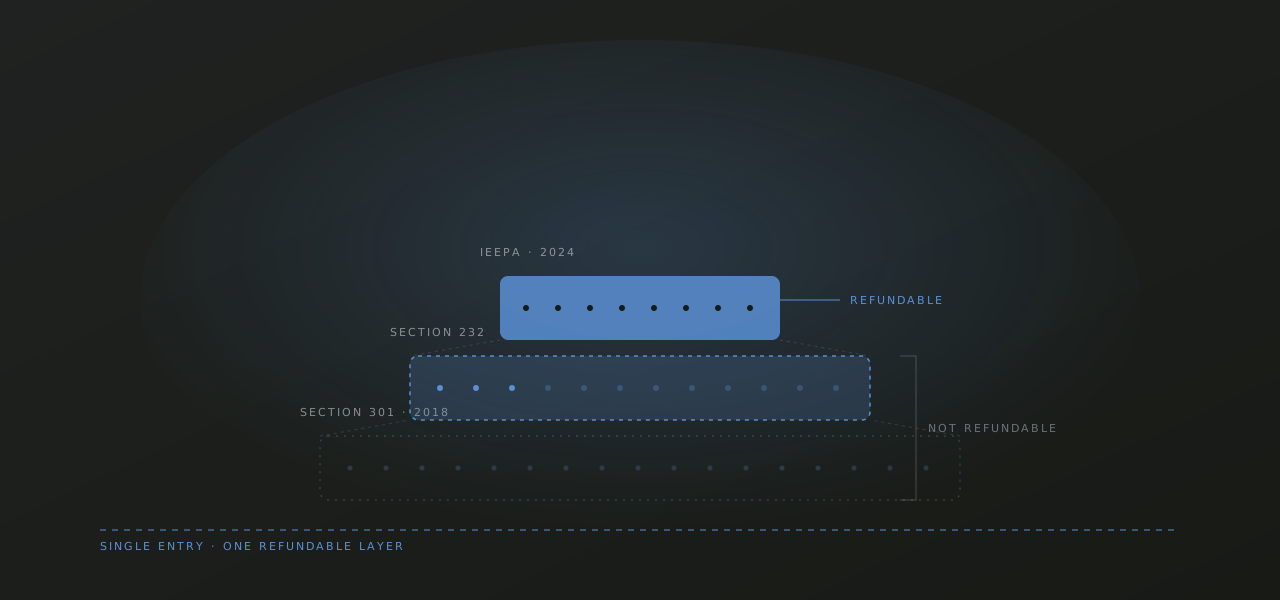
A single entry of goods from China can carry duties assessed under three separate legal authorities, each with its own rate schedule, its own history, and its own refund eligibility.
Section 301 tariffs, first imposed starting in 2018 following a U.S. Trade Representative investigation into China's trade practices, apply to thousands of HTSUS subheadings across multiple tariff lists, with rates that have historically ranged from the high single digits for most covered goods to a rate that exceeds the value of the goods themselves on a narrower set of specific products. Section 301 is a separate legal authority from IEEPA. It is not part of the invalidated IEEPA tariff population, it remains in effect today, and it is not refundable through the current recovery process.
Section 232 tariffs, imposed under a different statute covering national-security-related trade actions, apply to steel and aluminum and to a growing list of "derivative" products that incorporate steel or aluminum content, regardless of country of origin. China-origin goods that fall into covered derivative categories carry Section 232 duty on top of anything else that applies. Like Section 301, Section 232 duty is a separate authority and is not refundable under the IEEPA-specific recovery process.
IEEPA tariffs, the subject of the Supreme Court's ruling and the refund population Corvant is built around, were layered on top of both of the above for China-origin entries during the February 2024 to February 2025 window. This is the portion that is actually refundable.
Why the layering matters for your refund
The practical consequence of three-authority stacking is that a China-origin entry's total duty bill isn't a single number that's either refundable or not. It's a composite, and only one layer of that composite — the IEEPA portion — is what the current recovery process addresses.
Calculating the refundable amount requires isolating exactly how much of what was paid on a given entry was assessed specifically under IEEPA authority, as distinct from the Section 301 and Section 232 amounts assessed on the same entry. For importers whose customs broker kept clean, itemized records of which duty was assessed under which authority, this is a tractable exercise. For importers whose records commingle the total duty paid without that breakdown, isolating the IEEPA portion requires reconstruction work before a claim can even be filed.
Why China claims often need Phase 2 — or more
CAPE Phase 1 was built for single-authority, single-country, unambiguous claims. A China-origin entry with Section 301 and Section 232 duty layered alongside IEEPA duty rarely fits that description. The layered-authority profile is close to the textbook definition of what pushes a claim into CAPE Phase 2, where CBP expects more thorough documentation and more careful per-authority attribution before it will process a refund.
Some China claims go further still. Where the classification of the goods is itself contested — where a product's HTSUS subheading could plausibly fall under a Section 301-covered category or an excluded one, or where an importer previously sought, and was granted or denied, a Section 301 exclusion for the same goods — the analysis starts to look less like administrative documentation and more like the kind of statutory and classification argument that belongs with recovery counsel rather than a broker filing a form.
What to check before you file
Two things determine, more than anything else, whether your China exposure fits Phase 1, Phase 2, or litigation-grade counsel. First, whether your entry records already itemize duty by authority, or whether that breakdown has to be reconstructed. Second, whether any of your covered goods were subject to a Section 301 exclusion request, a classification dispute, or a Section 232 derivative determination — each of which adds a layer of contestability that a clean administrative filing can't absorb.
Most importers with meaningful China volume have some entries that are genuinely clean and some that are genuinely complex, often within the same product line, depending on when a given shipment was entered and what exclusions were active at the time.
What Corvant does
Corvant qualifies your China-origin entries by isolating the IEEPA-specific portion from the Section 301 and Section 232 layers, flags which entries fit CAPE Phase 1, which need Phase 2, and which show signs of needing specialized recovery counsel — then connects you with the professionals suited to each part of the claim.