Table of contents
Share
IEEPA refund exposure for importers sourcing from Canada
Canada shares the basic USMCA qualification dynamic that shapes Mexico-origin refund claims. Goods that qualify under USMCA's rules of origin are generally exempt from IEEPA tariff exposure, and goods that don't qualify, or whose qualification wasn't properly documented at entry, carry exposure like any other country's non-qualifying imports. But Canada's product mix, and Canada's much longer history of country-specific trade disputes, give Canada-origin claims a distinct shape of their own.
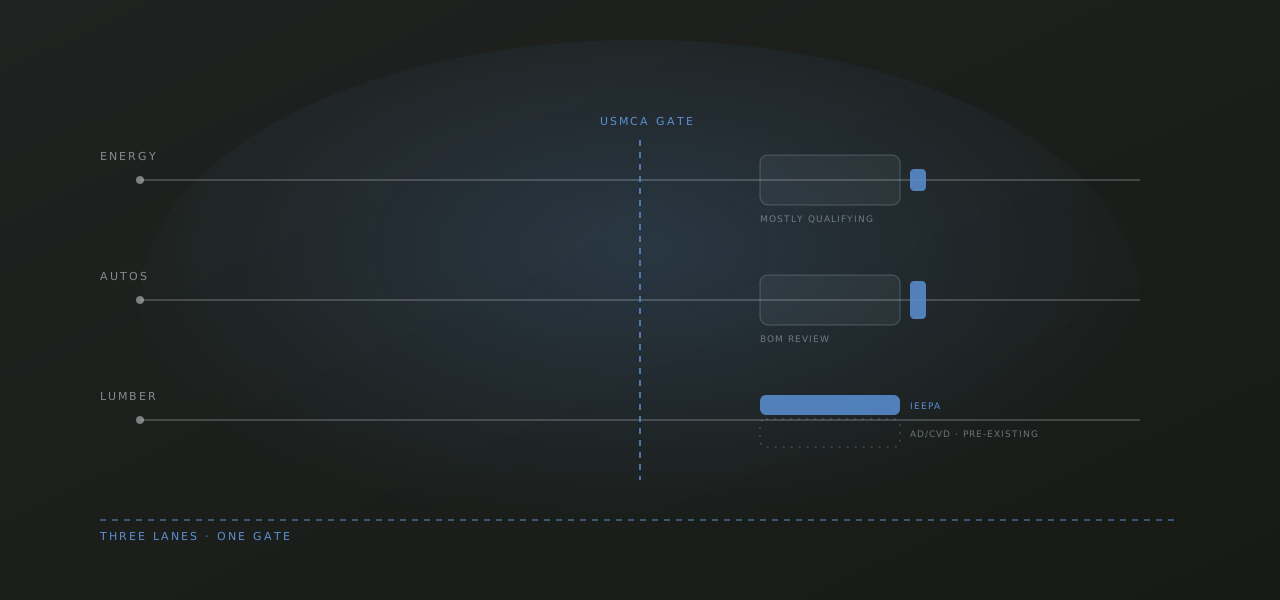
Energy, automotive, and softwood lumber each behave differently under IEEPA. Softwood lumber in particular carries decades of separate antidumping and countervailing duty history that predates IEEPA and continues alongside it, and untangling which portion of a lumber importer's duty bill is IEEPA versus that older remedy is its own kind of layering problem — different specifics from China's Section 301 and Section 232 stacking, but a similar shape.
This article covers what USMCA qualification means for Canada specifically, why the product mix diverges from Mexico's, and how the softwood lumber precedent illustrates a broader lesson about pre-existing trade remedies interacting with IEEPA claims.
The same qualification question, a different starting point
Like Mexico, Canada is a USMCA partner, and USMCA-qualifying goods moving from Canada into the U.S. were generally not subject to IEEPA tariffs — the exemption logic is identical. An importer sourcing qualifying goods from Canada, properly certified at entry, likely has little or no IEEPA exposure to recover, because there wasn't meaningful exposure in the first place.
Where Canada diverges from Mexico is in what fills the non-qualifying, or historically-disputed, side of the ledger. Canada's export mix to the U.S. is weighted toward categories — energy, motor vehicles and parts, and forest products among them — that carry their own separate tariff and trade-remedy histories, some of which long predate IEEPA and continue to run independently of it.
Energy and autos: mostly a qualification question
Energy products — crude oil, natural gas, electricity, and refined products — and automotive vehicles and parts make up a large share of Canada-origin trade. For most of this volume, the refund analysis looks similar to Mexico's: determine whether the goods qualified under USMCA, confirm the certification was in order at the time of entry, and calculate IEEPA exposure only on the portion that didn't qualify or wasn't properly documented. Automotive supply chains, as with Mexico, often require a full bill-of-materials review, because regional value content is calculated across a complex, multi-country parts network.
Canada is also a significant exporter of aluminum, and aluminum products can carry Section 232 duty in addition to whatever USMCA or IEEPA treatment otherwise applies. That's another example of a layer sitting alongside IEEPA that isn't part of the current refund population — a smaller-scale version of the same stacking dynamic that shows up most prominently with softwood lumber.
Softwood lumber: a different kind of layering
Softwood lumber is where Canada's refund profile genuinely departs from Mexico's. Canadian softwood lumber has been subject to antidumping and countervailing duty orders — separate from IEEPA, separate from Section 301, and separate from USMCA — for decades, in a dispute that predates NAFTA itself. Those orders have been revised, litigated, and re-imposed multiple times over the years, largely independent of whatever else is happening in U.S.-Canada trade policy.
For a lumber importer, a single entry can carry antidumping or countervailing duty under an order that has nothing to do with IEEPA, layered alongside whatever IEEPA duty applied during the February 2024 to February 2025 window. Only the IEEPA portion is part of the current refund population. The older duty is a separate, much longer-running dispute with its own separate remedy process, and it is not refundable through CAPE or the current recovery process at all.
Why this matters beyond lumber
The softwood lumber situation illustrates a broader point that applies across Canada-origin claims, and really across any country with a long-standing trade-remedy relationship with the U.S.: a new tariff authority like IEEPA rarely arrives on a blank slate. It stacks on top of whatever authorities were already there. Isolating the IEEPA-specific, refundable portion of a duty bill from older antidumping or countervailing orders requires the same kind of per-authority attribution work that China-origin claims require for Section 301 and Section 232. The specific authorities differ; the analytical problem is the same shape.
Importers with Canada-origin exposure across multiple product categories should expect the energy and automotive portions of their claim to look relatively close to a standard refund exercise, and the lumber portion — or any other category with its own pre-existing remedy — to need separate, careful attribution before a refundable amount can even be identified.
What determines your pathway
As with Mexico, documentation quality on the USMCA qualification side drives how quickly the non-lumber portion of a Canada claim resolves. On the lumber side, what matters is whether your entry records already separate the older duty from IEEPA duty, or whether that separation has to be reconstructed from CBP's entry data before a claim can be filed at all.
What Corvant does
Corvant qualifies your Canada-origin entries by resolving USMCA qualification where it applies and isolating IEEPA-specific duty from pre-existing trade remedies like softwood lumber orders — then connects you with the professionals suited to whichever portion of your claim needs them.