Table of contents
Share
IEEPA refund exposure for importers sourcing from Brazil
Brazil is South America's largest source of U.S.-bound trade exposure under the invalidated IEEPA tariffs, concentrated in three categories: steel, agricultural commodities, and industrial chemicals. If your business imports any of these from Brazil, you likely paid IEEPA duties during the 2024-2025 window, and a meaningful share of that is recoverable.
What makes Brazil's profile distinct is the steel piece. Steel imports carry their own overlapping tariff history in the United States, layered on top of the now-invalidated IEEPA duties, and that overlap changes how a Brazil-origin claim needs to be analyzed compared with a straightforward agricultural or chemical entry from the same country.
This article covers what's clean, what's complicated, and why the steel portion of a Brazil claim usually needs closer analysis than the rest.
Brazil's trade profile: steel, agriculture, and chemicals
Brazil is one of the largest exporters of semi-finished steel — slabs and other primary steel forms used as feedstock by U.S. mills — to the United States, alongside a substantial agricultural export base spanning soybeans, corn, coffee, orange juice, sugar, and beef. Brazil also exports a meaningful volume of industrial and specialty chemicals, aircraft and aircraft parts, and pulp and paper products.
Each of these categories entered the U.S. under different HTSUS chapters, at different points in the IEEPA window, and — critically — under different, sometimes overlapping tariff authorities. That variation is the starting point for understanding why a Brazil-sourcing importer's refund claim rarely fits neatly into one bucket.
Steel and the Section 232 overlay
Steel imports into the United States have, for years, been subject to additional duties under Section 232 of the Trade Expansion Act — a national-security tariff authority entirely separate from IEEPA. Brazil's steel trade with the U.S. has its own history here: at various points, Brazil negotiated arrangements involving quotas on steel volume in lieu of paying the Section 232 duty outright, one of a small number of countries to do so rather than simply absorbing the tariff. That negotiated history adds another layer to untangle when reconstructing what was actually paid, under which authority, on any given entry.
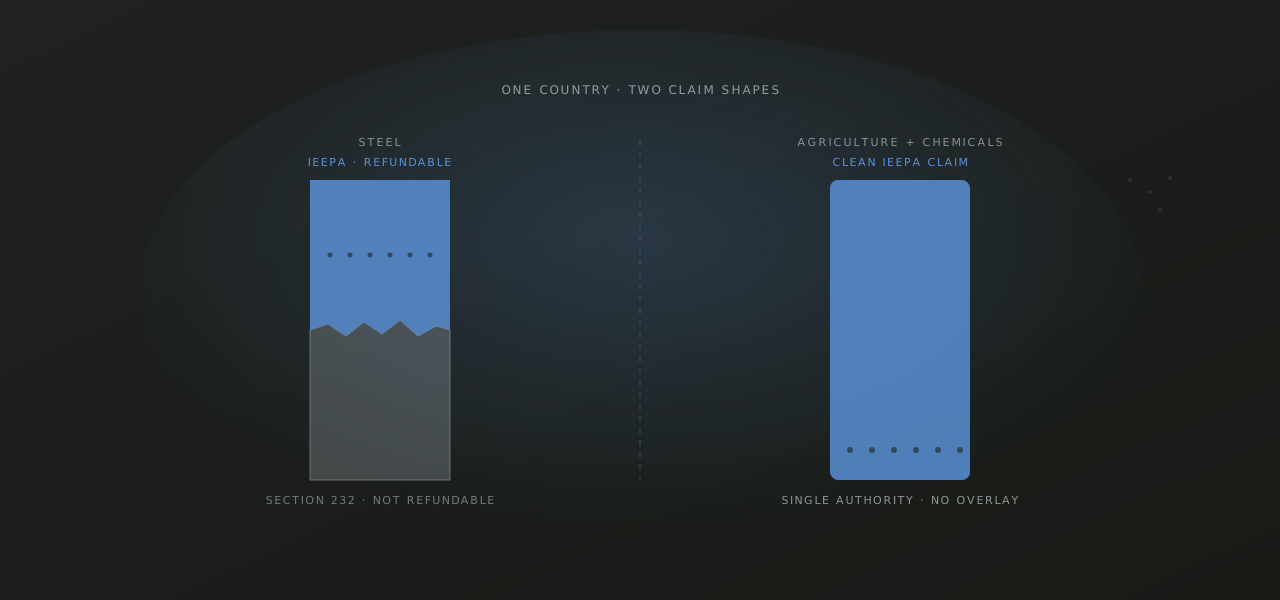
For Brazil-origin steel entries during the IEEPA period, a single shipment could carry duties assessed under two different authorities at once: the now-invalidated IEEPA tariff, and a separate, still-valid Section 232 duty or quota-related charge. Only the IEEPA portion is refundable under the SCOTUS ruling. Determining what part of the total duty paid on a given steel entry is attributable to IEEPA versus Section 232 requires line-by-line analysis of the entry record — the same layered-authority problem that shows up wherever a country's export profile includes steel, and the reason steel claims from Brazil tend to need more careful review than a single-authority entry.
Agricultural and chemical entries: a cleaner claim shape
Brazil's agricultural and chemical exports generally don't carry that same layered-authority complication. Soybeans, coffee, sugar, and most industrial chemicals were not typically subject to Section 232 or Section 301 overlays, which means the IEEPA duty on those entries is usually the only duty in play. Where the HTSUS classification is uncontested and the entry record is clean, these claims tend to fit CAPE Phase 1 — the fastest, most direct pathway to a refund.
For an importer bringing in both steel and agricultural products from Brazil, this creates a genuinely split profile: part of the claim moves quickly, and part needs more work before a refund number can be finalized. Aircraft parts and specialty chemicals tend to sit somewhere in between, depending on whether the specific HTSUS codes involved carried any additional tariff layers during the relevant entry period.
Brazilian orange juice is a useful reminder that steel isn't the only category with a layered history. Orange juice imports from Brazil have, at various points, been subject to separate antidumping and countervailing duties tied to disputes with U.S. citrus producers — a different overlay than Section 232, but the same underlying principle. The total duty on an entry isn't automatically the IEEPA duty. Any given product line can carry its own independent tariff history that has to be separated out before the refundable amount is clear.
The hybrid reality: layered claims across a mixed import profile
Most Brazil-sourcing importers of any scale bring in more than one product category, which means most Brazil claims are hybrid by nature. The agricultural and chemical entries can usually be filed as Phase 1 claims without much delay. The steel entries need the layered-authority analysis worked out — separating the refundable IEEPA portion from the non-refundable Section 232 portion, and accounting for any quota-related history — before a refund amount can be finalized.
Treating a mixed Brazil claim as a single, uniform filing tends to slow down the whole thing. Sequencing it, with the clean categories filed first and the steel analysis running in parallel, gets the straightforward money back sooner without holding it hostage to the more complex piece.
What Corvant does
Corvant qualifies Brazil-sourcing importers' entries by product category and tariff-authority overlap, separating the claims that are ready for a fast administrative filing from the steel entries that need layered-authority analysis, then connects you with the recovery professionals suited to each piece.