Table of contents
Share
IEEPA refund exposure for automobile and auto parts importers
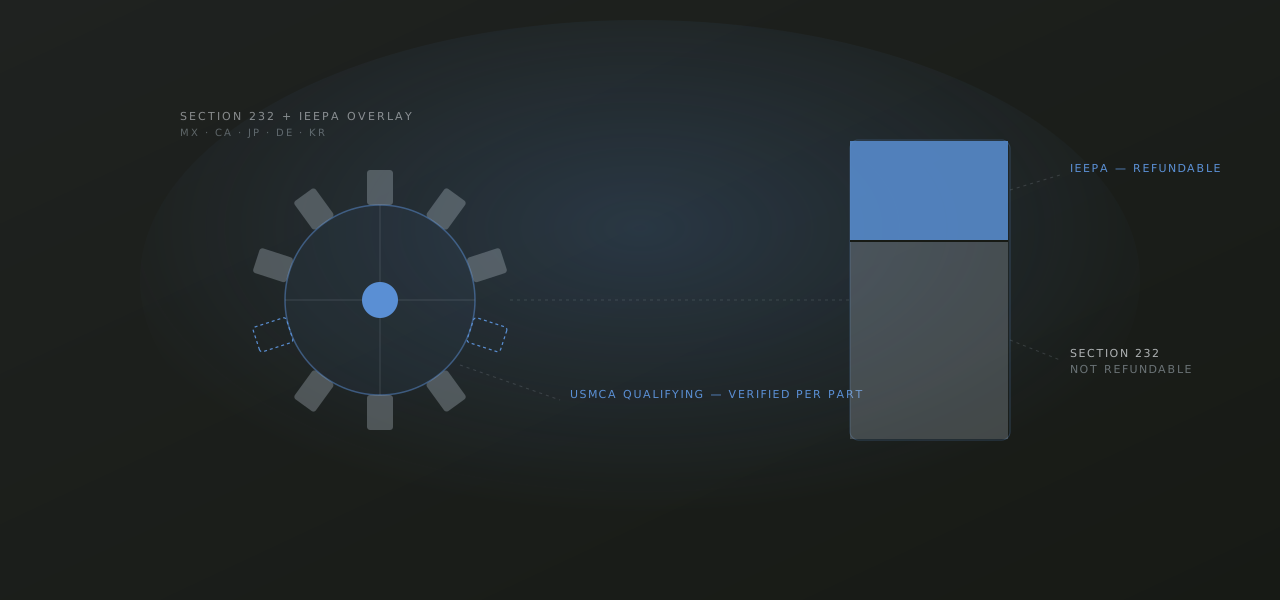
Automobile and auto parts importers face a tariff picture that looks different from almost every other category, because a separate national-security tariff authority — Section 232 — applies specifically to autos and auto parts, layered alongside whatever IEEPA exposure an importer has. Untangling the two is the first task in any auto-sector refund claim, since only the IEEPA portion is affected by the Supreme Court's ruling.
Sourcing adds a second layer of complexity. Auto and auto parts imports come heavily from Mexico, Canada, Japan, Germany, and South Korea — a mix of USMCA partners and non-USMCA countries that were treated very differently under both the Section 232 regime and the invalidated IEEPA tariffs. For USMCA-eligible parts, whether a given part actually qualifies for preferential treatment changes its refund exposure almost entirely.
This article walks through the Section 232 overlay, how USMCA qualification changes the calculation, and why auto-sector claims usually need careful per-part review.
The Section 232 overlay
Section 232 tariffs on automobiles and auto parts were imposed on national-security grounds, a separate legal authority from IEEPA, and they are not affected by the Supreme Court's ruling. That means an auto importer's total duty burden during the affected period often reflects two authorities layered together: Section 232 duties that remain valid and owed, and IEEPA duties that are refundable.
Separating the two requires knowing exactly which authority assessed which portion of the duty at the time of entry. For importers who didn't track this distinction carefully at the time — which is most importers, since the distinction only became legally significant after the ruling — reconstructing it now takes entry-by-entry review.
Sourcing concentration and its consequences
Mexico and Canada together account for a large share of U.S. auto and auto parts imports, reflecting decades of integrated North American vehicle production. Japan, Germany, and South Korea supply a significant share of both finished vehicles and higher-value components. Each of these countries had a different relationship to both the Section 232 regime and the IEEPA tariffs, which means the refund calculation looks meaningfully different depending on origin.
Auto parts supply chains are also unusually integrated across the three USMCA countries specifically. The same part, or its subcomponents, can cross the U.S., Mexican, and Canadian borders more than once before final assembly, which adds another wrinkle when reconstructing exactly which entries carried IEEPA exposure in the first place.
Where USMCA qualification changes everything
This is the complication that's specific to the auto sector. Parts and vehicles that qualify as originating under the United States-Mexico-Canada Agreement are eligible for preferential tariff treatment, but qualification isn't automatic just because a part shipped from Mexico or Canada. USMCA has detailed rules of origin for automotive goods, including regional value content thresholds and labor value content requirements, that a specific part either meets or doesn't.
A part that qualifies as USMCA-originating may have had a substantially different duty treatment at entry than an otherwise-identical part that doesn't qualify, even if both shipped from the same Mexican supplier in the same week. For refund purposes, this means the IEEPA-period exposure for a Mexico- or Canada-sourced part depends heavily on its USMCA status — a determination that has to be verified, not assumed, for each part number in a claim.
Why documentation from the time of entry matters
USMCA preferential treatment depends on a certification of origin that the importer, exporter, or producer completes, and that the importer has to be able to produce on request. For a refund claim built well after the entries in question, whether that certification exists — and whether it actually supports the origin claimed at the time — determines how confidently a given part's USMCA status can be established now. Reconstructing an origin qualification after the fact, without contemporaneous documentation, is possible, but it takes meaningfully more work than confirming a certificate that was already on file.
Why finished vehicles and parts don't behave the same way
Finished vehicles and auto parts are often treated differently under both Section 232 and USMCA rules of origin, even when they move through the same supply chain. A parts importer bringing in components for aftermarket or assembly use may have a very different qualification profile than an original equipment manufacturer importing finished vehicles, even when sourcing from the same country. Claims that lump the two together without distinguishing part-level from vehicle-level treatment risk missing meaningful differences in what's actually refundable.
Why this usually needs part-by-part review
Between the Section 232 overlay, the origin mix across five major sourcing countries, and the USMCA qualification question for Mexico- and Canada-origin content, auto-sector refund claims rarely resolve cleanly at the shipment level. Getting the exposure right typically means working through the claim part number by part number, or at minimum by major product line, rather than applying a single blended rate across an importer's entire auto-related import volume. That sequencing is real work, not a formality — but it's also where the largest individual refund amounts tend to surface, since higher-value components carry proportionally higher exposure per unit.
What Corvant does
Corvant qualifies automobile and auto parts importers' refund exposure across sourcing country, Section 232 treatment, and USMCA qualification status, then connects each situation with the recovery professional suited to the complexity involved. try the demo or view pricing to see what your auto-sector exposure looks like.